When Flávio Bolsonaro was considering a run for president of Brazil, he flew to one of Latin America’s tiniest nations, looking for ideas. President Nayib Bukele of El Salvador had turned what was once the world’s deadliest country into one of its safest, largely by rounding up tens of thousands of young men and sentencing them to prison in mass trials.
Mr. Bolsonaro, the son of Brazil’s right-wing former president Jair Bolsonaro, was inspired. He announced his campaign a few weeks later, in December, and adopted a platform that called for five new maximum-security prisons, eight-year prison sentences for cellphone thieves and chemical castration for rapists and pedophiles. At a recent rally, he told voters: “I’m starting to think El Salvador isn’t enough.”
He then won the first round of Brazil’s election, and in Sunday’s runoff, he is the favorite to win the presidency. That would make Mr. Bolsonaro the eighth consecutive right-wing president elected in Latin America over the past 18 months, all of whom have praised or adopted Mr. Bukele’s hard-line tactics.
Many of these new leaders are building megaprisons and undermining civil liberties to incarcerate more people, while turning to social media to promote their work and demonize the young men they target.
Mr. Bukele’s influence is clear. The presidents of Colombia, Ecuador and Costa Rica are carrying out crackdowns featured in slickly produced videos resembling his. In Lima, propaganda lines a highway promoting a politician who declares himself the “Peruvian Bukele.” Dozens of Latin American officials have toured Mr. Bukele’s 40,000-capacity prison to try to burnish their crime-fighting credentials. And eight countries have their own maximum-security prisons in the works.
All of this comes with the backing of the most powerful country in the hemisphere. President Trump is one of Mr. Bukele’s biggest fans and has lifted him up as a model for the region.
Call it the Bukeleization of Latin America.
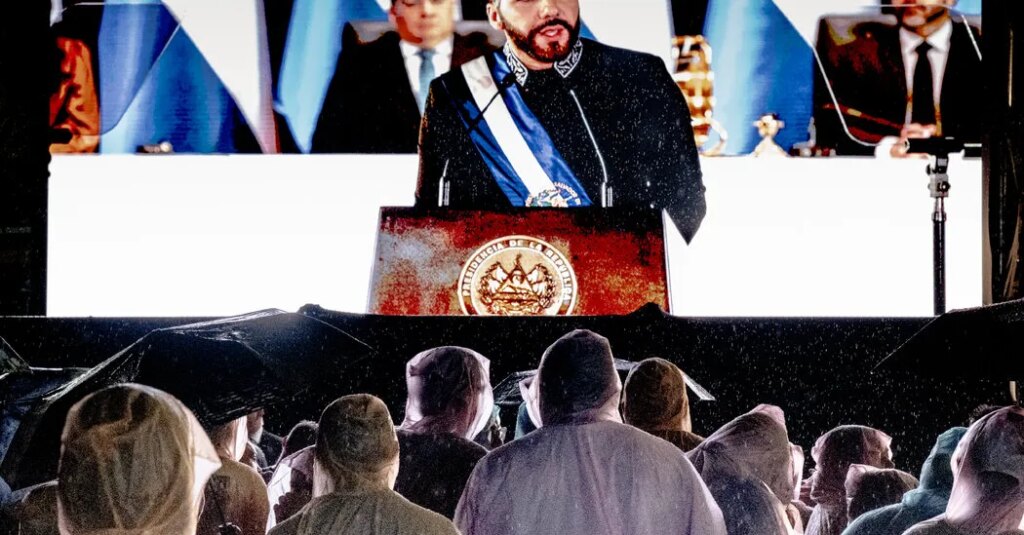
El Salvador’s very online strongman has taken the archetype of the Latin American populist dictator, known in the region as the caudillo, and brought it into the 21st century with remarkable results. Homicides in El Salvador are, according to official statistics, down 95 percent since he took office in 2019. And, according to polls, his approval rating hovers around 90 percent.
“He’s pulled off a miracle,” said Steven Levitsky, a Harvard professor of government who studies authoritarian leaders. “So politicians are replicating his discourse, his style, his maximum security prisons,” he added.
But the open question is: What they can really accomplish and how it will change Latin America? “I’m pretty sure this will end badly,” Mr. Levitsky said.
The Bukele model
Mr. Bukele is building on long-running trends in Latin America.
Brutal drug wars have been fought for decades. Since the 1980s, the United States mostly backed technocratic governments to take down drug kingpins and disrupt supply chains. In Mexico and Colombia, governments brought bombs and helicopters to the fight, and tens of thousands of people died.
Strongman presidents aren’t new, either. There have been dozens in the region’s history, spanning an ideological spectrum from Augusto Pinochet, the Chilean general who crushed communist opponents, to the charismatic Venezuelan left-wing populist Hugo Chávez, who mobilized the masses with long speeches at rallies in the street.
El Salvador’s president, however, has innovated. Instead of hunting kingpins, he has focused on mass detentions. Instead of political rallies to win support, he vilifies his targets on social media. And he has executed a systematic authoritarian takeover, including by suspending rights, consolidating power, purging judges, eliminating term limits, and chasing off critics and journalists.
Absolute control has been essential to imprisoning so many. His dismantling of El Salvador’s democracy allowed him to push forward with an unfettered crackdown. His government suspended some constitutional rights under an indefinite state of emergency, so the authorities no longer needed arrest warrants and detainees could be imprisoned without charges.
He then transformed the justice system to keep them there, according to human rights groups. Hundreds of defendants are tried at once. Anonymous witnesses testify against dozens of the same people. Gang membership, which Mr. Bukele has suggested can be proven by tattoos, can carry decades-long sentences. He even amended the Constitution to allow life sentences for 12-year-olds.
The result is that El Salvador now has the highest incarceration rate in the world.
Manuel Meléndez-Sánchez, a Salvadoran researcher who studies the Bukele model at the University of Notre Dame, said that two decades ago, the Mexican president, Felipe Calderón, carried out what was widely regarded as one of the region’s most intense crackdowns, arresting roughly one in 1,000 Mexicans. In the first two years of Mr. Bukele’s campaign, Mr. Meléndez-Sánchez said, the Salvadoran leader arrested nearly one in every 80 Salvadorans.
Perhaps even more stunning are the results. Homicides have fallen to less than two per 100,000 people, from about 50 when Mr. Bukele was elected and 100 a decade ago. That has made El Salvador safer than the United States. Many Salvadorans say they can now finally go out at night. Tourists are flowing in. And even some mothers with imprisoned sons say there have been benefits.
As a result, Mr. Bukele has become Latin America’s most popular leader, if not the world’s. With time, he has also increasingly played the part of a 19th-century caudillo, swapping his baseball cap for a gold-trimmed uniform of sorts and even digging up the remains of a past leader to create a national mausoleum.
But online, he continues to act like the 45-year-old Bitcoin devotee he is. He trolls leftists and posts slickly produced videos, including shots of inmates in boxer shorts cowering under the watch of prison guards. When running for re-election, he changed his social media bio from the “world’s coolest dictator” to “Philosopher King.”
That online persona has been critical to building his profile abroad. He frequently posts in English, and he now has more than twice as many followers on TikTok (13.5 million) than there are people in El Salvador (six million).
To many politicians across Latin America, it has made imitation irresistible.
The Bukele imitators
Last week, President Laura Fernández of Costa Rica gave local officials and influencers a tour of her government’s new maximum-security prison, showing off the large caged cells that will hold 50 prisoners each.
Mr. Bukele was not only an inspiration, she said, but also a hands-on adviser. “Dear President Bukele,” she said at an event inaugurating the 5,000-inmate penitentiary. “I send you a big, strong hug, along with the appreciation and respect of the entire population of Costa Rica.”
There is no leader who has pursued the Bukele model more aggressively than President Daniel Noboa of Ecuador. In January 2024, he suspended many constitutional rights under a state of emergency and deployed 22,000 troops against gangs. He is building multiple new prisons that he said were sure to please the “Bukele lovers.” And he has released Bukele-style images of shaved prisoners bowing their heads to guards.
Yet the strategy has not exactly worked. In 2025, homicides in Ecuador surged 30 percent to a record 9,200. The murder rate has since fallen by 10 percent, but overall it is still slightly higher than when he took office.
One difference from El Salvador: Mr. Noboa ran into checks on his power. His government has carried out nearly 58,000 arrests this year, but Ecuador’s incarceration rate has not grown nearly as fast, as judges have released many of them pending trial.
Mr. Bukele plays by a different set of rules. “What truly defines his model and what explains the outcomes is that justice does not exist,” said Laura Chinchilla, a former president of Costa Rica. Mr. Bukele, not the law, “decides who is arrested and who is kept in prison.”
That means, she said, few presidents will truly be able to follow the Bukele model.
Even recreating Mr. Bukele’s success under a full authoritarian state would be difficult, Mr. Meléndez-Sánchez said. For one, El Salvador is the size of Massachusetts, making it much easier to police than a continent-spanning country like Brazil — or even a country only moderately bigger, like Ecuador.
Most important, Mr. Bukele annihilated the gangs because he caught them off guard, Mr. Meléndez-Sánchez said. U.S. prosecutors found significant evidence years ago that Mr. Bukele’s government made a pact with the gangs to reduce violence, and then suddenly reversed course and went after them.
And while his social-media videos are easily imitated, that doesn’t mean their effectiveness can be replicated. In her video from Costa Rica’s new mega-prison, Ms. Fernández showed none of the winking charm or dark charisma of the typical Bukele TikTok.
Mr. Meléndez-Sánchez, the Notre Dame researcher, said there are two likely paths for Latin America’s new leaders: carry out an assault on democracy like Mr. Bukele did and potentially crush the gangs as a result — or adopt only aspects of the Bukele model and undermine democracy without actually reducing crime.
“Either way you slice it, I think this has really bad implications for criminal violence, really bad implications for human rights and really bad implications for democratic institutions,” he said.
The Bukeleization of Latin America arrives at the same time that Mr. Trump has intensified U.S. aggression in the region and tried to cement the United States’ control over the Western Hemisphere. He has rewarded Mr. Bukele and cheered him on, joking that he should build more megaprisons, and is now pushing other Latin American leaders to take a no-holds-barred approach against the drug cartels, including by allowing the U.S. military to join the fight.
The most significant change Mr. Bukele has wrought may be on the international stage. By providing a model that is overwhelmingly popular with voters in crime-stricken countries, he has helped reshape the Latin American map, helping accelerate a lurch to the right. If Brazilians elect Mr. Bolsonaro on Sunday, today’s most powerful holdout in the region will join the right-wing ranks.
David Bolaños and Emiliano Rodríguez Mega contributed reporting.
The post The Bukeleization of Latin America Has Arrived appeared first on New York Times.