Deo Kasereka said he could pinpoint the moment he was infected with Ebola. As a catechist at the Notre Dame of Maternal Charity church in Mongbwalu, Democratic Republic of Congo, it was his job to comfort the sick, he said.
When he attended the funeral of a parishioner this summer, he touched the body, in keeping with traditional burial practices in Congo, he said. A few days later he started feeling ill. “I was feverish and so hot I couldn’t sleep. I was just sweating and coughing,” he said.
In the early days of the outbreak, many people say they did not know how to protect themselves against the virus. “If someone reached out their hand, I would take it,” Mr. Kasereka said.
But after Mr. Kasereka got sick, his daughter implored him to seek treatment at the new Ebola clinic. She knew the importance of early treatment, having helped respond to another Ebola outbreak in 2019 here in Mongbwalu, a remote town spread over steep green hills and surrounded by informal gold mines.
Four days after checking into the clinic and testing positive for Ebola, Mr. Kasereka was released when he got a negative test. He credits his daughter for his recovery. “Because my family was well informed, I got treatment early,” he said. “But if you wait, and come after vomiting and diarrhea has started, it’s usually too late.”
Mr. Kasereka now uses his status as a low-level church official and an Ebola survivor to help spread the word about the importance of early treatment and to counter widespread claims that Ebola was invented by outsiders to kill local inhabitants and steal their mineral-rich land.
“People come up with mysterious justifications for illnesses when they don’t understand,” said the Rev. Richard Dieudonne Ivale, the priest in Mr. Kasereka’s parish.
The outbreak in Congo has killed at least 4,687 people since May, making it the fastest-spreading Ebola epidemic ever recorded. It has also reached its widest expansion ever, with cases in Uganda, Kenya and Nigeria. At least 346 Ebola patients have died at the Mongbwalu clinic. But health workers agree that infections are starting to decline here, in part because of the effective community outreach done by health workers as well as faith leaders.
“I can only give the medical message, and that may not always work, but priests are using their authority to convert that message into something spiritual, something related to the Bible,” said Dr. Marie Roseline Belizaire, a World Health Organization official in Africa. “I heard one priest give a sermon, and he referred to the commandment, ‘Thou shalt not kill.’ He said by not taking people who are sick to get treated, people were in effect killing them. That’s a very strong message.”
Congo has the largest Roman Catholic population in Africa, with around a third of the 117 million Congolese identifying as Catholic. The church is one of the few institutions with a functioning national infrastructure in the country. It provides social services such as hospitals and around half the nation’s schools, according to the Vatican.
The church also holds considerable influence over politics and daily life in a nation ravaged by decades of conflict.
During Mass at Notre Dame of Maternal Charity, congregants get hand sanitizer before receiving holy communion, while priests share the latest information about Ebola and remind their hundreds of parishioners to follow safe burial practices. (The Ebola virus is highly contagious after a victim dies, potentially infecting anyone who comes into contact with the body.)
Before a service in June, members of the choir sang to celebrate two young boys who had just recovered from the virus.
“We were the first to start informing people through our church and through our radio,” Father Ivale said. “We have communities spread out across the province, and we relayed truthful information for them to share. Now people have started to understand. There’s a big change. We’ve had to provide a lot of awareness so that the population believes Ebola exists.”
This was no small task.
The death of a Mongbwalu pastor in February most likely set off a superspreader event, well before the World Health Organization declared the outbreak an epidemic in May. Dozens from the community, including three close relatives, died within two weeks of his funeral.
The sudden wave of deaths and some circumstances of the pastor’s burial prompted rumors, misleading social media posts and even a song by a local band about a ghostly casket haunting the neighborhood and causing the illness.
To help counter such misinformation, as well as rumors that patients were being killed inside Ebola clinics and their organs harvested, Mr. Kasereka, the catechist who survived, has made regular appearances on popular church radio broadcasts to talk about Ebola. He has also ventured out into surrounding communities to speak with residents directly.
“Before I survived Ebola, people said not to go to hospital because it only meant death,” Mr. Kasereka said. “But when I was healed, by the grace of God, things started to change. I was an example that treatment can work.”
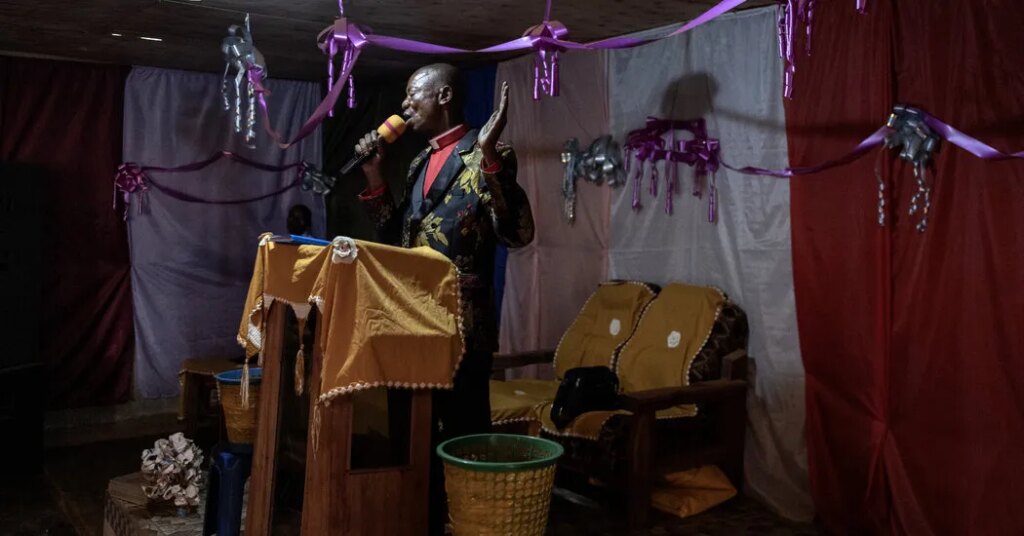
The Catholic Church is not alone in trying to dispel the misinformation. On a recent Sunday morning, inside the Vision of the Ladder Evangelical church in Mongbwalu, The Rev. Paul Kayongo was just getting warmed up.
Wearing a shiny jacket with a golden leaf pattern over his red clerical shirt, he danced, hips swaying and palms upturned, as women sang in Swahili. A guitarist, a drummer and a keyboardist played on instruments amplified by a generator that also powered a single fluorescent bulb above the pulpit.
Purple and silver bunting hung from the low plywood ceiling. Behind the preacher, multicolored curtains covered the mud walls.
A few dozen churchgoers danced and prayed as the music and song drifted out into the surrounding streets. The service lasted three hours, and culminated with Pastor Kayongo’s most pressing message: If there is one thing to believe in, aside from God, it’s that Ebola is real.
“This neighborhood is where it all started,” Pastor Kayongo said as he greeted passers-by in the streets after the service. “We didn’t know what was happening.”
“People here were just dying everywhere before the epidemic was even announced,” he said, pointing up a winding alleyway. “On this street alone, more than 80 people died in a few weeks. Now there is almost nobody left; they have all died or fled.”
Pastor Kayonga also works at Mongbwalu’s Ebola clinic, counseling family and friends of the sick or deceased. He has been in Mongbwalu from the start of the outbreak, which began here as early as January.
“It was terrible at that time,” he said. “It’s still bad, but without our efforts to inform people, things would be much worse.”
The post Converting Ebola Skeptics: Christian Leaders Mobilize Communities in Congo appeared first on New York Times.