I set the phone down on the silk comforter that my husband and I had brought back from Beijing, a precious souvenir from one of our around-the-world adventures. Randy had objected to its purchase at the time because he had little room in his suitcase, and mine had none. But now, at my home in Connecticut, it lived up to its name, comforting me on the bed we had shared for 43 years.
I had lost Randy the previous summer, and now, 14 months later, my mother was dying.
Calling from Florida, my younger brother said, “If you want to say goodbye, you should come down right away. But we will all understand if you can’t.”
What he meant was that they all assumed I could not fly. I was terrified to fly. Ever since the plane crash, fear had kept me grounded.
It seemed like a lifetime ago that I had sat beside Randy in the right seat of our plane as he flew us to Martha’s Vineyard for a family reunion and blacked out at the controls. I crash-landed the plane at 125 m.p.h.
The aircraft had been destroyed, and I, too, was a total loss. I could no longer occupy my mind and body symbiotically. I dissociated from my miraculously intact five-foot frame, marveling endlessly that nothing had been broken, burned or disfigured. I became an observer of my own psychological wreckage. Startled by real or imaginary phenomena, I felt a painful pulsing energy begin in my feet and ripple through my flesh. I saw my car crashing into trees, off bridges, across medians.
Get on a plane? The mere sound and sight of one overhead was paralyzing, a lightning bolt of grief and panic. I couldn’t banish the flashbacks.
On that final flight in July 2023, Randy and I were on approach to Martha’s Vineyard Airport from Westchester County Airport, a route we had flown frequently over the years. He had passed his F.A.A. medical exam just 15 days earlier and retained his pilot’s license for another year. Having endured decades of heart disease, lifesaving interventions and two open-heart surgeries, he had questioned his ability to fly for the first time that summer.
“If the F.A.A. says you can fly,” I said cavalierly, “then you can fly.”
We would pay a high price for our denial.
Air traffic control called our plane’s tail number: “N444RR, are you on a right downwind to Runway 24?”
I looked out the window and saw Runway 33 beneath the aircraft, not Runway 24. Randy, a meticulous pilot, was rarely corrected by a controller. As he adjusted our heading, I could see confusion on his face. Something was wrong.
The tower instructed: “N444RR. Cleared to land.” Randy’s movements were steady as he disengaged the autopilot, extended the flaps, lowered the gear and slowed the aircraft to landing speed, 85 mph. I knew this landing dance. It felt like it would be OK after all. But as the runway disappeared beneath us, I saw we weren’t going to make it. We were 300 feet above the ground and dead ahead stood a metal fence separating the airport from busy Edgartown Road. I froze. Randy said, “I’m not OK.”
I heard the whine of the gear retracting into the belly of the plane, and a sudden jolt of power as Randy pushed the throttle forward, then fell unconscious, his body pinning down my left arm. Suddenly, it was my plane.
I pulled back on the yoke and the plane climbed, avoiding the fence and the towering forest surrounding the airport. Was Randy dead or alive? “Wake up, wake up!” I shouted. “We’re going to die! I can’t do this!”
With Randy’s full weight on my body, I couldn’t reach any controls without letting go of the yoke with my right hand.
The plane was in landing configuration, and the autopilot would not engage. I tried to change the VHF radio to the emergency frequency, but as soon as I released my grip on the yoke, we headed down. I couldn’t trim the plane. I couldn’t call air traffic control. I could only hold on and climb to buy time to make my decision — or have it made for me.
I had one chance to land. My mantra was simple. If I had to die, so be it, but I wasn’t taking anyone else with me.
Ditch it in the ocean? It was a beautiful July afternoon, and the water was teeming with ferries, boats, kayaks and swimmers. Not an option. I made erratic circles in the sky as I contemplated my choices.
I had to head back to the airport. I had to get Randy help. I knew the runway. And although I was “NORDO” (not in radio contact with air traffic control), the tower would know that our aircraft was in distress, an imminent threat to all that lay below.
I was not a pilot. And the plane, a Piper Meridian, was not a trainer. It was a jet turbo prop, a complex aircraft, a Porsche not a VW Beetle. I’d had lessons in small piston trainers, but their top cruising speed was our landing speed. In landing configuration, the Meridian was heavy and hard to control. My physical stamina was evaporating. Too fast and a graveyard spiral awaited. Too slow and the plane would stall and drop like a bomb.
I headed for the rough field alongside Runway 24. I did not lower the landing gear. I did not slow down. I thought it was game over. The grass came to meet the belly of the plane to cushion the impact. So fast, so violent and yet so peaceful. It was as if someone else guided me, saving my life and giving Randy a chance at his.
I got to the ground, but Randy never came back to me. Though he officially died five days later in a Boston hospital, I believe he was gone in the sky doing what he loved best, beside the person he loved most. Neither of us had a scratch. Even the bottles of wine we were bringing to the family reunion remained intact. I would later see the recorded 15 minutes of my first solo flight tracked on the Flight Aware website, a series of chaotic headings and altitudes until we hit the ground.
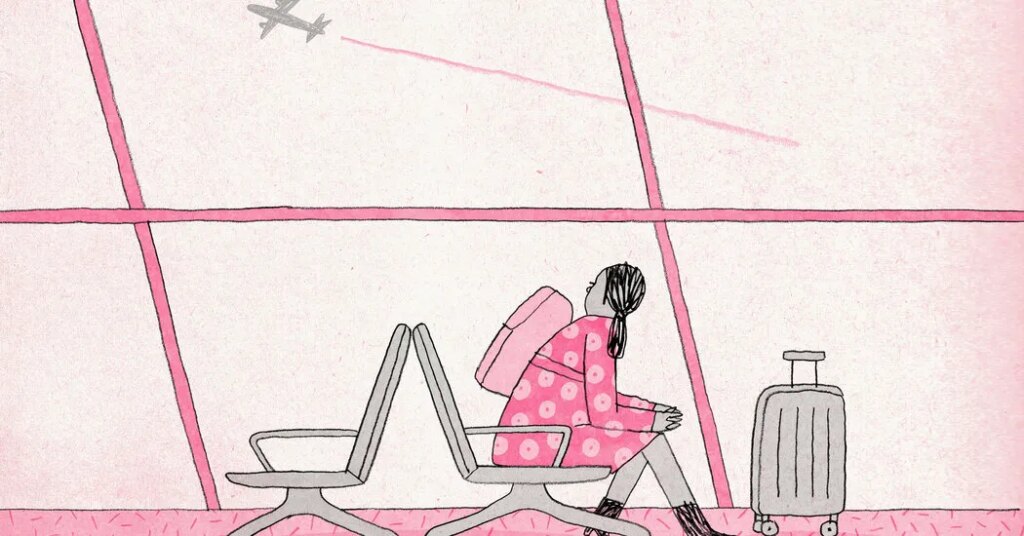
To get to my mother in Florida, I would need to board an Airbus A320 for the two-and-a-half-hour flight from New York. Driving was not an option; there wasn’t enough time. Friends offered to fly with me, but I would go solo. That was my life now.
I reached out again to the PTSD expert I had discovered while listening to a podcast and desperate for help. Dr. Arash Javanbakht, director of the Stress, Trauma and Anxiety Research Clinic in Detroit, had become my lifeline after he watched a news reel I sent him about my crash-landing. Although unable to treat me remotely, he offered me invaluable guidance.
His first question was: “Can you tell me about that day?”
“I should have died,” I said.
“No, you could have died,” he said. He taught me that PTSD was not a life sentence.
After explaining that I needed to fly to Florida immediately, I said, “What should I do?”
The doctor made no judgment. He merely tendered his story.
“My father died in Iran a few months ago,” he said. “I had 46 hours to renew my passport, fly there, and get to my hometown before my father would be buried. I arrived just in time to see him clothed in a shroud, kiss his face and help put him in the ground.”
Later that day, I rose from bed and packed a small carry-on, including the simple black suit I had worn to my husband’s funeral. The next day, our friend Parks, a retired Navy pilot and commercial airline captain, drove me to Westchester County Airport. I was shaky. Park’s reassuring manner soothed me. “If you can get a plane to the ground under emergency circumstances like you did,” he said, “then you’ve got this.”
Robotically, I walked the jet bridge. Peering through the gap between the fuselage and the jet bridge, I saw the building where Randy and I had hangered our plane for more than a decade. That life was gone. I sent love to all I had lost, knocked on the side of the plane three times for good luck as he always did, and boarded.
A few hours later, I arrived at my mother’s bedside in hospice. I hadn’t seen her for over a year, having been tethered to the earth. But I got there in time to kiss her cheek, hold her hand and hear her say, “I love you.” Then her spirit took flight gently, as had Randy’s, granting me a farewell gift — my wings.
Robin Bonnist, who lives in Westport, Conn., is working on a memoir about this experience.
Modern Love can be reached at [email protected].
To find previous Modern Love essays, Tiny Love Stories and podcast episodes, visit our archive.
Want more Modern Love? Watch the TV series, sign up for the newsletter and listen to the podcast on iTunes or Spotify. We also have two books, “Modern Love: True Stories of Love, Loss, and Redemption” and “Tiny Love Stories: True Tales of Love in 100 Words or Less.”
The post When My Husband Blacked Out, I Crash-Landed Our Plane appeared first on New York Times.