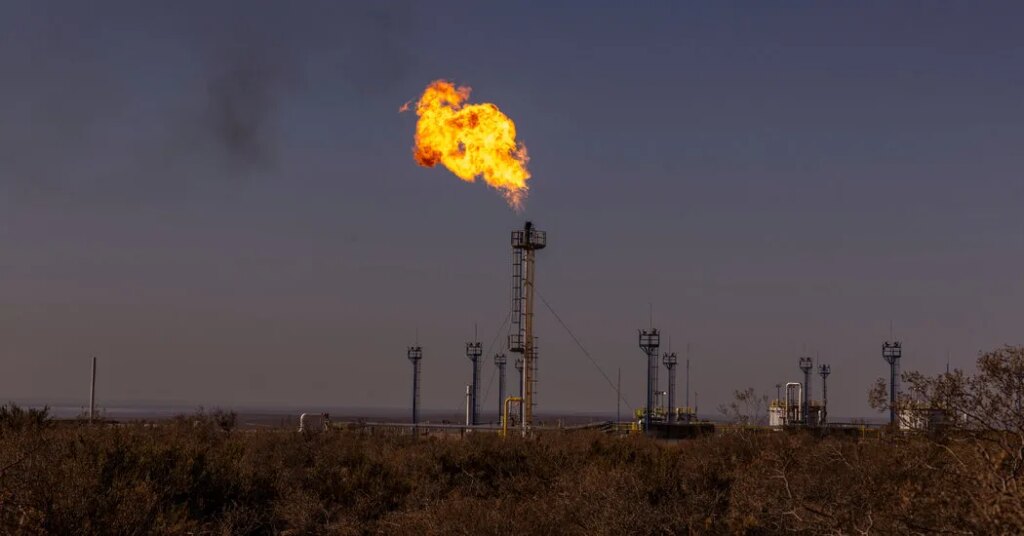
The world is on track to have warmed by 2.6 degrees Celsius (4.7 degrees Fahrenheit) on average by the end of the century compared with preindustrial times, according to an annual report from the U.N. that tracks the disparity between global climate goals and reality.
The temperature change is greater than the one predicted by the organization last year by around 0.3 degrees Celsius. About half that difference comes from the United States abandoning its climate pledge, my colleague, Chico Harlan, reports.
The report lands at a time when economic interests have been edging out climate priorities around the globe. This week’s news delivered two new examples: Brazilians are preparing to head to the polls for an election with enormous implications for the future of the Amazon rainforest. And Britain, facing an energy squeeze exacerbated by the war in Iran, just approved new gas drilling in the North Sea.
The emissions gap
In the landmark 2015 Paris Agreement, most of the countries in the world agreed to try to limit global warming to “well below” 2 degrees Celsius compared with preindustrial times, and preferably to 1.5 degrees. Last month, the U.N. formally acknowledged the world’s failure to meet the 1.5 goal.
Every bit of warming beyond 1.5 Celsius is known as “overshoot.” Now, the trillion-dollar climate question is how much overshoot is inevitable and how much can realistically be avoided. In a scenario where countries manage to slash emissions by almost 20 percent in the next four years — a far more aggressive drawdown than current plans suggest — temperatures would rise by 1.7 or 1.8 degrees by the middle of the century, then fall back to an uptick of 1.5 degrees over the next 50 years.
Global average temperatures have already risen by 1.4 degrees Celsius since the beginning of the industrial revolution. The implications of that increase are still coming into focus.
“The impacts at 1.5 are higher than we thought they’d be a decade ago,” Bill Hare, the chief executive of Climate Analytics, a climate science institute, told Harlan last month.
The Amazon on the ballot
Deforestation of the Amazon rainforest reached its lowest level on record under President Luiz Inácio Lula da Silva, who was elected in 2022. That may change after Sunday, when Brazilian voters head to the polls to choose their next president.
Flávio Bolsonaro, son of former president Jair Bolsonaro, is the current favorite to win. He does not believe climate change is caused by humans and sees economic opportunities in allowing greater access to the rainforest for farming and mining, my colleagues, Sergio Peçanha and Ana Ionova, report.
Though Bolsonaro has promised to end illegal deforestation, experts worry he will do so by opening up more legal pathways to clear trees, Peçanha and Ionova write.
“For decades, Brazil has been alternating between plundering the Amazon for resources or keeping it bucolic and green,” Salo Coslovsky, an expert on the Amazonian economy at New York University, told my colleague Adam Ellick. “But neither option produces a stable outcome.”
Drilling for gas in the North Sea
On Wednesday, the British government gave the green light to a major offshore natural gas project in the North Sea, a decision Prime Minister Andy Burnham called “pragmatic,” my colleague Lisa Friedman reports.
The Jackdaw field off the coast of Scotland is expected to meet up to 6 percent of Britain’s gas needs, according to Adura, the energy company that plans to develop the project. Environmentalists put the figure closer to 2 percent, Friedman reports.
Britain relies on imported natural gas to meet its energy needs, and the war in Iran has sent prices upward. Leaders have looked to domestic production to blunt the impact.
The Jackdaw approval drew criticism from environmentalists. Green Party leader Zack Polanski called it “climate vandalism” in a statement, adding that the development will not bring down energy bills and will create just 27 jobs. “This is a victory for Shell over the people,” he said.
A power plant in name only
Traditionally, utilities have built big new power plants — coal, gas, nuclear, solar, wind — whenever they need to add more electrical capacity to the grid. But in recent years, some companies have been eyeing what they say is a much faster and cheaper option.
This approach is often referred to as a “virtual power plant,” and it basically involves making extra space on the grid by getting thousands of homes and businesses to shift around their electricity usage.
The underlying idea is that for the vast majority of the year, most grids generate more electricity than they actually need. But there are small periods — during a heat wave, say — when the grid is stressed and power plants are tapped out. If enough people could be convinced to use less power during those periods, it could avert the need to build costly new plants and save everyone money.
Companies that build virtual power plants try to do just that.
For example: NRG, a power provider in Texas, has been offering residents free smart thermostats and Ring doorbells so that operators can automatically tweak energy use in those homes as needed — say, by bumping up thermostats just a few degrees on hot days when the grid is strained. (Residents can still override the controls.) By doing this across thousands of homes, the company says, it can avert the need to build new gas plants to meet growing demand.
Other virtual power plant providers work with businesses or factories and offer to pay them to switch off machinery or dim certain lights when the grid is particularly stressed and power prices surge. SunRun, the nation’s largest solar installer, is setting up programs that store electricity from thousands of home rooftop solar panels and sell it to the grid when it’s needed most.
Each of these individual tweaks may be small. But some studies suggest that the aggregate effect of these virtual power plants could be very large, potentially saving consumers billions per year, as long as they can be shown to perform reliably.
Now tech companies are taking notice. Google on Thursday announced it would fund one of the nation’s largest virtual power plants, run by a company called Voltus, as it scrambles for electricity for its growing fleet of data centers. — Brad Plumer
Read more about Google’s proposed power plan.
More climate and environment news from around the web:
-
Pollution has long been indirectly linked with various health effects, including dementia. The Washington Post reports on scientists investigating how the air around us could be physically reshaping the brain.
-
The European Union plans to expand its Arctic presence as rapid warming opens shipping routes and intensifies competition over resources, the Los Angeles Times reports. And Reuters has a look at the parliamentary vote to delay new E.U. methane rules for three years.
Read past editions of the newsletter here.
If you’re enjoying what you’re reading, please consider recommending it to others. They can sign up here.
Follow The New York Times on Instagram, Threads, Facebook and TikTok at @nytimes.
Reach us at [email protected]. We read every message, and reply to many!
The post Losing Ground in the Climate Fight appeared first on New York Times.