The first time Lexi Hawk sensed something was wrong, she was playing in her backyard with her toddler, Bailee. Ms. Hawk heard a plane that sounded as if it was right on top of them. She looked and there it was, flying super slow and right above the treetops. It passed over her house again and again.
“I was like, ‘What’s going on?’” she remembers thinking. “‘Are we getting attacked?’”
That was the summer of 2024. A year later, Ms. Hawk and Bailee were outside again when three men pulled up to their house in a truck. One got out and started sweeping a Geiger counter along the grass.
“They told me not to worry, it was probably just a rock,” she said. Some rocks, they explained, could have natural, low-level radioactivity. “I was a little concerned.”
Then, this summer, after finishing her shift at a hair salon, she drove home to find a crew of men on her property wearing head-to-toe protective suits. One used a little yellow backhoe to dig holes in the yard.
“It was like a horror movie scene,” said Ms. Hawk. “It was like driving into a nightmare.”
The little blue ranch house in Niagara, N.Y., was supposed to be a suburban oasis for Ms. Hawk, 24, and her partner, Trevor Bradley, 26. They had lived much of their lives in the toxic minefield of nearby Niagara Falls, a small city where Love Canal — the site of perhaps America’s most infamous environmental disaster — ranks as only the most well-known of dozens of local landfills.
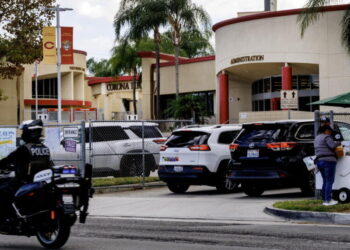
Then this spring, the government contacted people living across a 60-mile swath of western New York, from the suburbs of Niagara Falls to a constellation of farm towns south of Buffalo, with an alarming request: Could officials test their property for radioactivity?
Out of 1,400 households that received the requests, 38 may need extensive cleanups. Four were so radioactive that the U.S. Army Corps of Engineers offered to relocate families immediately. This was how Ms. Hawk and Mr. Bradley learned that they had been letting their 3-year-old daughter play in a yard contaminated by Thorium-232 and other radioactive isotopes.
Ms. Hawk and Mr. Bradley now keep a map that government workers gave them that shows the radioactivity on their property. It is covered with hundreds of dots, each representing a Geiger counter reading. Blue dots, like those in the driveway, indicated low radioactive risk. Yellow dots — elevated risk — crisscrossed the lawn.
Red dots — radiation that government agents described as “red hot” — covered the woods and followed a trail leading to a creek, ending at a swing that Mr. Bradley built for his daughter. It’s Bailee’s favorite place to play.
“Why am I still living here?” Mr. Bradley said, minutes after he was given the map. “And how do I keep my daughter safe?”
Lexi Hawk spent much of her childhood living with her grandparents in a house near Military Road in Niagara. They had an aboveground pool that she swam in all summer with her eight cousins, who visited often. They would play on the swing set and stomp around Gill Creek. When they felt adventurous, the cousins would cross the creek and explore the abandoned drive-in theater on the other side.
“We were catching little crawfish, and the little minnows that swim by, and frogs,” Ms. Hawk said. “It was so fun.”
Her grandparents’ house was a refuge from a chaotic home life. Her father was in the navy and would be absent for months at a time, and her mother struggled with opioids and was in and out of jail. Seven members of her family contracted cancer, she said, and six of them died, including her grandmother.
“So that kind of messed with me as a teenager,” Ms. Hawk said. “I started acting out, smoking weed.”
Trevor, too, had a difficult childhood. As a boy he lived five blocks from Love Canal, a neighborhood that had been evacuated in the 1970s after residents learned the toxic waste dump beneath their homes had most likely caused hundreds of birth defects, rare diseases and early deaths.
Even decades after the toxic landfill at Love Canal was capped and supposedly contained, Mr. Bradley said his family’s basement reeked of chemicals. He reports a litany of health disasters. His aunt got sick in her 20s with a mysterious illness that plagued her until her death at age 53. His grandmother died at age 34, of leukemia. She was the eighth person on the block to die of leukemia, he said; the youngest was 12 years old.
Ms. Hawk met Mr. Bradley when they were in high school; Lexi was 15, Trevor 16. After they dated for a week, Trevor moved in with Lexi and her family.
“We’ve just dealt with a lot of death,” Ms. Hawk said. “So we were both just like, ‘We have nobody but each other.’”
Ms. Hawk became a hairdresser, and by age 18 she was managing a Supercuts salon. In a year she had saved enough money to buy a house of her own — the blue ranch right behind her grandparents’ place, for $129,000. It was in a good school district, at the end of a quiet street bordered by woods and her beloved Gill Creek.
Mr. Bradley, a carpenter, gut-renovated the home with Ms. Hawk’s help. For four happy years they believed they had escaped Love Canal and the legacy of toxic dumping around Niagara Falls.
“I thought we were in the good area,” Ms. Hawk said.
Then the men in white protective suits arrived with their backhoe.
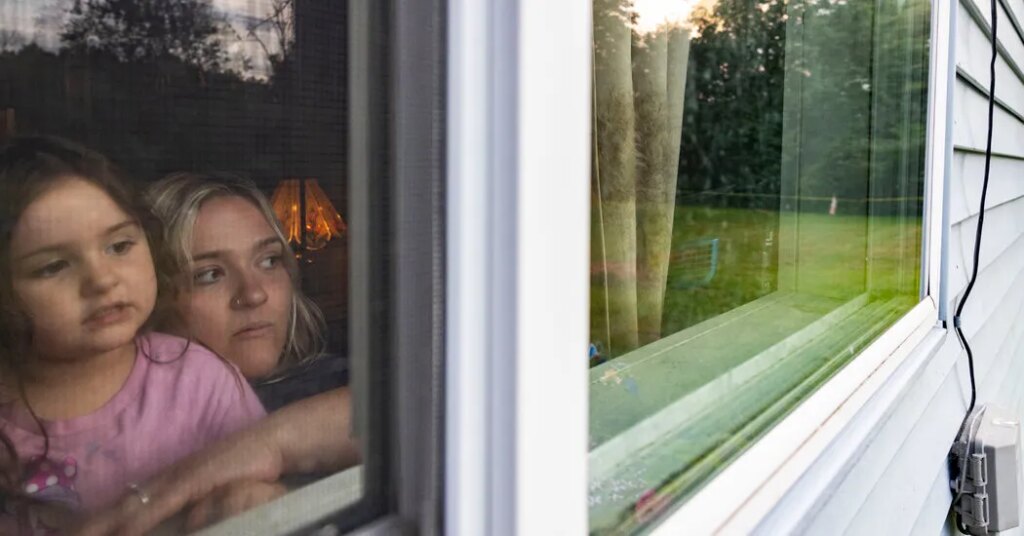
On a sunny afternoon this August, Bailee stood at the sliding glass door in her parents’ bedroom. She looked to her mother, who was in the kitchen, then back outside. This is Bailee’s new ritual, Ms. Hawk said, and she does it throughout the day. Ms. Hawk relented.
“You’re allowed to go on your trampoline,” she said.
Bailee smiled. She stepped onto the back deck, climbed onto the trampoline and started to hop. Moments later, her mother saw that she had moved. Ms. Hawk hustled outside and found Bailee sitting in the yard with one hand in her mouth.
“Bailee!” Ms. Hawk called from the deck. “Get up here! Are you trying to eat grass? Let’s not do that. Can you not eat that?”
Bailee stood and followed her mother. She pouted, but did not cry. Safely back indoors, Ms. Hawk quizzed her daughter, who is 3.
“Bailee, what’s happening in the backyard?” Ms. Hawk said.
“Poison,” Bailee said.
“What kind of poison?” Ms. Hawk said.
“Radioactivity,” said Bailee.
The poison is the legacy of decades of corporate greed and government indifference. According to the state Department of Environmental Conservation, at least some of the nuclear waste buried around Niagara Falls was generated by the Manhattan Project, when chemical companies there were part of the effort to build the first atomic bomb. But most of it was created by private companies processing naturally radioactive ores into commercial products.
In both cases, leftovers that resembled ordinary gravel or dirt were given for free or at reduced cost to local contractors. It was used for road beds, for instance, or as fill in residential yards, possibly including Ms. Hawk’s.
By 1981, reports by federal and state agencies confirmed that radioactive waste was buried in unregulated dumps around Niagara Falls, and that a thorough regional study was required to find it all. Locals have long traded rumors about unregulated dumping, and Ms. Hawk grew up hearing her grandfather’s stories about his bosses at a local chemical factory ordering him to dump barrels of waste into sewers or even the Niagara River.
“Hey, this is western New York,” a Niagara Falls city planner told The Buffalo News in 2018. “You dig in something that was put down in the 1940s or 1950s, you might find something you didn’t expect. This stuff turns up everywhere.”
The government’s systemic study did not begin until 2023, when the Environmental Protection Agency began its low-altitude aerial surveys. So far, according to Amanda Lefton, commissioner of the Environmental Conservation Department under Gov. Kathy Hochul, it appears that the waste came from the manufacturing of chemical products and not nuclear weapons.
“What we’re finding here,” Ms. Lefton said, “are levels that are worrisome for long-term exposure.”
The testing happening now is proof that the government is getting ahead of the problem, said Ms. Lefton, adding that state and federal agencies “launched this effort together to proactively look for radiological wastes that shouldn’t be there.”
But to Ms. Hawk, the government’s decision to look now does not absolve it of the greater sin: doing nothing for nearly 50 years.
“They knew,” she said. “And they let me live here.”
Ms. Hawk and Mr. Bradley understood they would have to relocate, but they were finding it painful to relinquish their dream home. For weeks this summer, Mr. Bradley resisted the urge to mow his yard or weed his garden for fear of what lurked beneath.
By August, he could no longer stand the mess. He finally cut the grass (but didn’t bag the potentially radioactive clippings). A few days later he went to the garden and began pulling weeds with his bare hands. On the government’s map, both areas are blanketed in red dots.
“I wanted something that I could be proud of,” he said. “I wanted to have little trails through the woods, have flowers and plants and a little bridge over the creek. I had visions of living here till the day I died.”
So far, at least, Ms. Hawk and Mr. Bradley say they have avoided the illnesses that have plagued their families. But they are worried. When government workers arrived to test Ms. Hawk’s grandfather’s yard, they walked in circles around the pool with a Geiger counter. They huddled quietly for a few minutes, then approached Ms. Hawk and asked if she ever used the pool. They suggested she avoid it.
“I was like, ‘What do you mean?’” Ms. Hawk said. “I went in that pool all the time when I was pregnant and when Bailee was an infant.”
One day, Ms. Hawk strapped Bailee in her car seat and headed to the grocery store to buy bottled water — the family’s preferred source of drinking water since they got the news about their yard.
“We go through a case every three days,” Ms. Hawk said as she left. “It’s crazy.”
Mr. Bradley stayed behind on the couch. With his partner and daughter gone, the smile fell from his face. Ms. Hawk is so busy now — organizing protests, rallying supporters on Facebook, haranguing government employees on the phone, working scattered shifts at the hair salon — that Mr. Bradley does not want to burden her any further. He keeps his feelings to himself.
“I go to work, come home, put a smile on my face,” he said. “I’ve got to act like it’s all OK. And, like, I’m terrified.”
Mr. Bradley has fought the government over toxic waste before. When he was 12, his mother filed a lawsuit against the city of Niagara Falls and local chemical companies, arguing that Love Canal’s containment system had failed, allowing toxic chemicals to seep into their house. He remembers his brother became sick and got terrible headaches every time he went into the basement.
Trevor was a named plaintiff in the case. As a child and young adult, he sat for hours of depositions about toxic waste. As the case progressed, he watched, powerless, as members of his family died strange, early deaths. The case was dismissed on technical grounds in 2023.
When his partner organized the neighborhood’s first news conference about radioactive waste this July, Mr. Bradley stayed home.
“I dealt with this for so long, I don’t want any part of it,” Mr. Bradley remembers telling Ms. Hawk. “Do you think you’re going to get any further than my mom did?”
Mr. Bradley worried about removing Bailee “from her safe space, the only home she knows.” He didn’t know where the U.S. Army Corps of Engineers would find them a house to stay in, or how long his family would need to live there while the E.P.A. removed waste from his yard. If his family ever moves back home, he worries they might never be safe from environmental hazards. Whatever happens, he said, the house he loves is now worthless.
“No one’s going to buy this house,” he said. “Are you kidding me? Everyone in Niagara and Erie County’s seen our house on the TV, next to radiation. So we’ve just got to eat that loss.”
He looked from the couch to the front door. Beside it sits an overstuffed chair that Bailee likes to climb to look out the window. Just outside lies the garden, a cluster of red dots on the government map. Mr. Bradley fell quiet, wondering how much radioactive bombardment Bailee took before the family ever learned it was there. He began to cry.
“I just want to know if my daughter is going to be OK,” he said. “And I know they’ll probably never be able to answer that.”
The post The Little Girl With the Radioactive Backyard appeared first on New York Times.