Ope! I’m Bram Sable-Smith, Midwest correspondent at KFF Health News. Send tips about hospital bills, the social safety net and Frito pie recipes to [email protected]. Not a subscriber? Sign up here.
Today’s edition: The Centers for Medicare and Medicaid Services is proposing to stiffen regulations around the marketing practices of the private-sector version of Medicare. Republican attorneys general in three states are suing the Biden administration over mail-order abortion pills. But first …
Ohio votes on abortion rights today. Next year, 11 more states may follow.
Voters in Ohio are deciding whether to add abortion rights protections to the state’s constitution today.
The vote comes on the heels of last year’s string of ballot measure wins for abortion rights in six states: California, Kansas, Kentucky, Michigan, Montana and Vermont. But this is just the start.
Next year, 11 more states could see abortion-related ballot measures, part of a wave of such actions since the Supreme Court’s 2022 Dobbs decision, which overturned Roe v. Wade. The groundwork for these next campaigns has been in motion for months, sometimes years.
In Iowa, for example, efforts to pass a state constitutional amendment declaring no right to abortion began in 2021, although the GOP-led legislature has yet to finish the process. In Colorado, competing initiatives — one to enshrine abortion protections and one to ban abortion — could appear on the same ballot if supporters of both garner enough signatures.
And in Missouri, where I’m based, two groups filed a combined 17 initiative petitions to increase access to abortion. The proposals range from exemptions for rape, incest, fetal abnormalities and the health of the mother to preventing any restrictions on abortion without a “compelling governmental interest.”
It’s unclear which, if any, of those will make it to the ballot since months of litigation has delayed signature collection and highlighted internecine conflicts on both sides of the issue.
- “In a way, I think this is what the Supreme Court wanted,” said John Matsusaka, executive director of the Initiative and Referendum Institute at the University of Southern California. “They said, ‘The people ought to figure this out.’”
Money has been pouring into the initiatives. In the two months leading up to the vote in Ohio, the campaign to protect abortion rights raised about $29 million, and the opposing campaign raised nearly $10 million, according to the Associated Press.
There’s much more to come. Last month, Illinois Gov. J.B. Pritzker, a billionaire Democrat whose family owns the Hyatt hotel chain, announced his Think Big America organization to help fund abortion rights ballot measures across the country.
The cost of launching a ballot campaign can be a daunting obstacle, said Emily Wales, president and CEO of Planned Parenthood Great Plains, which has clinics in Kansas, Oklahoma, Arkansas and Missouri. During last year’s vote in Kansas, for example, the competing campaigns raised more than $11.2 million combined. That may be a factor in the absence of a ballot measure in Oklahoma, despite momentum for one last year.
- “It’s not just: Can you pull together a coalition, educate voters and get them out? But: Can you also raise enough to combat what has been years of misinformation, miseducation, and really shaming and stigmatizing information about abortion?” Wales said.
Six of the 17 proposals in Missouri were filed by Jamie Corley, a former Republican congressional staffer who helms the new 501(c)(4) nonprofit Missouri Women and Family Research Fund. An abortion rights supporter, she’s trying to land on language that appeals to sympathetic Republicans like herself and thus has a chance of prevailing in her largely red state, one of 14 to ban abortion since the Dobbs decision.
“I can’t emphasize enough how dangerous it is to be pregnant in Missouri right now,” Corley said. “There is a real urgency to pass something to change the abortion law.”
That’s for next year. In the meantime, we’ll find out today whether abortion rights supporters can go 7-0 for ballot measures and add Ohio to the states with constitutional protections. A recent poll from Baldwin Wallace Universityfound that 58 percent of likely voters favored passing State Issue 1.
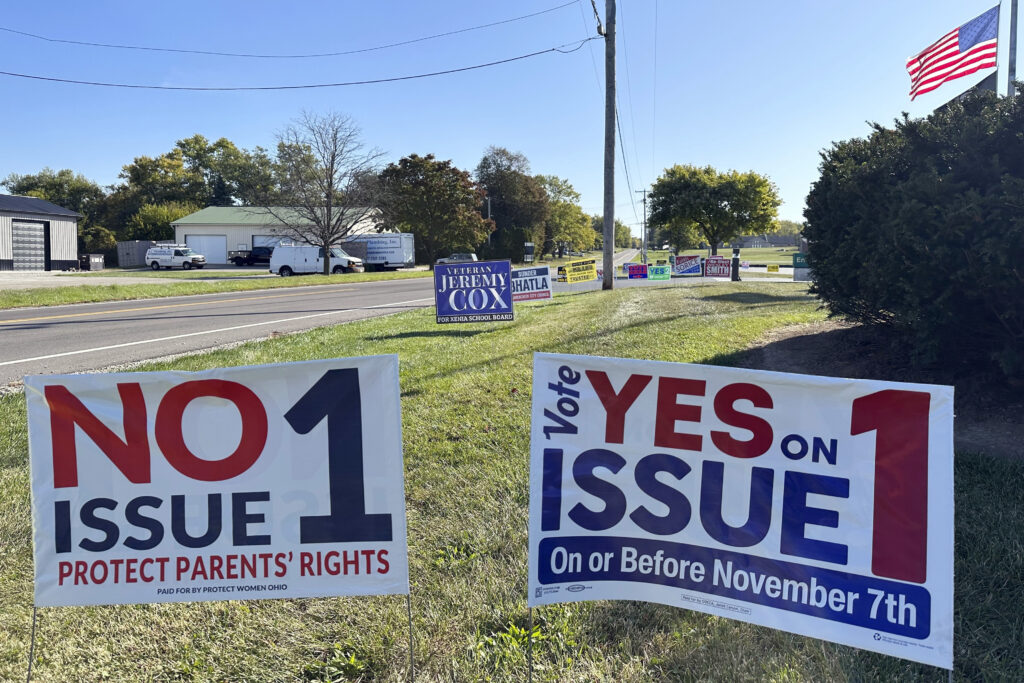
Turnout is expected to be high because the measure is under much debate locally, with competing pro and anti signs dotting yards and road medians. Last week, for example, at a small restaurant on the east side of Cincinnati, my KFF Health News colleague Stephanie Stapleton was on hand when a table of four women heatedly discussed Issue 1, criticizing men in the state legislature who they said were trying to control their bodies.
The restaurant got quiet, and people at the table next to them stared. Some of the women who had been loudly talking apologized in case they had caused offense.
But at the table that had been staring, laughter broke out. One of the young women stood up, took off her jacket and revealed that she was wearing a vintage 1973 T-shirt celebrating Roe v. Wade.
KFF Health News is a national newsroom that produces in-depth journalism about health issues and is one of the core operating programs at KFF — an independent source of health policy research, polling and journalism.
Agency alert
Biden administration seeks to crack down on private Medicare health plans
The Centers for Medicare and Medicaid Services is proposing a fresh crackdown on the marketing practices of private health plans that have grown to cover half the people on Medicare, The Post’s Amy Goldstein reports.
The details: The draft rule issued yesterday would establish guardrails more firmly restricting the compensation of insurance agents and brokers who advise Medicare customers, setting a fixed amount for such advice, no matter which plan a consumer chose. Currently, there are caps, but some companies pay agents and brokers lavish extras for steering business to them, according to Lael Brainard, director of the White House National Economic Council.
- The proposal would also expand access to mental health services, help Americans with Medicare drug benefits gain access to biosimilars and require private health plans to notify enrollees halfway through a year what supplemental benefits remain available to them.
The bigger picture: The proposed rule marks the second time in a year that the administration has sought to stiffen regulation of Medicare Advantage. Last year, the federal health department proposed a different set of changes that mainly focused on restricting predatory marketing practices, which became final in April.
The view from the industry: The Better Medicare Alliance, which advocates for Medicare Advantage, “appreciates CMS’ continued efforts to help beneficiaries make the best choice for their health care needs and the agency’s continued focus on advancing health equity and improving access to care,” Mary Beth Donahue, the group’s president and CEO, said in a statement provided to The Health 202.
In the courts
Red states sue to block abortion pills sent by mail
Republican attorneys general for Missouri, Idaho and Kansas are suing the Food and Drug Administration and the Department of Health and Human Services for allowing a key abortion drug to be shipped to women nationwide.
The lawsuit, filed in the U.S. District Court for the Northern District of Texas last week, asked the court to issue a preliminary injunction that would reverse the FDA’s 2019 approval of a generic version of mifepristone and reinstate a requirement that the drug be dispensed in person.
The legal challenge mirrors a lawsuit filed last year by the conservative legal firm Alliance Defending Freedom, which claims that the FDA acted outside its authority when it first approved the drug more than two decades ago. Missouri Attorney General Andrew Bailey (R) has requested that the court combine the two suits.
More from Bailey:
Data point
Children who survive being shot, and their families, face enormous health challenges relative to peers who don’t suffer gun violence, including an average $35,000 increase in their medical bills, Liz Szabo of KFF Health News reports, citing a new studyin Health Affairs.
About 85,000 people in the United States survive firearms injuries each year. The study is one of the first to look at the impact of shootings on families.
A closer look: The shooting survivors in the study, ages 19 and younger, were found to be 68 percent more likely than other kids to have a psychiatric diagnosis and 144 percent as likely to develop a substance use disorder. In the year after they were shot, child and adolescent survivors were more than twice as likely as other kids to experience a pain disorder.
State scan
California’s plan to start manufacturing its own insulin is facing delays
The state initially aimed to start delivering biosimilar insulin under its own CalRx label sometime next year, but that timeline has been extended, California Health and Human Services Secretary Mark Ghaly told Bloomberg Law’s Andrew Oxford.
Key context: Gov. Gavin Newsom (D) announced in March that the state had contracted with the nonprofit drugmaker Civica to manufacture its own insulin, which would be available for as little as $30 for a 10-milliliter dose.
The company “does not have a specific time frame for approval by the FDA and plans to provide an updated filing timeline soon,” Ghaly said.
In other health news
- On tap today: The U.S. Court of Appeals for the Fifth Circuit will hear oral arguments in a case that will decide whether HHS can enforce agency guidance that a federal emergency law requires abortions in some situations, even in states where the procedure is banned, Mary Anne Pazanowski reports for Bloomberg Law.
- The Centers for Disease Control and Prevention is expanding its infectious-disease surveillance of international travelers at four major U.S. airports to include more than 30 pathogens. The agency originally launched the initiative to help with the early detection of new coronavirus variants.
- The Justice Department has ordered one of Puerto Rico’s biggest distributors of pharmaceutical drugs to pay $12 million after allegedly failing to report hundreds of suspicious orders for opioids and other controlled substances.
- Senate Finance Committee Chairman Ron Wyden (D-Ore.) and ranking Republican Mike Crapo (Idaho) released the Chairman’s Mark of a bipartisan mental health and drug pricing package ahead of a markup slated for Wednesday.
Health reads
HHS secretaries Becerra, Azar face off on lowering drug prices (By Sarah Owermohle | Stat)
Sugar rush
The post Ohio votes on abortion rights today. Eleven states may follow in 2024. appeared first on Washington Post.