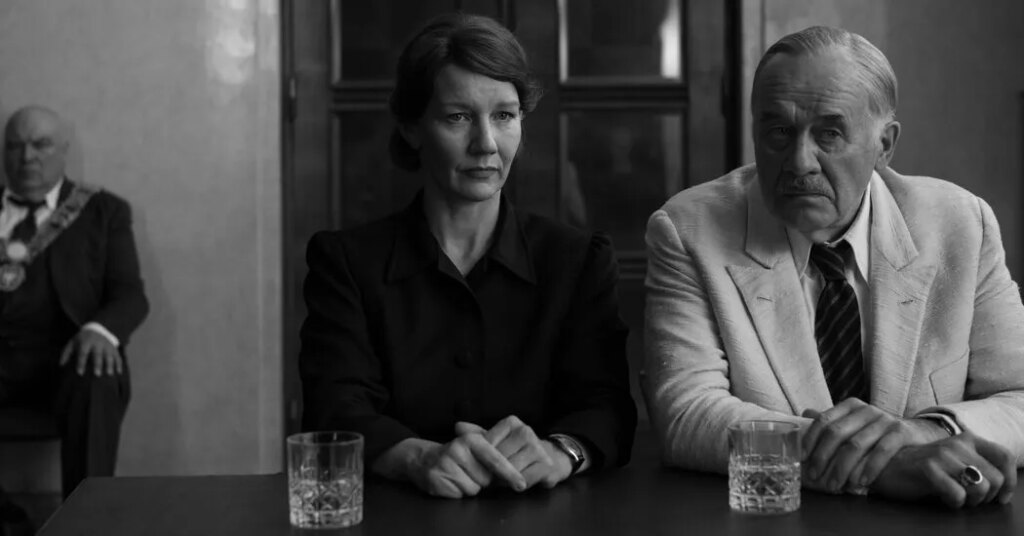
In 1949, four years after the surrender of Nazi Germany and after years wandering the wilderness known as the United States, the writer Thomas Mann returned to his divided Germany. By the time he did, he had American citizenship and an F.B.I. file on him, and he had filled Madison Square Garden like a rock star, denouncing Hitler to a cheering crowd. When he was invited to visit Frankfurt (in West Germany) and Weimer (in the East) for the 200th anniversary of Goethe’s birth, he returned to his birth country with his daughter Erika. Their trip is the basis for the fictional “Fatherland,” a film of deep, luminous feeling.
The journey is relatively brief, as is the movie itself, which (minus credits) runs about an hour and change. Much of it tracks Thomas (Hanns Zischler) and his eldest daughter, Erika (Sandra Hüller), as they travel through a postwar Germany populated by ghosts, some not yet dead. There are awkward parties in Thomas’s honor in both East and West Germany, including one where he exchanges awkward pleasantries with two of Richard Wagner’s slick, sycophantic grandsons before swiftly cutting them down to size. He mesmerizes some who clamor around him, bores and scares others; only Erika’s opinion seems to concern him.
When he reads a draft of one speech aloud, she proves that she’s worthy of his trust: “Three relative clauses in one sentence are a bit much,” she says with brisk authority while busily unpacking his suitcase.
“Fatherland” isn’t a completist portrait; it’s representative, not encyclopedic. The sweep of the Mann family — its complicated personalities, histories, triumphs and calamities — is referenced, but much remains unsaid. The director, Pawel Pawlikowski, and his co-writer Henk Handloegten, assume that the audience has, at least, a passing acquaintance with Thomas Mann, but they also fold in enough tight, context-setting scenes to fill in the background. At an early news conference, journalists state the obvious (“You have a Nobel”) and pose helpful questions. When one asks Thomas where he lives, he says California. Where he belongs, he continues — using the word “heimat,” homeland — is difficult to say.
Thomas and Erika’s trip is both a journey and a destination, though whether it is also a homecoming hangs over them, clouding their faces, especially his. Thomas has returned to the country to honor Goethe, which, he tells an audience, he could only do in Germany. He speaks of the country with sweeping, outward idealism and simply refers to it as Germany, not West or East. He gestures to the past, present and future, and invokes art, culture and dialectics. “The Good Germany,” he says, “is the strength blessed by art and civilized greatness.” Yet while he alludes to why he personally left the country (the Nazis stripped Mann of his citizenship in 1936), it is another character who invokes the extermination camps.
Zischler and Hüller have the kind of wonderfully interesting, sloped and furrowed faces that you never get tired of looking at, and they complement each other visually and stylistically. Zischler gives Thomas flashing eyes (the fire still burns in this man) but also a great, ponderous physicality that suggests an enormous weight has pressed down on his character. (Mann died six years later in Zurich at the age of 80.) Erika seems infinitely lighter, by contrast, though often restless, even agitated. Huller’s ability to let you into her characters’ thinking is a marvel, and you can almost see the thoughts forming in Erika’s head, whether she’s impatiently scanning a room or watching, still as stone, her father rehearse his talks.
Like Pawlikowski’s last two movies (“Ida” and “Cold War”), “Fatherland” was handsomely shot in black-and-white. (The cinematographer is Lukasz Zal.) It’s striking but not overly beautiful. Like the costumes and cars, the palette summons an earlier age, which works for a story that also — as it circles around issues of trauma, nation, self, fascism, collectivism — addresses the present. In a similar vein, it has a near-square aspect ratio, and while the boxy frame evokes an earlier historic and cinematic era, it’s also of a piece with the compressed narrative. The framing here doesn’t suggest boundlessness, as widescreen often does, but instead emphasizes that “Fatherland” takes place at a specific moment in time.
Each stop on Thomas and Erika’s journey reveals something new, adds nuance and shadow. There are flashes of humor here and there, even at a fete where the old Germany spookily mingles with the new. There, while her father backhands the Wagner spawn, Erika confronts her former husband, an actor who stayed in Germany and became a pet of the Nazi power elite. What were all these people doing four years ago, Erika wonders aloud to a reporter friend, Betty Knox (Anna Madeley); it’s more of a statement than a question. The warm, searching looks that the women exchange indicate that they share an intimate history, one that, Erika suggests, might help answer why she has been denied American citizenship.
“Fatherland” is suffused with its characters’ longing, with desires that they express and others they can’t. There’s pathos in some of their words, though often it is what remains unsaid that hits hardest. One of the most indelible passages takes place at the start of the movie before the trip, and serves as a melancholic prelude. It opens in a hotel room in Cannes, France, where Klaus Mann (a haunting August Diehl) — Erika’s beloved brother, Thomas’s eldest son — is seated naked on the floor. Erika asks him to join them on their travels, but Klaus is exhausted, spent. There are circles under his eyes, and his pale body looks wasted. For him, the return home is impossible, and is a tragedy that has already been written.
Fatherland Not rated. In German, French, English and Russian, with subtitles. Running time: 1 hour 22 minutes. In theaters.
The post ‘Fatherland’ Review: Returning to a Divided Germany appeared first on New York Times.