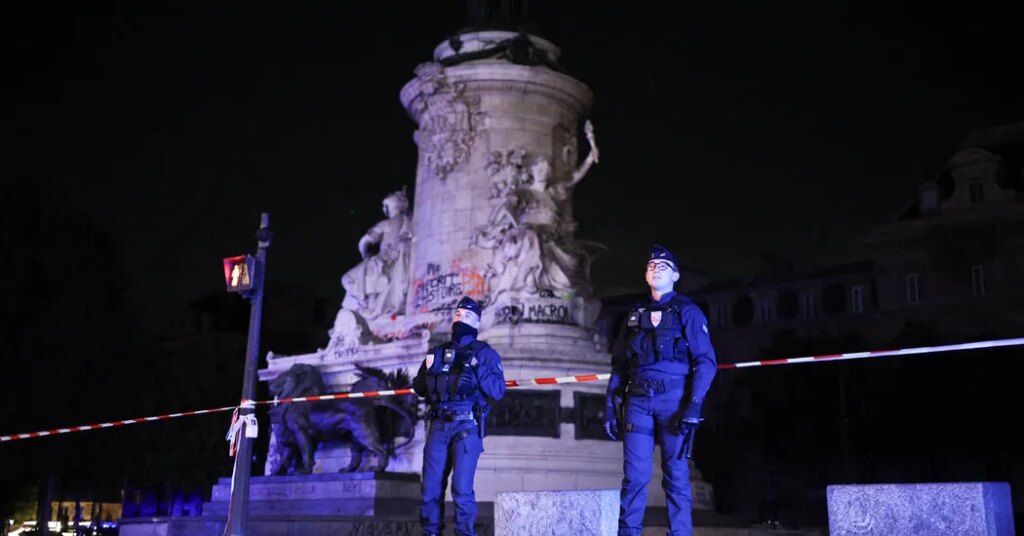
The French authorities banned gatherings in some cities on Thursday and over the coming days, in an attempt to avoid a repeat of the riots that rocked the country last weekend.
President Emmanuel Macron of France said on Thursday that the bans were necessary “so that calm prevails, so that we can protect businesses and so that we can also protect public buildings.”
“The general recommendation is that there should be no protests in the coming days,” Mr. Macron announced after emerging from a security council meeting with cabinet ministers and the French intelligence services. He said that some demonstrations planned by unions would be permitted, though the authorities would propose alternative protest routes.
Last weekend, riots spun out of huge and largely peaceful demonstrations in cities across France. During the unrest, nearly 1,000 police officers were injured and more than 3,000 shops were looted or damaged, according to the authorities.
With more than 2,500 people arrested across the country, French courts were expediting trials. Police investigators were still working to identify other suspects.
Still, the large CGT union and student groups were among those urging further demonstrations and another march on Saturday. Many are calling those protests a “second act” to the rallies last weekend, which numbered more than half a million participants. That has prompted the authorities to move to limit further fallout.
Even before Mr. Macron’s declaration, the authorities in places like Paris and Lille imposed temporary bans on public gatherings for Thursday.
The police prefecture in Paris banned gatherings, protests and marches in some parts of the city for 12 hours on Thursday, starting at 8 a.m. The areas designated as off-limits for demonstrations included around many important government buildings, train stations and tourist sites including the Louvre and the Champs-Élysées.
However, an administrative court in Paris overturned a ban on a student march Thursday afternoon, according to its organizers.
“When the government tries to ban protests, tries to repress in every way it can, we need to stand together and show a display of force to guarantee the right to protest,” Coppelia Moureau, a member of a union representing students from universities in the Greater Paris region, told reporters as she left the courthouse on Thursday.
The union is demanding the end of Parcoursup, a state-run website that students must use to apply for higher education programs. Its members later gathered on the city’s left bank and planned to march across the Seine River and to the Place de la Bastille.
It was not clear how that court decision would impact the larger ban on protests in Paris, or if further challenges would be lodged.
Some cities, including Grenoble and Le Mans, have imposed multiday bans on protests. Rouen, Toulon, Nice and Le Havre banned any protests in their city centers on Saturday.
In the Var department of southern France, which includes the city of Toulon, the authorities also implemented other restrictions. They banned people from wearing face coverings and protective clothing, and from buying or selling fireworks from Wednesday night until Monday.
The authorities in Paris have not announced restrictions on demonstrations for Saturday. However, City Hall said it would remove garbage containers, barriers and construction material from the streets by then so that they could not be “used to commit damage” and urged citizens to follow suit, citing “the risk of further violence perpetrated by vandals.”
Art Basel Paris announced it would close two days early — on Friday evening — “in the interest of safeguarding our visitors, exhibitors, partners, staff, and artworks.”
The post In the Wake of Riots, French Authorities Ban Some Protests appeared first on New York Times.