On a visit to the Bargello sculpture museum in Florence, Italy, a 3-year-old friend of mine was fascinated by its statues’ naked butts.
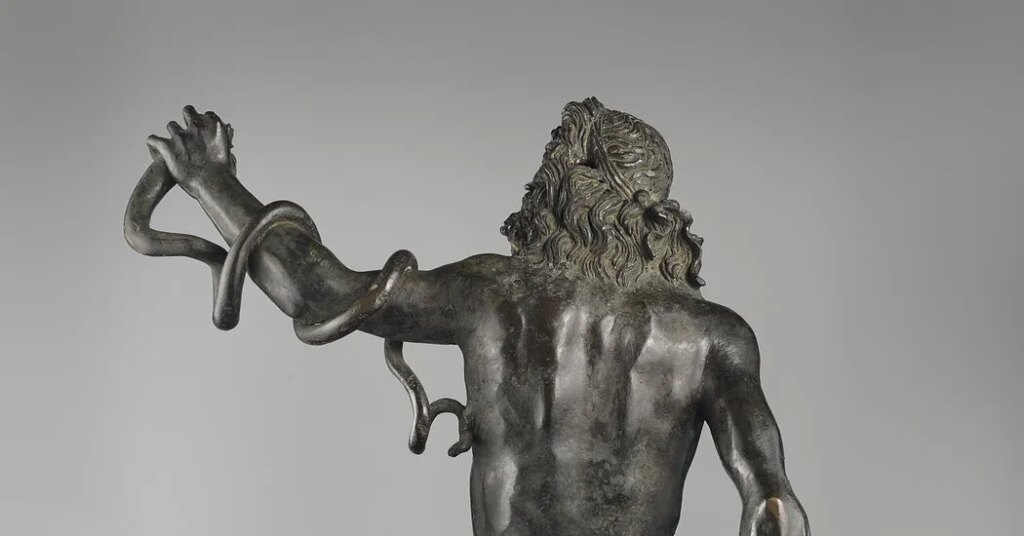
We should bring the same fascination to “Siena: The Art of Bronze, 1450-1500,” at the Frick Collection. It includes a naked Hercules, cast by the Renaissance sculptor Giovanni di Stefano in 1489, whose rear is as beautiful as any sculpted since. Walk around Giovanni’s “David and Goliath” or a Hercules by his contemporary Francesco di Giorgio, and you’ll see more gluteal grace.
It’s not the beauty of those behinds that ought to impress us, but their simple presence. They had hardly been seen in European statues since the fall of Rome. In the 15th century, making a sculpture that invited you to view a figure, especially a naked one, from front and back was profoundly strange. We don’t usually think of our backs as expressive, compared with the faces we use to smile or the chests we beat. To send a clear human message, earlier Italian art had always been frontal.
The Frick exhibition helps solve the riddle of why its statues displayed their far sides.
Its first room lays out how bronze — copper alloyed with metals like tin and lead — was especially treasured in Renaissance Italy, because it was especially useful. There’s a big church bell here that’s almost a twin to the one by Francesco di Giorgio still ringing in Siena. The same room displays the pair of thick ledgers that tracked a five-year contract to build two bronze cannons, dangerously lacking from Siena’s defenses.
Bronze was so vital, it was rarely used for artistic ends. Giulio Dalvit, curator of sculpture at the Frick, said that the exhibition’s five free-standing figures, two tomb monuments, 11 cast reliefs and eight commemorative medals represent a large portion of bronze artworks from 15th-century Siena. To justify their existence, those objects, whether sacred or secular, had to make up for the functions their bronze wasn’t serving by delivering some notable surplus value — a surplus we today would call “art.”
A new kind of statue that had no traditional function — no role in religion or commemoration — could assert its worth by giving equal weight to front and backside. That let it echo the era’s newly excavated Roman statues that had also been conceived “in the round,” and that had lost any cultural purpose they might once have had, other than to please.
Those functionless ancient works gave Sienese artists license to explore a new, purely artistic excellence. Giovanni di Stefano’s “Hercules” riffed on the second-century “Apollo Belvedere,” just then unearthed, and aimed to be just as pointlessly splendid.
Bronze casting itself came with a classical pedigree. The Roman author Pliny described it as almost divine, and as a source of lasting fame; Siena’s bronzes showed off the ancient craft they’d revived.
It’s easy for us to see sculpting in stone as straightforward; Michelangelo just had to chisel away whatever wasn’t the David, as the old joke goes. It’s harder to ignore the challenges of working in molten metal, with its many stages of modeling, mold making, casting, chasing and polishing.
Those challenges, overcome, are trumpeted at the Frick in a relief plaque of Christ’s resurrection by the artist Vecchietta. Its technique ranges from scratches that capture angelic feathers to a Risen Christ in such high relief that he’s almost upon us. Soldiers asleep at his feet have limbs so deeply undercut, it’s a marvel they could slip from their mold.
Francesco di Giorgio was Vecchietta’s pupil, and he does his master one better in a relief of “St. Jerome in the Wilderness” that could be a step-by-step illustration of the bronze caster’s art. Some areas stay rough, as though fresh from the foundry’s mold, while others reveal the progressive smoothing of those first “thoughts” as a cast moves toward its final state. This piece is not just “a bronze”; it’s about the bronze it’s made from, and how it can be made to speak. (Not incidentally, that metal could be sourced from mines owned by Sienese nobles.)
The overflowing detail in Francesco’s “wilderness” — lizard, tortoise, scorpion, snake, deer, storks, cranes and Jerome’s lion — seems addressed to the eyes and tastes of art connoisseurs, and to the time they have for close looking. It’s no accident that, if the relief could once have spent time in a chapel, before long it was hanging with a collector’s fine paintings.
Like its mates in the Frick’s exhibition, Francesco’s bronze shows off the surplus — of meaning, of craft and yes, sometimes of flesh — that’s peculiar to art.
Siena: The Art of Bronze, 1450-1500
Through Jan. 18, 2027, the Frick Collection, 1 East 70th Street, Manhattan; 212-288-0700, frick.org.
The post Siena and the Art of What Lies Behind appeared first on New York Times.