When I was growing up in the suburbs of Denver, my family and I took a lot of road trips: quick weekenders into the Rocky Mountains; longer jaunts to Durango, Colo., or the Great Sand Dunes; multiday journeys to southern Oregon and back.
Those drives allowed lots of time to observe the wide-open scenery and roadside attractions — and, punctuating those long stretches of freeway, the motels.
Late last year, on the hunt for a story, I was surprised to find a widely agreed upon date when the first motel opened in the United States: Dec. 12, 1925. That was when the Milestone Mo-Tel in San Luis Obispo, Calif., turned its lights on, beckoning drivers traveling from San Francisco to Los Angeles and in between to stop and stay the night.
Over the last 100 years, motels have grown and evolved, changing our landscape and our collective consciousness. They have not only opened up travel to the masses, they have shaped our culture — from the birth of the road trip to the growth of the civil rights movement to the chainification of America. It’s a phenomenon I recently explored in a timeline for The New York Times, focused on motels’ place in our national story. And the more I researched, the more I realized that motels have also traced many of the stories of my own life.
When we were kids, my brother and I would press our faces to the glass as we crossed southern Wyoming or northern Utah, searching for the ubiquitous billboards for a roadside oasis called Little America. Route I-80 is long and lonely, so when the first of these signs came into view, it kicked off a miles-long game of “I Spy” as the two of us looked for the next billboard touting a Little America wonder: the soft pillows; the sweet, cold, freshly swirled soft serve; the endless blue pool.
We never made it to Little America (a hotel, technically) — the location wasn’t right for a stopping point — but we did make it to many other roadside stops. I still remember how my brother and I giggled when we first discovered a Magic Fingers in a motel in Rockaway Beach, Ore., and the delight we took in feeding quarters into the coin box, waiting a moment, then feeling the bed start to shake.
As I got older, motels went from a novelty to a place of comfort. When I was in Micronesia as a Peace Corps volunteer, fresh out of college and more than 6,000 miles from my familiar Rocky Mountains, the local motel, the Pacific Treelodge Resort, became a home away from home. Volunteers lived with host families in their homes, but Treelodge was where we did our language training, and where we spent quiet afternoons, evening happy hours, Halloweens, Thanksgivings and New Year’s Eves.
Thinking back on all of my motel memories, I realize why researching and writing the timeline took months. How could I possibly synthesize so many years of my own experiences, not to mention 100 years of everyone else’s?
I started the whole process at the reference desk of my local public library, a load of books under my arm. When I told the librarian I was writing about motels, his eyes lit up, and he started reminiscing about the old Motel 6 ads.
“Do you remember them?” he asked. “‘I’m Tom Bodett for Motel 6, and we’ll leave the light on for you.’”
And though I had many motel tales of my own — not to mention months of the pandemic spent bingeing “Schitt’s Creek” — every interview surfaced new insights. I heard a story of how, after World War II ended, people were full of pent-up hunger for the open road after years of gas rationing. One author I interviewed talked about how, in the early days of the Green Book, most Black travelers stayed not in motels, but in the homes of welcoming locals. “We were Airbnb before Airbnb,” he explained.
I learned the back story of the “no-tell motel,” how early motels that were friendly to sex workers and trysting lovers became known as “hot-pillow joints,” and how J. Edgar Hoover had written that roadside tourist camps (the progenitor of motels) were “camps of crime.” It all put the Magic Fingers — which my brother and I had found so innocuously delightful — into a completely different light.
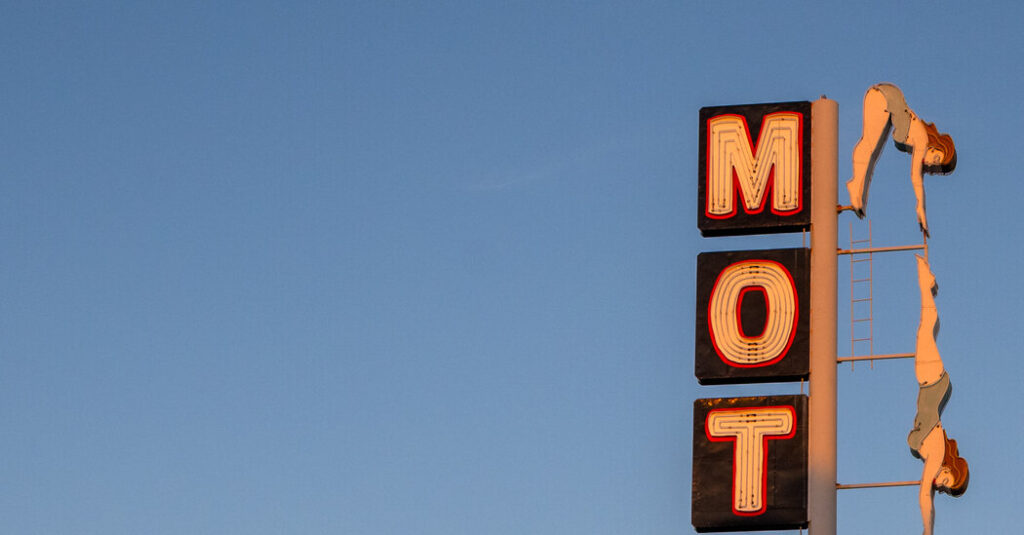
Our designers brought the story together online with an eye-catching neon sign at the top, featuring a diving woman making a splash alongside bright letters spelling out the word “MOTEL.” The woman dove nightly on the sign for the Starlite Motel in Mesa, Ariz., and our photo editor sent a videographer to capture her in motion.
Recently, I was walking through Manhattan’s Lower East Side, the day the timeline ran in print, when I did a double take. Just above a bar along Avenue A shone a neon sign of a diving woman, with the same color hair and swimsuit as the diver in Arizona. The bar’s name? Motel No Tell.
Even here, in the concrete canyons of New York City, many miles from the open roads of the West, motels were ever-present — not just on my mind, but all around me still.
The post A Milestone for the American Motel appeared first on New York Times.