These days, it seems Americans can hardly go outside without walking into a festival, from small-town celebrations of pickles or mariachi to high-ticket destination events like Burning Man.
But for festival aficionados, there was one big absence on the 2026 calendar. The Smithsonian Institution announced in February that its annual Folklife Festival would not take its usual spot on the National Mall in Washington around the Fourth of July. Instead, the country’s symbolic front lawn would be occupied by President Trump’s Great American State Fair.
For decades, the festival stood as a testament to faith in the breadth and diversity of American culture. Founded in 1967, it was the place to see musicians, dancers, cooks and artisans from every part of the country, while taking in sites like a recreated New Jersey boardwalk, a New Mexico-style adobe plaza, a 130-foot Texas oil rig and even a piece of glacier imported from Alaska.
For the 1976 Bicentennial, the event lasted all summer and drew roughly 4.5 million visitors and 5,000 participants, from Navajo weavers and Irish fiddlers to baseball-bat turners and singing truck drivers.
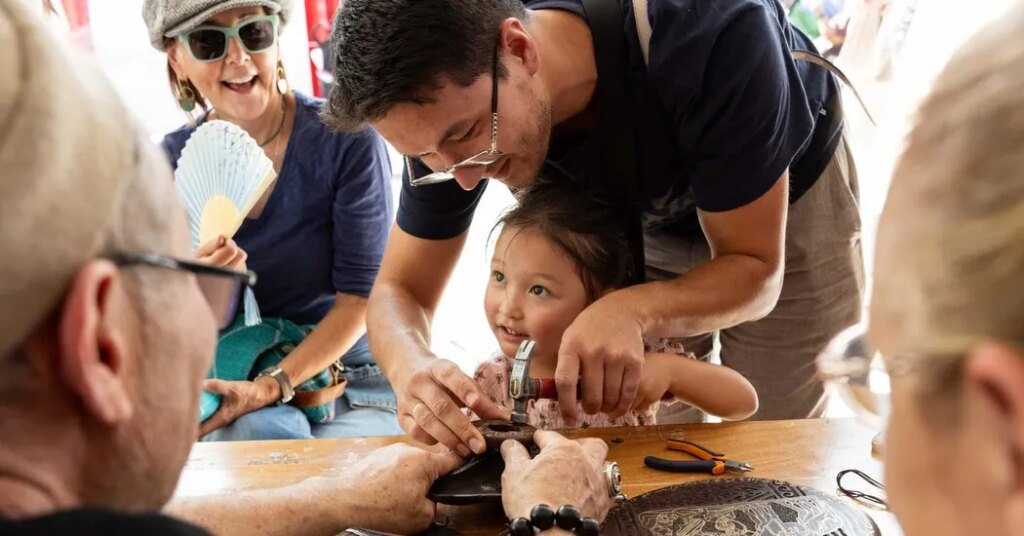
This year, instead of sitting out the country’s 250th birthday, the Smithsonian took the show on the road, partnering with 34 large and small festivals around the country on a nine-month rolling party called “Of the People: The Smithsonian Festival of Festivals.”
Clifford Murphy, the director of the Smithsonian Center for Folklife and Cultural Heritage, which runs the festival, called it a “democratizing experience” — one that added up to more than just making lemons into lemonade.
“Every year, we present a festival about place, out of place,” he said in a video interview this week. “This year, we’ve had an opportunity to collaborate with festivals in the spaces where they live.”
Murphy, a musicologist by training, had just returned from Tucson Meet Yourself, an annual gathering founded in 1974 in Arizona, where he ate a lot of Chinese chorizo, a style of Mexican sausage made by Chinese grocers who arrived in the late 19th and early 20th centuries. (Yes, it also has its own festival.) This weekend, he’ll be at the Talbotton Blues Festival, a one-day acoustic event held annually since 2021 in a restored church in Talbotton, Ga.
“Doing this work in 2026 has been like an extended family reunion,” he said. “The vibrancy of our cultural democracy is incredible.”
Here are excerpts from the conversation, which have been lightly edited and condensed.
The folklife festival was founded in 1967, as a way of taking culture out of “the nation’s attic” (as the Smithsonian is nicknamed) and into the open air. What is the festival’s, and the folklife center’s, mission today?
We are the people who engage with living culture in the United States and around the world. We work to promote the understanding that all people and communities are endowed with culture. How do we share it? How do we understand each other? We are a research organization. In our partnerships this year, we wanted to ask the question: Why do we gather?
In 1967, almost everybody whose job it was to pay attention to cultural heritage in the United States could fit in one room. Cultural festivals, as we think of them today, largely didn’t exist. Our first festival included a symposium, and one of the questions asked was: Does the United States have its own cultural traditions? In 2026, it’s incredible to even think of that question being asked.
For many people, “folklife” conjures up banjos and wood-carving and other old-timey things. What about newer things? Does the festival now include cultural forms that weren’t necessarily seen as “traditions” when it began?
We have a skateboarding festival we’re working with next month. [Exposure, dedicated to women’s skateboarding, takes place Nov. 6-8, in Encinitas, Calif.] We’ve always engaged with traditions that have been around for generations, and those that are emergent. Skateboarding always looks like it is of the moment, culturally speaking. But when you talk to people what you find is it’s an oral tradition. It’s all people who learned from a person who learned from a person.
Were you disappointed that this year’s festival could not be held on the Mall as originally planned?
I’m going to answer this way: It has been a lot, and it has been a gift. It has been an incredible experience visiting so many different communities, so many different cultural festivals of scale and size, in different cultural spaces, different geographies, different climates. The vibrancy of our cultural democracy is incredible.
The Smithsonian is in a standoff with the Trump administration, which has accused it of promoting narratives that “portray American and Western values as inherently harmful and oppressive.” Has that conflict affected the folklife center?
I can’t comment on that. But what I have found is that going to different communities around the country has been a great democratizing experience. People have expressed surprise and pride that Smithsonian is doing work in their community.
You personally attended more than a dozen partner festivals, including well-known ones like Farm Aid. What did you learn from some of the smaller festivals you visited?
I was at the August Quarterly Festival in Wilmington, Del. It was started in 1814 by the Union Church of Africans, the first independent Black church in the United States. It takes place in Tubman-Garrett Park, which is named for Harriet Tubman, who used to go to this festival to try to recruit people to go north. The church [now Mother African Union Church] burned down in May. But at no point did they say, “We don’t think we’re going to do the festival.” There’s a resiliency to the community that I believe gathering on a regular basis has helped to develop.
In June, I was at the Dawnland Festival of Arts and Ideas in Bar Harbor, Maine, which is dedicated to Wabanaki culture. [The festival, hosted by the Abbe Museum, began in 2024.] The first ethnographic field recordings ever made, in 1890, were of the Passamaquoddy, who are part of the Wabanaki federation. Since the 1980s, the tribe has been working with those wax cylinders to reanimate their language and music traditions.
So, what were Americans looking for when they gathered in this big, contested birthday year?
I met a lot of people who reflected on the sense that there is a lot of division in our society, and were upset about that. But they were also choosing to be in spaces with people who look and sing and dance differently from them.
I was also struck by how young we are as a country. At the ROMP Bluegrass Festival in Owensboro, Ky., I was talking to Ronnie McCoury, the son of Del McCoury. He’s in his late 50s. He said to me, “I’ve met or have seen in concert almost every member of the Bluegrass Hall of Fame.” To me, that really shrinks the passage of time.
Will the festival be back on the Mall in 2027, for the country’s 251st birthday?
The future has us being both in Washington and in different locations around the country. Stay tuned.
The post Ousted From D.C., Smithsonian Folklife Festival Finds Its Roots on the Road appeared first on New York Times.