It’s a bird. It’s a plane. No, wait — it’s just more space junk. And it may fall to Earth without warning, as people in two spots across the globe from each other were just reminded.
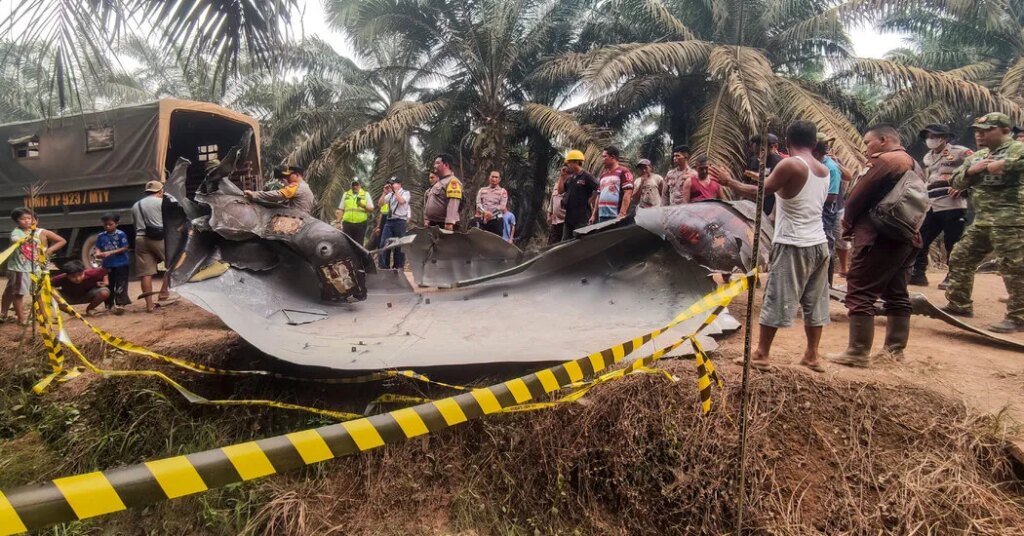
The authorities in Indonesia are investigating what they say is space debris found on Monday in Indonesian Borneo at a palm oil plantation. Just days earlier, a sheriff’s office in Minnesota reported that state and federal agencies in the United States were examining what is “presumably a space object” found in a cornfield.
Most space debris re-entering the atmosphere falls into oceans, and the fallen objects found over the past week did not cause injuries, according to the authorities who reported them. Still, they offer more evidence that a serious incident may be practically inevitable, given the international space race and the boom in launches, experts say.
A European Space Agency assessment, published last month and based on 2025 data, found that there is a “growing casualty risk on the ground” from fragments re-entering the atmosphere.
Indonesians are no strangers to the issue. They have documented about three cases of space debris landing in their country in about five years, including this week’s incident.
Thomas Djamaluddin, a senior space science researcher at the Indonesian National Research and Innovation Agency, wrote in a post on social media on Monday that workers at the palm oil plantation, in the Sampit area of Borneo had discovered very large torn pieces of metal that morning. Accompanying his post were photos showing the objects, each about the size of a car.
The discovery followed reports of a very loud boom the evening before, the researcher said, and orbital data showed that remains of a rocket had passed directly over the region. “The object’s orbital path took it over Sampit, consistent with the reports from residents,” Mr. Djamaluddin wrote. “It turned out that this was its final orbital trajectory.”
The Astronomical Society of Brunei Darussalam in the sultanate of Brunei on Borneo — an island shared with Indonesia and Malaysia — said Sunday that eyewitnesses had spotted a blazing fireball streaking across the sky. It passed the information on to the International Astronomy Center in the United Arab Emirates, which monitors satellite re-entries.
The Emirati center said Sunday that it had conducted an analysis after receiving reports from Brunei. Based on astronomical calculations and a review of spacecraft data, it said, it concluded that “the phenomenon was associated with the entry of relatively large rocket debris into Earth’s atmosphere.”
The center identified the debris as part of a rocket produced by the private Chinese space company Landspace, which was launched on Oct. 14 from China. Landspace did not respond to a request for comment.
News of the fallen debris in Southeast Asia came shortly after the Stevens County Sheriff’s Office in Minnesota announced on Thursday that the previous day, it had received “a phone call of foreign debris that was found in a cornfield.”
Deputies went to the scene, according to the post, and confirmed that a large metallic object, about 11-feet in diameter and “presumably a space object,” was in the field. The sheriff’s office said that there was no danger to the public and that it was working closely with state and federal agencies “to identify and notify the owner of the debris and to plan for removal from the field.”
The sheriff’s office did not respond to multiple requests for comment via phone or email on Tuesday, and on Wednesday it directed queries to the U.S. State Department. The State Department did not immediately respond to a request for comment.
Though the object that fell in the Minnesota cornfield has not been conclusively identified, its discovery may solve a mystery about streaking fireballs that were reported over Kansas and Minnesota on social media the month before.
Such incidents are increasingly common, and likely to become more so. Last year, rocket fragments landed near a busy shopping mall, as well as near an airport, in Poland. In 2024, space debris crashed down on a home in Florida. Months later, a village in Kenya became the site of a space junk fall.
“Space activities continue to grow at a remarkable pace,” the European Space Agency said in its report last month, noting that in 2025, more than 300 launches took place with over 4,000 new payloads put into orbit.
The agency said that there were more than three re-entries every day on average. Controlled re-entries of rocket bodies outnumbered uncontrolled ones last year for the second time, it said, “demonstrating progress in responsible space operations.”
But there is nevertheless an increased risk, the report said.
“While the probability of a casualty remains low compared with many everyday risks,” it said, “the upward trend reflects the cumulative effect of more launches, more satellites and more re-entries.”
The post Space Debris Found Twice Within Days Amid ‘Growing Casualty Risk’ appeared first on New York Times.