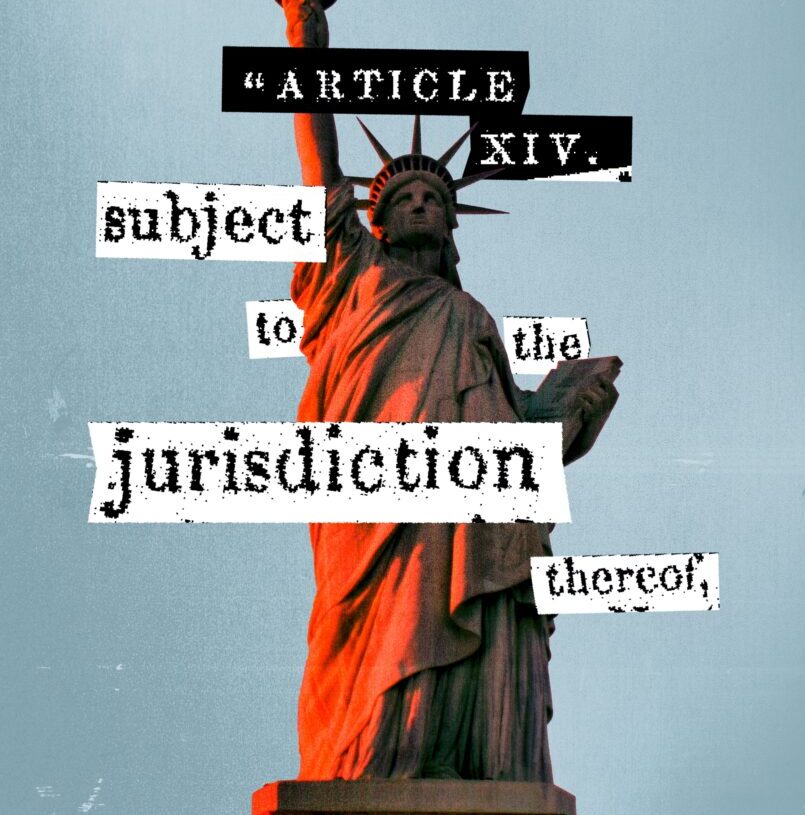
Through the magic of the law, all the passion of immigration politics is about to come to bear on the phrase “subject to the jurisdiction thereof.”
That’s because on the first day of his second term, President Donald Trump issued an executive order aiming to deny citizenship to any children born in the United States to illegal immigrants. The Supreme Court has just agreed to hear a case challenging that order, and the legal dispute turns on the meaning of those five words.
The 14th Amendment, ratified in 1868, says that “all persons born” in the U.S. and subject to its jurisdiction are citizens. That has generally been taken to include illegal immigrants’ children: American courts can prosecute them and American police often protect them from crime. On this view, the exceptions — the reason the contested “jurisdiction” phrase is there — were Native Americans on tribal lands (Congress later made them citizens) and the children of diplomats and of invading soldiers.
The contrary theory, advanced in a bill sponsored by several Republican senators, led by Tom Cotton of Arkansas, holds that the phrase grants birthright citizenship only to the children of people who have “allegiance and obedience” to our government — which illegal immigrants don’t have. Supporters of this theory say the people who drafted and ratified the 14th Amendment were trying to ensure citizenship for Black Americans, not the children of illegal immigrants.
They are surely correct about that. Nobody was thinking about illegal immigrants at the time, when the U.S. didn’t have immigration restrictions. They’re right, too, that the Supreme Court has never issued a ruling directly affirming birthright citizenship for illegal immigrants. And they also have a point when they say the policy has some serious costs. It creates an incentive for unlawfully coming to the U.S. and then impedes deportation.
The president and his allies are, however, wrong about the Constitution. The meaning of a law is, in the first place, not limited to what its authors mainly had in mind. The equal protection clause, also in the 14th Amendment, was motivated principally to ensure that state governments protected ex-slaves. Because it was written in general language, though, it extends to other groups and it doesn’t apply only to racial discrimination.
“Subject to the jurisdiction thereof” is a legal term of art that requires some historical research to unpack. Cotton’s theory that it required “allegiance and obedience” is based on an English case from 1608. But that case affirmed that even if a foreigner were in England only temporarily, he would have a duty of obedience while he was there — and any child he had there would be “a natural born subject” of the king.
In 1854, Secretary of State William Marcy wrote that birthright citizenship “is presumed” except for children born in “foreign legations.” The Supreme Court disturbed that understanding when, in the 1857 Dred Scott case, it excluded all Black people too. But the 14th Amendment restored the earlier understanding, and by 1871 Secretary of State Hamilton Fish was writing that the five words now in dispute were “probably intended to exclude the children of foreign ministers.”
Political scientist Matthew J. Franck points out a powerfully suggestive absence in the historical record: There’s no law in U.S. history that created a naturalization process for the U.S.-born children of immigrants. It was assumed that they were already citizens because they were born here.
Trump’s executive order raises another issue: If the children of illegal immigrants aren’t citizens, what about the children of legal immigrants? The order already blurs that distinction, going beyond the Cotton bill by excluding from citizenship any children born in the U.S. to people here on temporary visas.
The good news is that while applying birthright citizenship to the children of illegal immigrants hinders the enforcement of immigration laws, the problem can be overcome. The country has had periods of low illegal immigration — low legal immigration, too, for that matter — while following this policy. The Trump administration is shrinking the illegal population today, and thus reducing the number of illegal immigrants’ children who automatically become citizens tomorrow, all while birthright citizenship remains in effect. And there are more steps the government could take to control immigration, such as making large employers verify the legal status of new hires.
We don’t have to change or distort the Constitution to have a tighter immigration policy, and we shouldn’t.
The post These five words will soon to be driving immigration discussion appeared first on Washington Post.