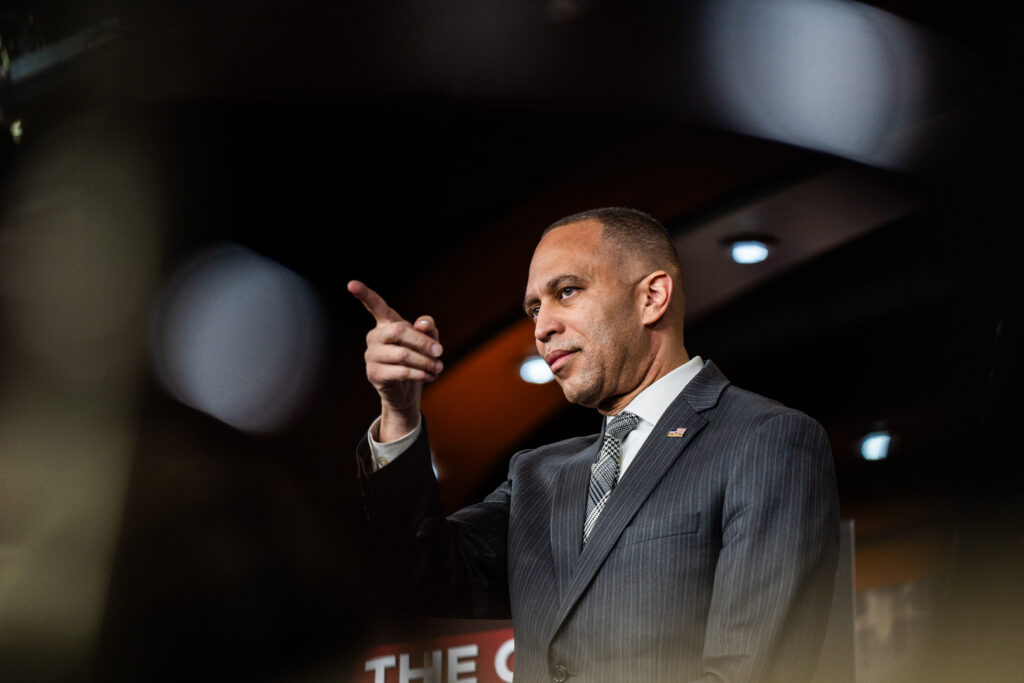
If Democrats retake the House in November, Hakeem Jeffries is all but certain to become speaker in January — the first Black American to hold the post.
Yet the question facing the 56-year-old New York lawmaker is not whether he can make history, but how he would lead — specifically, whether the consensus-building style that helped him rise through the ranks to minority leader can hold together what is expected to be an increasingly restive and ideologically diverse Democratic caucus.
Jeffries is a highly focused strategist and approachable leader who seeks to persuade through discussion, according to more than two dozen lawmakers, people close to Jeffries and others who have worked with him. Colleagues also say he can be cautious and deliberative — to a fault, at times.
“Hakeem works hard to make everyone feel listened to and to try to understand where they’re coming from,” Rep. Debbie Dingell (D-Michigan) said. “As he moves into this job, he’s going to have to be tougher — and he will be.”
His allies say he already has been when it mattered: by keeping a divided caucus’s message focused on health care during the 2025 government shutdown and pushing Democrats to answer the GOP redistricting push that began in Texas with redrawn maps in Democratic-led states. Jeffries wanted “maximum warfare.” The effort yielded mixed results.
But the job ahead would be different. The party’s last speaker, Rep. Nancy Pelosi (D-California), ruled through a mix of fear and finesse. Speaker Mike Johnson (R-Louisiana) has leaned on President Donald Trump to wrangle his narrow, unruly majority. Governing with an iron fist is not Jeffries’s style, colleagues say, and his adversarial relationship with Trump could complicate any Democratic agenda over the next two years.
The success of a Jeffries speakership would depend on how he manages what could be a fragile majority, including a cadre of new lawmakers whose politics are more liberal than his and whose loyalty he has yet to earn.
Jeffries declined to be interviewed for this story; a spokesperson said he thinks it’s premature to talk about a speakership. Some Democrats have warned against being too optimistic, suggesting pickups on Election Day could fall short of what polling suggests. Democrats need to net only three House seats to win the majority.
Shaped by Brooklyn
The son of a social worker and substance-abuse counselor, Jeffries was born in 1970 and raised in Crown Heights, Brooklyn, during the advent of hip-hop and the throes of the crack cocaine crisis. Artists like Run-DMC, LL Cool J and KRS-One were on repeat. Jeffries’s representative was Shirley Chisholm, the first Black woman elected to Congress.
The district Jeffries now represents, one of the most diverse in the country, resembles a claw extending from Brooklyn’s eastern flank down to its southernmost tip, and over into the borough’s Bedford-Stuyvesant neighborhood — home to Jeffries’s longtime church, Cornerstone Baptist.
When he was a child at services, Jeffries has recalled, his mother insisted he recite his lines from memory in the annual Easter and Christmas pageants instead of reading off a sheet of paper. His grandmother would reward Jeffries and his brother, Hasan, with $500 at their graduations, up through the advanced degrees she encouraged them to pursue.
In the Jeffries household — and a world in which Black leadership was still underrepresented and underestimated — there was little room for error.
When he got to college, Jeffries’s friends noticed an intensity in the freshman who showed up to study political science at Binghamton University, a nearly four-hour drive upstate. His fraternity brothers elected him president when he was a sophomore.
“He didn’t present like the typical freshman because he just had this very serious part about him,” said Joseph Cordero, one of Jeffries’s brothers in Kappa Alpha Psi. The older students wanted a leader who would maintain the chapter’s culture, traditions and standard of conduct. They saw that promise, Cordero said, in Hakeem.
Jeffries managed the chapter’s fashion show, sporting a white suit with a red bow tie and cummerbund — fraternity colors — and joined the step team, Cordero said.
At Binghamton, Jeffries also met the woman who would become his wife, Cordero said. Kennisandra Arciniegas-Jeffries became a social worker, like Jeffries’s mom, and the couple too would have two sons. Jeffries is guarded about his family, whose photos are not featured on his website.
After graduating, Jeffries earned a master’s in public policy at Georgetown University and then attended NYU Law School. The dean who introduced Jeffries, as he stepped up to deliver the student address at the 1997 commencement, predicted he might one day join Congress, like Rep. Diana DeGette (D-Colorado), another speaker that day.
Three years later, Theodore Wells — a partner at Paul Weiss, the white-shoe law firm where Jeffries was an associate — would take him aside to tell him he had the potential to become a partner at the firm. But what Jeffries wanted, he replied to his mentor, was to go into public service. And he had his eye on a seat in the New York State Assembly, representing the area where he grew up.
Jeffries first ran that same year, in 2000. It would take three campaigns before he won office in 2006.
On the rise at a time of ‘firsts’
By 2008, a woman had been elected speaker of the House and a Black man had been elected president. By 2012, people were comparing Jeffries to Barack Obama, who was running for a second term as president as Jeffries was running for a seat in the U.S. House.
Rep. James E. Clyburn (D-South Carolina) was the highest-ranking Black member of Congress in history at that point, the first to serve as Democratic whip. He was heading to Manhattan for meetings in 2012 when a longtime mentee asked if he had met Jeffries, the young congressman-to-be. He had not. Dinner was arranged.
“I saw that I could identify easily with him, his experience,” Clyburn said. Both men had lost several times before finally breaking into the political establishment.
In addition to his role in Democratic leadership, Clyburn was also an influential member of the Congressional Black Caucus. There, Jeffries found early mentorship and opportunity.
Along with Rep. Steven Horsford (D-Nevada), Jeffries gave weekly speeches on the House floor on the caucus’s priorities. The two freshmen joked that the only people watching them on C-SPAN were their mothers and Rep. Eddie Bernice Johnson (D-Texas), an early Jeffries supporter and mentor of many younger lawmakers in the House.
People began speculating about whether Jeffries might challenge Bill de Blasio for New York mayor. Rumors would circulate for years. Instead, Jeffries continued to climb in the House.
After the 2018 election, when Democrats reclaimed the House majority, Jeffries defeated Rep. Barbara Lee (D-California) to become Democratic caucus chair, the fifth-ranking member in the chamber’s Democratic leadership. Rep. Katherine Clark (D-Massachusetts) was vice chair. Rep. Pete Aguilar, a California Democrat and prominent Congressional Hispanic Caucus member, was also on the rise. The three watched Pelosi, Majority Leader Steny Hoyer (D-Maryland) and Clyburn govern the House, and they started to think about what would come.
Early in summer 2022, Jeffries, Aguilar and Clark met for dinner at a restaurant near the Capitol, Aguilar said. They discussed the future — what it could look like, whether they could step up, whether they were ready. They didn’t know when the current leadership trio would step aside. But they wanted to be prepared.
“It wasn’t adversarial, like ‘Who’s doing what?’” Aguilar said. “It was like, ‘Hey, what if we do this together? What if this all happens at the same time?’”
Weeks later, Jeffries shared some big news with Clyburn: He was going to run to succeed Pelosi as the top House Democrat. Clyburn told Jeffries he should spend his time talking to other people because he was already on board. By November, Jeffries would become the highest-ranking Black American in Congress’s history.
Plotting a path forward for his party
In contentious moments on the House floor, Aguilar said, when the three leaders huddle, Jeffries’s first question is: “What do you think?”
The approach is emblematic of the nearly four years Jeffries has spent leading House Democrats. He is “very consensus-oriented” — more so than any recent speaker, one person close to Jeffries said, speaking on the condition of anonymity to be candid. While Pelosi prided herself on leading the caucus to where she wanted it to go, Jeffries has “a willingness to cautiously wait for consensus.”
At times, that has caused problems.
At a procedural vote this year on the first day back from August recess, Jeffries was blindsided. Two Democrats — without warning — threw in with Republicans to green-light the week’s agenda, forcing their colleagues into some politically fraught votes so they would have an opportunity to vote on other bills important to them.
Some Democrats wanted the rogue members to be punished.
Occasional disobedience occurred under Pelosi. When that happened, members generally understood there would be consequences. Democrats watched their leader closely: How would Jeffries respond?
He deliberated with Clark and Aguilar, and then the trio released a statement. The move was a “significant breach of trust,” they said, requiring a “serious response.”
Two weeks later, the two lawmakers did it again, siding with Republicans to cast the deciding votes for another procedural measure.
“I’ll respond when I respond,” Jeffries told reporters who asked about possible consequences or changes to Democrats’ rules to crack down on insubordination.
He hasn’t yet.
The episode resurfaced a fear among some in the caucus: that their consensus-oriented leader might not crack down when needed.
“The question to be answered about Jeffries is, when we need to pass a bill or kill a bill, and we need those six votes who are straying — how will he approach that?” one House Democrat supportive of Jeffries said, speaking on the condition of anonymity to be candid. “Because he doesn’t have a Donald Trump to call.”
Jeffries faces other concerns, too.
Progressives say he is out of step with the Democratic base on Israel, universal health care and money in politics.
Jeffries is one of the most pro-Israel members of Congress at a time when public support for Israel has plummeted among Democrats. He’s resisted calls from the base to end aid to Israel’s government, has visited Israel several times — including as minority leader — and has long been aligned with the pro-Israel lobbying group AIPAC.
Last summer, radio host Charlamagne Tha God dubbed Jeffries “AIPAC Shakur,” a derisive moniker that still floods the comment sections of Jeffries’s posts online.
This summer, Jeffries upset progressives when he backed away from supporting Medicare-for-all, after repeatedly supporting it before he became leader. And this fall, the internet erupted when the New York Times reported he met with Jared Kushner, Trump’s son-in-law.
Among Jeffries’s other challenges: The oratorical skills his colleagues praise in hearings and floor speeches can translate awkwardly on social media. He often cycles through the same phrases: “Donald Trump’s reckless and costly war of choice in Iran,” “Republicans are running scared,” “We’re going to hold the crooks accountable.”
Jeffries’s allies praise his message discipline as strategic, tailored for a fractured media ecosystem that runs on short clips.
“Give him a chance,” Rep. Jim McGovern (D-Massachusetts) tells people who raise concerns about Jeffries’s unflashy style. “We don’t really need a showman right now. We need effective and competent leadership.”
With donors, Jeffries’s message has been effective. House Majority PAC, which aims to elect Democrats, and its affiliated organization, House Majority Forward reported raising a combined $230 million in the third quarter of 2026, marking their best quarter ever. To date, the two groups have reported raising a combined $514 million for the 2026 cycle.
But even moderates who support Jeffries unequivocally have privately complained that they want clearer guidance and communication from leadership and a heavier hand when members are disloyal.
When Democrats were divided over the government funding bill last year, Pelosi met privately with Jeffries and gave him advice: “Use your power,” she said, according to reporting from CNN at the time. Jeffries can take time to reach a decision, colleagues say, and won’t be rushed. But once he makes up his mind, he shows a deep belief in his own judgment.
Jeffries is a “skillful plotter,” said Rep. Haley Stevens (D-Michigan). “He’s not a bull in the china shop, reacting before the facts have been fully formed or gathered.”
A new style of leadership
Jeffries has built his own road to the speakership.
He laid the groundwork for his rise the old-fashioned way, colleagues say: by building relationships. Through texts, phone calls, strategic alliances within the caucus and early meetings with members working to support his rise, he secured the backing he needed.
“Jeffries fought for it and spent a lot of time and effort trying to build coalitions within the House … to get to the point where, if and when Nancy decided to leave, that he was the only choice,” someone close to him said, speaking on the condition of anonymity to be candid. “And that is basically what happened.”
The question for most Democrats is not whether Jeffries will become speaker — it’s how he would handle the various factions flexing their muscles. Members are already making clear they are wary of the heavy-handed leadership that has become synonymous with Pelosi’s tenure.
“I certainly don’t respond to people twisting my arm,” said Rep. Adam Gray (D-California), one of the leaders of the moderate Blue Dog Coalition. “If anything, my response to people twisting my arm is I buckle down.”
“My hope is that we will learn some of the lessons from 2018 and 2020,” said Rep. Alexandria Ocasio-Cortez (D-New York), by far the most well-known progressive in the House. “A lot of the division and a lot of the icing out is not always the path forward.”
Charged with governing a rowdy caucus, Jeffries’s gamble is that potential rebels might end up being more responsive to his consensus-building approach than to threats from above — that what some have diagnosed as his weakness could be a strength.
“I guess the question is, do you have to replicate [Pelosi] in order to be successful?” asked a person close to both Jeffries and Pelosi. “I’m guessing the answer is no.”
Karen Tumulty and Liz Goodwin contributed to this report.
The post Hakeem Jeffries is poised to make history. His leadership style faces a test. appeared first on Washington Post.