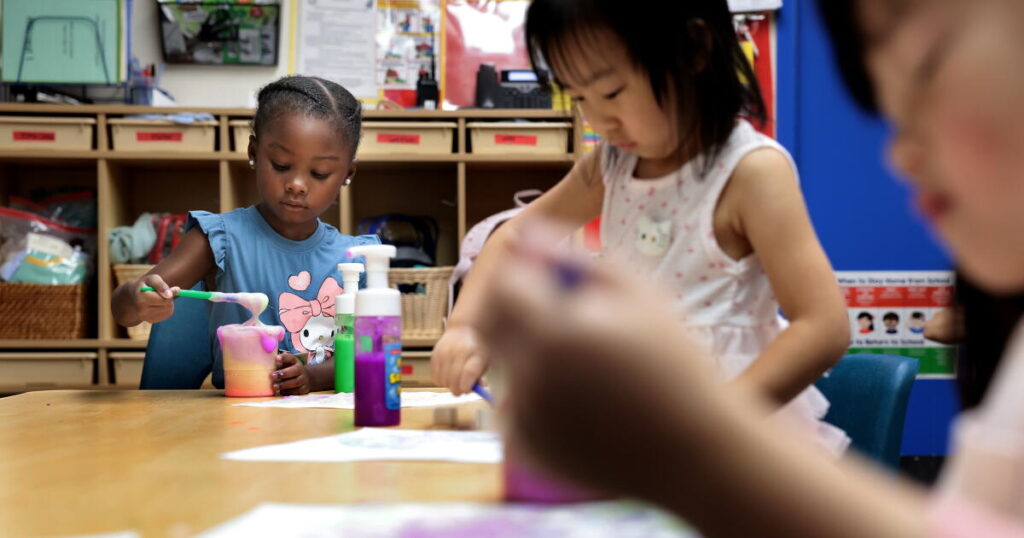
One of the most comprehensive studies of California’s multibillion-dollar investment in early education programs offers evidence that the funding is paying off in academic achievement years later.
Children who enrolled in school under California’s first transitional kindergarten programs, made possible by a 2010 law, scored 11 months ahead in reading and eight months ahead in math by third and fourth grade compared with children born in the same months but in years before the program began, according to a study by UC Berkeley researchers commissioned by Stanford University.
The law, which took effect in 2012, allowed a limited number of children with fall birthdays to attend a full year of school before kindergarten, called transitional kindergarten. At the same time, the law changed when children became eligible for state-funded preschool, allowing more to enroll at age 3. Researchers found that this extra early education helped children perform better years later.
The findings come as California enters its second year of offering free transitional kindergarten, called TK for short, to all 4-year-olds, fully expanding the earlier and smaller program. Just over half of children eligible for the grade level are enrolled in TK, according to 2025 data, falling short of state projections. The state budgeted about $4.1 billion for TK in the 2025-26 school year, alongside an additional $2.8 billion for its state preschool program.
For Rucker Johnson, a professor of public policy at UC Berkeley who is co-author of the study, the promise of such early investments in the state’s youngest children extends far beyond elementary school test scores. It’s chance to help children succeed who might otherwise be limited by circumstances outside their control.
“We call it finding the lost Einsteins,” Rucker said. “There are people who have the capacity, but without the investment, they don’t realize that potential.”
An early opportunity to narrow gaps
For decades, researchers have documented that children from wealthier families tend to perform better in school than their lower-income peers, and those disparities follow them through school.
“Give me your family’s income at kindergarten, and I’ll tell you where you’re going to show up in the test score ranking,” said Austin Land, a Berkeley researcher and co-author of the study. “That’s a tragedy of our society.”
The new study — published by the nonprofit, nonpartisan Learning Policy Institute — indicates that preschool and TK can help close that gap. The study was funded by the William T. Grant Foundation, Heising-Simons Foundation and the Ballmer Group. Heising-Simons and the Ballmer Group are among the philanthropies that in part fund Times education coverage.
Researchers followed 1.6 million children who started kindergarten between 2011 and 2014, comparing the later reading and math scores of children who had access to TK before kindergarten with those who did not.
Researchers then looked specifically at how much of the improvement came from attending TK. For children from low-income families with English-speaking parents, TK alone led to about seven additional months of learning in third-grade reading and math.
Children from wealthier families saw smaller gains from TK, possibly because they already had access to private preschool and other resources.
The overall higher gains in reading and math reflect the how the preschool and TK programs changed by the 2010 law affected children from families of all incomes.
In addition, children from low-income families who attended both preschool and TK and whose parents spoke a language other than English saw gains in fourth-grade math that were roughly five times larger, and gains in reading three times larger, than the estimated benefits for those who did not attend state preschool, the study said.
‘They are ready to learn’
The study crystallized what kindergarten and elementary school teachers are also seeing: High-quality education that starts earlier gives students a better foundation.
In Marylou Escobar’s kindergarten classroom at John Muir Elementary in Glendale, seven of her 20 students attended transitional kindergarten. The other 13 came from a variety of preschool backgrounds.
Escobar, who has spent most of her 41-year teaching career in kindergarten, said she immediately sees the difference.
The children who attended TK already know how to sit on the classroom rug, listen to a lesson and move between activities. They’re familiar with holding a pencil and working independently. Escobar can begin teaching them letters, syllables and how to put words together.
For some of the other children, she’s still teaching the basics of how a classroom works: paying attention for five to 10 minutes, and which way is up and down on a piece of paper. These are skills TK students have already mastered, she said.
“They are ready to learn, whereas the other children are preparing themselves to learn,” Escobar said.
Anna Markowitz, an associate professor of education at UCLA who was not involved in the research, said the findings are striking in a field where some studies have found academic benefits of preschool fade over time.
Even a single month of additional learning would leave researchers “out of your mind excited,” Markowitz said.
Early education is not a “magic balm,” Markowitz said. But the study is “proof of concept” that TK and preschool can contribute to lasting benefits when it works alongside the broader school experience.
Johnson, the study co-author, described the results as a multiplier effect, in which each educational investment — preschool, TK attendance and higher spending at schools — adds value to the next step.
“You might think of this as additive, like two plus two equals four,” he said. “We’re finding like it could be multiplicative.”
What happens next
The findings arrive as California faces the challenge of maintaining quality across its rapidly expanded TK system, including recruiting teachers with the training and experience to work with young children.
“If it’s a whole new grade, it means we have to have a whole teacher workforce risen for the challenge,” Johnson said.
He hopes to eventually follow the students into high school and college to examine whether their early academic advantages translate into higher graduation rates and college readiness.
“I could imagine that the likelihood of going to college increases, and I could also imagine that the quality of college also improves because college readiness is being affected by these investments,” Johnson said.
Those foundations can begin with something as simple as learning to put on a jacket, a common milestone for a preschooler.
What looks like getting ready to go outside requires children to remember several steps, coordinate their movements and keep trying when something goes wrong.
“It’s a multistep process,” Markowitz said. “It involves physical discomfort if you’re getting it wrong, so they’re learning how to move through that.”
Those early skills help children approach more complicated challenges as they grow older, such as learning to read and solving math problems.
“Learning to pay attention, learning to feel excited about trying something new or challenging — that stuff carried forward means everything,” Markowitz said.
This article is part of The Times’ early childhood education initiative, focusing on the learning and development of California children from birth to age 5. For more information about the initiative and its philanthropic funders, go to latimes.com/earlyed.
The post Preschool, transitional kindergarten deliver big: 11 months ahead in reading, 8 in math appeared first on Los Angeles Times.