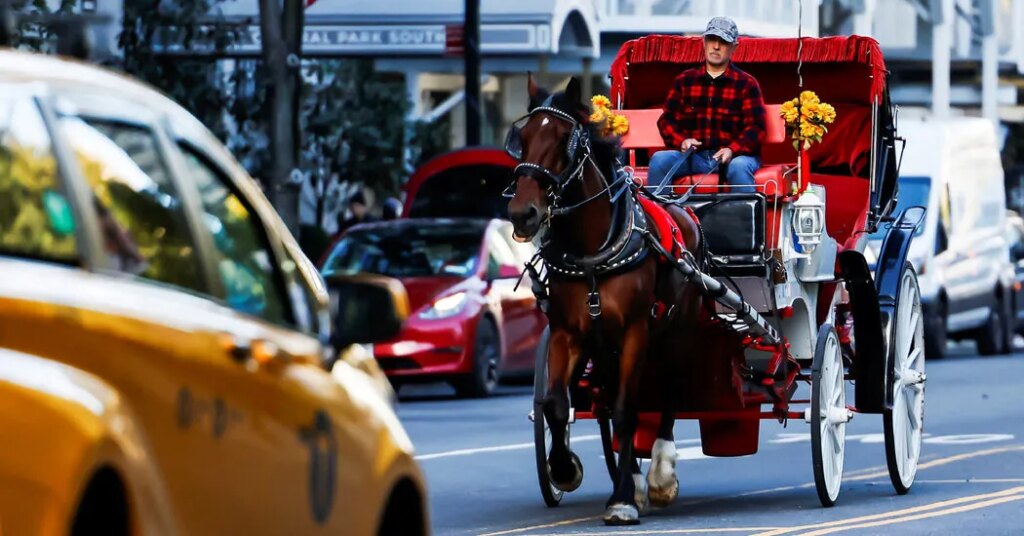
With the New York City Council set to vote on Thursday to banish horse carriages from Central Park, one thing is definite: The end would come in June 2028.
As for what happens to those whose livelihoods are at stake, city leaders say there is plenty of time to figure that out between now and then. Critics of the bill that would impose the ban are not reassured.
On Wednesday, the union that represents the roughly 200 owners, drivers and stablehands who make up the carriage trade threatened on Wednesday to sue the city should the Council pass the bill as expected. Separately, a councilwoman who had supported the legislation said she no longer would because it included only vague plans for those set to lose their jobs.
Nonetheless, with 29 other members of the 51-member Council listed as sponsors, the bill appears virtually assured of passage on Thursday — a victory for animal-rights activists who have waged a long-running campaign to ban the carriages as a form of animal cruelty.
Those efforts, which had previously failed to attract substantial political support, gained momentum this summer when Romanch Mahajan, an 18-year-old tourist from India who was in a carriage with his family, died in a fall when the horse suddenly ran off.
By last week, Julie Menin, the Council speaker, and Mayor Zohran Mamdani had agreed on the legislation.
Transport Workers Union Local 100, which represents carriage owners and workers, argues that the bill’s provisions for addressing the economic fallout, which include creating a “horse- drawn-cab industry transition plan” by next April, amount to empty promises.
John Samuelsen, the T.W.U.’s international president, said on Wednesday that the bill “does not have any protections in it” for his members. He reiterated his belief that Ms. Menin was using a “contrived public safety crisis” to cater to real estate interests eager to develop Manhattan parcels now occupied by horse stables. Ms. Menin has denied that accusation.
In a letter to city officials on Wednesday, lawyers for the union said they had ample grounds to fight the bill in court, including the absence of any provision to compensate those who had spent “many thousands of dollars” to buy carriage medallions from the city. Should the bill pass, the lawyers wrote, the union would seek a court order blocking it “before the ink dries.”
Nicholas Paolucci, a spokesman for the city’s Law Department, said officials were “reviewing the letter.”
“We are confident the legislation is grounded in the law and will be prepared to defend it,” he added.
The councilwoman who withdrew her support for the bill, Joann Ariola of Queens, said in a statement posted online that the ban in its current form did not give adequate “consideration to the hard-working carriage drivers whose livelihoods are at stake.”
“The drivers deserve a meaningful plan, real solutions and a clear path forward before their ability to earn a living is taken away,” Ms. Ariola, a Republican, wrote.
Ms. Menin said on Wednesday that setting the ban’s effective date two years off gave city officials enough time to help drivers and others employed in the industry find new jobs and that she was committed to working with Mr. Mamdani’s administration to achieve that goal.
A spokeswoman for Mr. Mamdani said the administration “has been working on a detailed plan for the transition of the work force and industry, and we have begun discussion of compensation for medallion owners.” She did not respond to a question about whether Mr. Mamdani planned to sign the bill should the Council approve it.
The post With Horse Carriage Ban Set to Pass, Workers’ Future Remains Murky appeared first on New York Times.