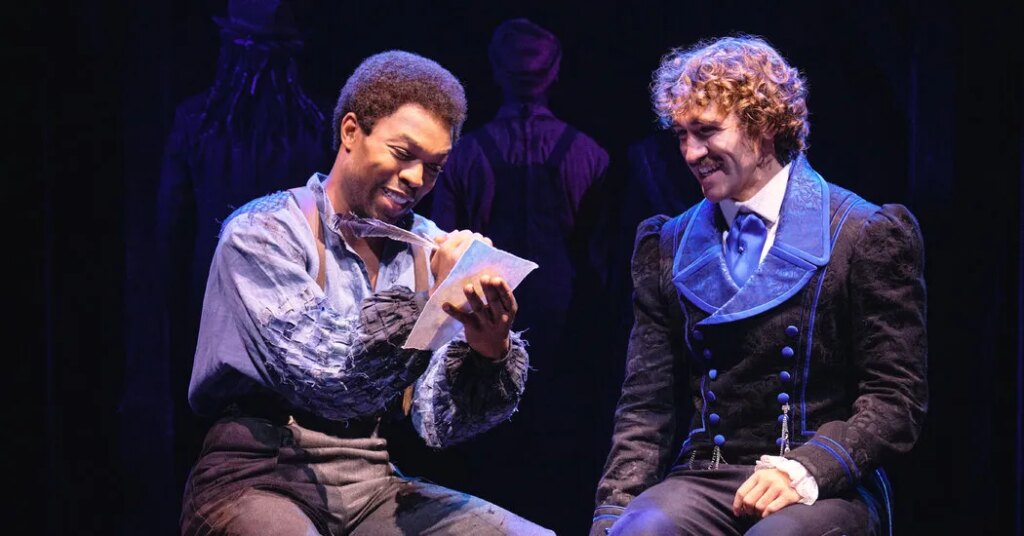
Two curious musical cases have opened in New York this October, two oddly constructed and concept-driven shows. “Midnight” and “The Curious Case of Benjamin Button” are both preoccupied with time and its tragic insistence on running forward — both try, in their way, to correct that. And both falter when they run up against their own internal clocks.
Concepts! Easy to have, hard to hold.
The more compelling is the sprawling “Midnight,” an intermittently gorgeous, often exasperating, utterly overstuffed quasi-opera at the Daryl Roth Theater, written by, directed by, choreographed by and starring Todrick Hall.
Like its polymath creator, “Midnight” wants to do it all. And for almost an hour, “all” seems like a real possibility. Hall was inspired to write the sung-through musical — a queer, transgressive antebellum romance — by his own challenging experiences in an interracial relationship. There are psychosexual currents here that run deep.
The story is set in the South in the 1860s, and Hall plays Rail, a Black man enslaved by a family of white women. While serving drinks in a crowded ballroom one night, he attracts the attention of two wealthy white brothers: the sweet Richard (Jeremy Beloate), who falls hard for Rail’s “pretty eyes,” and the venomous Harry (Jimmy Brewer), who nearly kills him for showing “disrespectness.” (“I don’t think ‘disrespectness’ a word, sir,” Rail murmurs.)
At its core, “Midnight” is a through-the-looking-glass Cinderella story, in which the wildest transformation is Richard’s: from white Southern slaveholder to antiracist fairy-tale prince. Rail and Richard have their trysts at midnight. And in the most beautiful song in the show, “The Dancing One,” Cinderella’s glass slippers are refashioned into Rail’s only pair of shoes, a gift from a friend named Ethel (Ayana George), whose son was lynched. “He look like he still dancin’ when he was found,” Ethel sings, and her anguish makes the walls tremble.
The show contains several moments like this: deadly serious ones, shocking amid the delirious melodrama. “It’s certainly a musical,” I overheard a woman say, doubtfully, at intermission. I think she meant: It’s all the musicals. Or really all the shows? “Midnight” manages to be part Jeremy O. Harris’s “Slave Play,” part Rodgers and Hammerstein’s “Cinderella,” and — judging by Beck Jones’s furbelowed, richly saturated costumes — part Munchkinland from “The Wizard of Oz.”
And just as Dorothy makes her wish to go home, Rail makes his own world-changing wish. “I wish for them to be us,” he sings. And so, during the second act, we see a race-reversed South, with Black overseers abusing white slaves. A piece that was tenuously on the rails, goes off them. People have no memory of the reality before the change, so the cruel behaviors remain the same: Someone pushes a whip into Rail’s hand and tells him to hurt his lover.
Whatever I might think of that narrative kickflip, I was constantly amazed at Hall’s musical capacity; the singing here is stunning across the board. Even after a three-hour-long, increasingly discombobulated show, a post-curtain-call anthem held us in our seats, rapt. Compositionally, Hall is deft at everything from gospel to comic charm numbers. Lyrically, he (too) often borrows Lin-Manuel Miranda’s “Hamilton” method of rat-a-tat rhyming: “Switch up the plot, loosen the knot, it’s worth a shot, with all I’ve got.”
Part of the trouble comes when Hall uses Miranda-esque patter as exposition for the seriously underwritten action. Huge, baffling plot developments are compressed into a single stanza. (A director might have warned him about this, but he’s the director.) The show needs fewer subplots and thus more space to explore its pivotal concept. What would such a supernatural revision do? What could it mean? The Greek-chorus-like narrators assure us that “your disbelief you should suspend.” Hmm.
The discourse about “Midnight” has been loud: Hall has already gone online to address those who have censured the show (some before seeing it). These voices claim that it irresponsibly stages Black trauma for white audiences, making the work damaging or inauthentic. “I’m a proud Black artist, and I think if I’m making art, it’s Black art,” Hall responded in an Instagram video.
For good or ill, Hall is connecting the horror of slavery both to the language of the queer erotic (Rail’s name is Rail) and to the counterfactual fantasia of a Disney theme park. He has also found a way to write an 1860s story that doesn’t force only its Black actors to re-enact the whipping block or to wear ragbag costumes. Here, that burden is shared among the company, and, eventually, it’s top hats and cotillion gowns for everyone.
“Midnight” is morally slippery and audacious. It’s also very messy. Hall, though, has already done so much! If he needs to perfect the piece by taking on just a few more roles — ruthless editor and thoughtful dramaturg, perhaps — I bet he can. There’s still time.
Unfortunately, I don’t think all the time in the world would change “The Curious Case of Benjamin Button” into my kind of show. For one thing, the two hour and 45 minute British production, remade at the Public Theater with a U.S. cast, hits one musical idea — a folksy Celtic reel — and then never veers. This starts out joyfully, but it palls. Man is born as an old guy? Folksy Celtic reel. Man enters World War II? Folksy Celtic reel.
Other artists have taken a crack at F. Scott Fitzgerald’s 1922 short story about a Baltimore man who ages backward, but Jethro Compton, the director and book writer, and his composer-lyricist Darren Clark discard these earlier efforts. In their version, presented as a kind of group storytelling event, Benjamin Button (Andrew Durand) is born in 1918, in a fishing village on the Cornish coast. The spot is conveniently populated with cutesy locals, like a lady who is married to a garden gnome. How quirky! (She, like everyone in Benjamin’s life, is portrayed by a talented instrumentalist, who dances and acts and plays.)
Much of the show operates like over-sanitized children’s theater, though the musical does have two intriguingly adult ideas. The first is that Benjamin is born not just wrinkled but also wise. Hidden away in his father’s attic, baby Benjamin helps his pater fill in his crossword. What other answers might this old-young man know? (Durand, with his patient eyes, indicates some hidden understanding.) The second is the blessing of Benjamin’s death. His mind retreats into playfulness, then a swaddled pre-memory, then into softness, warmth and light. We should all be so lucky.
Unfortunately, there is a lot of strangely inert musical theater between those two moments. Compton sees the story as a romance between Benjamin and a barmaid, Elowen (Kelsee Kimmel), who’s basically the first woman he sees. Yet the vector of Benjamin’s life doesn’t prompt particular insights — not about the 20th century, nor about the human experience, nor about love. The libretto keeps reducing everything of weight, even war, into that same grinning, knees-up, ceilidh cheer.
Appropriately, the best song is reprised at the end; if you enjoyed the show, you can imagine the whole caboodle going around again. “So here’s a toast to makin’ the most, an’ worry not o’ the time we got,” the company sings. I’m not sure that’s the message of the Benjamin Button story, which is about a man who can tell exactly how much time he’s got. But it has the rhythm of encouragement, anyway. And none of us are getting any younger.
Midnight Through Jan. 3 at the Daryl Roth Theater, Manhattan; midnightoffbway.com. Running time: 3 hours.
The Curious Case of Benjamin Button Through Dec. 6 at the Public Theater, Manhattan; publictheater.org. Running time: 2 hours 45 minutes.
The post ‘Midnight’ and ‘Benjamin Button’: New Musicals Preoccupied With Time appeared first on New York Times.