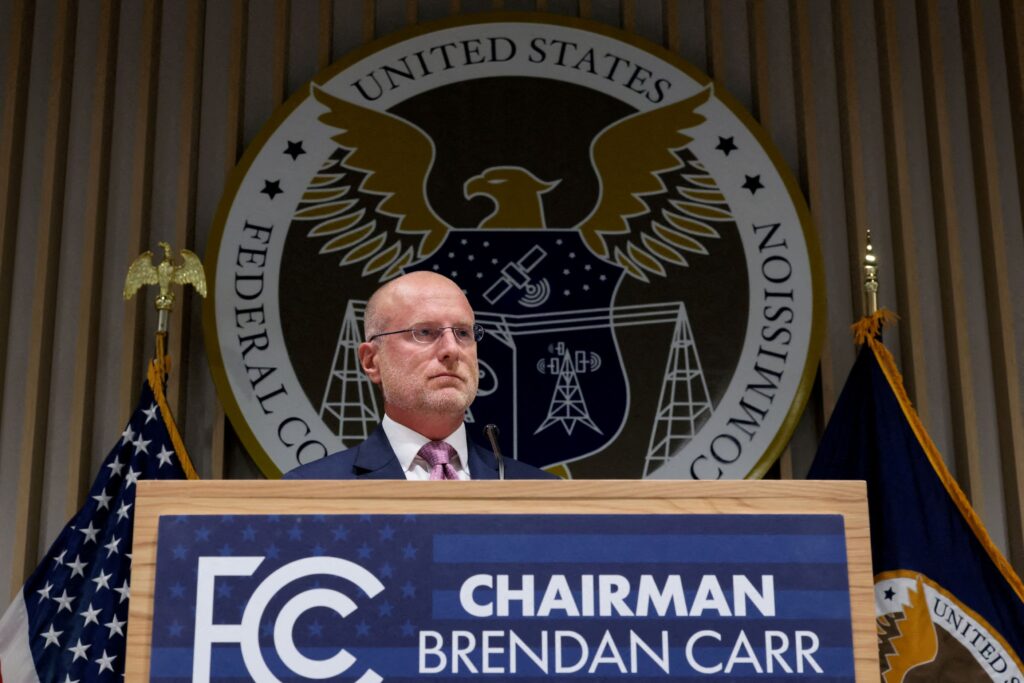
Brendan Carr, the chairman of the Federal Communications Commission, wrote Wednesday on social media that broadcasters need to avoid “amplifying or airing” fake election polls.
“Broadcasters are prohibited by the terms of their federal licenses from engaging in News Distortion or promoting Broadcast Hoaxes,” Carr wrote in a post on X.
Anna M. Gomez, the lone Democrat on the commission, disagreed with Carr’s assertion.
“Pollsters who intentionally mislead the public should answer for it, but broadcasters who report publicly available polling data should never be punished when a poll is wrong,” Gomez wrote on X. “FCC rules on news distortion or hoaxes do not apply to a station that reports this data in good faith.”
Carr’s comments came one day after a group calling itself Wedgewood Polls said in a social media post that it published fabricated polls in midterm election races, claiming that it was an “experiment” to test whether media outlets and aggregators would report on the data.
The group made the admission after FiftyPlusOne, a poll-tracking website, contacted Wedgewood for comment on an investigation into its polling methods. Unlike an incident this summer involving a fake polling firm called Median Strategies, Wedgewood’s polls were included in polling averages by poll-tracking websites. It’s not clear whether any broadcasters regulated by the FCC covered the Wedgewood polls.
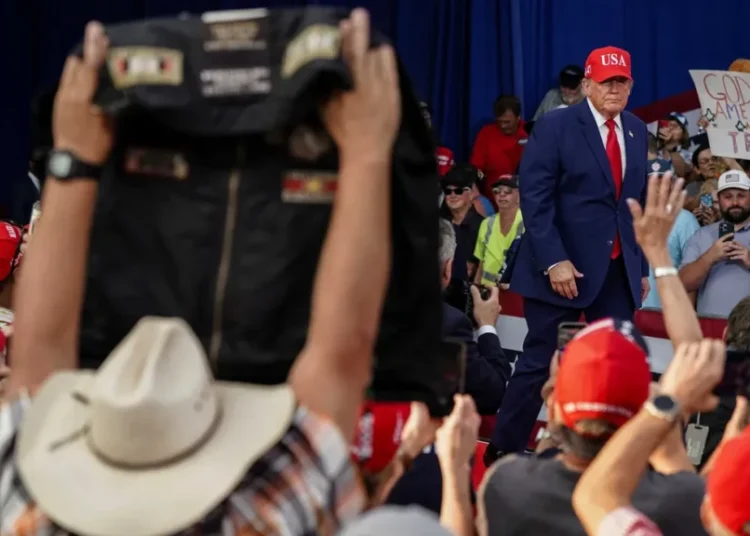
Carr’s warning to broadcasters Wednesday is the latest evidence that he is keeping close watch over the content that major media companies are disseminating through the country’s public broadcast airwaves. Carr has emerged as President Donald Trump’s media enforcer during his second term.
But the commission’s scope is limited: The FCC regulates individual broadcast stations but not TV networks themselves — for example, a local NBC affiliate station as opposed to the national brand NBC News — or cable networks like CNN, Fox News and MS NOW.
Under the chairman’s leadership, however, he has opened numerous investigations into media companies and criticized content that he has deemed a “distortion” of the news, controversially invoking a little-used agency rule. A bipartisan group of former FCC chairs publicly urged Carr to repeal the “news distortion” policy last year.
Since becoming chairman at the outset of Trump’s second term, Carr has sparred most with Disney-owned ABC. He drew condemnation from speech advocates for his criticism of Jimmy Kimmel last year, and he also took issue with the daytime talk show “The View” over its interview bookings with political candidates.
The FCC under Carr initiated an early review of ABC’s eight broadcast licenses — including for stations in New York and Philadelphia — over the network’s diversity practices, though the company has challenged that review in court as illegal.
ABC sued the FCC in August, claiming that the early review was retaliation for speech that the chairman did not like, and said that the commission had violated its free press protections under the First Amendment.
“As a federal judge just said … in rejecting President Trump’s claim against Iowa pollster Ann Selzer, there is no such thing as a ‘fake poll.’ And even if there was, the FCC’s long-dormant news distortion and anti-hoax rules would do nothing to empower the FCC to take action against broadcasters who report on them,” said Enrique Armijo, a law professor at Elon University who specializes in the First Amendment.
A judge in September dismissed Trump’s defamation lawsuit against Selzer and the Des Moines Register. Trump, who sued in his personal capacity, had claimed that a 2024 presidential election poll constituted “fraud.”
Carr, Armijo said, is “attempting once again to intimidate journalists from airing news that his boss does not like.”
Olivier Sylvain, a law professor at Fordham University who specializes in communications law, said Carr’s post is “plainly at odds with the idea of free speech and a free press.”
He also highlighted Trump’s record-low approval numbers as a possible motivation for the post.
“Here, we have the head of an extraordinarily powerful federal media regulator warning against reporting on politically salient data — in this case, polls that indicate how unpopular this administration has become,” he said.
Representatives for Carr did not respond to a request for comment beyond the chairman’s social media posts.
The post FCC’s Brendan Carr warns broadcasters against covering fake polls appeared first on Washington Post.