The White House is using federal disaster relief as leverage while Republicans fight to keep power in Washington, with President Trump saying on one occasion that voting for Democrats could mean less money for states.
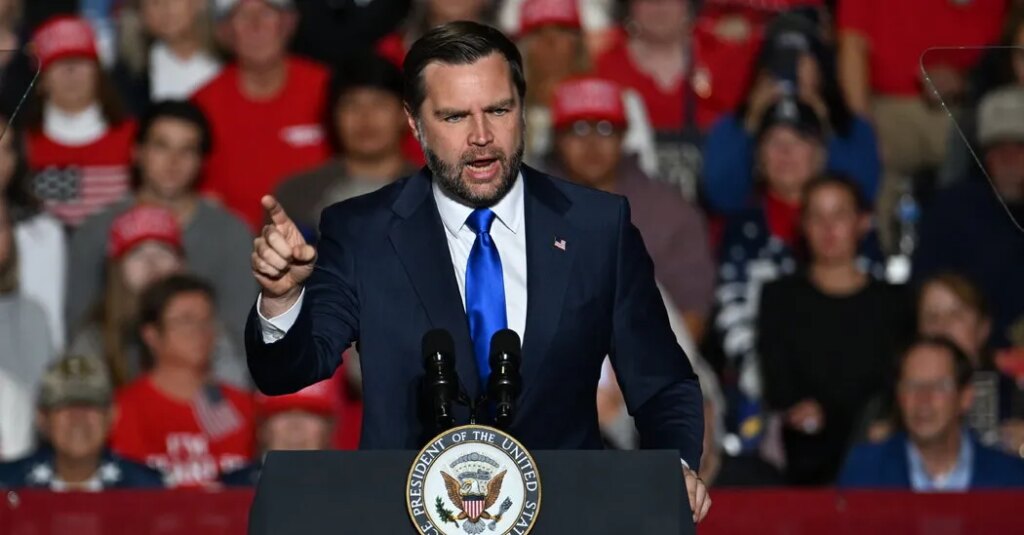
During a Monday visit to western North Carolina communities still struggling to recover from Hurricane Helene two years ago, Vice President JD Vance promised more than $800 million in additional aid for the region.
But weeks earlier, President Trump had said he would withhold aid if Democrat Roy Cooper wins a hotly contested Senate fight in North Carolina.
The president immediately said he was joking, but he has linked disaster assistance there and in other states to his support for Republican candidates. States that tend to vote for Democrats have faced a longer wait for aid and seen their requests rejected more often, according to analyses of federal disaster declarations during Mr. Trump’s second term.
In a speech in Greenville, N.C., Tuesday night, Mr. Trump discussed Hurricane Helene, which he called a “water-cane” because of the volume of rain involved. The president blamed Mr. Cooper, the former governor, for failing to help clean up from Helene’s destruction.
“It was a disaster,” Mr. Trump said. “I’ve never seen anything like it. I’ve been to some bad ones. This was one of the worst. Roy Cooper did nothing. And the only way it got fixed is when I became president on Jan. 20.”
In response, Mr. Cooper’s campaign pointed to executive orders he issued while governor to speed up recovery from Helene. Jordan Monaghan, a campaign spokesman, said hurricane victims “aren’t pawns” and that “hurricane recovery isn’t a joke.”
Experts said the Trump administration is underscoring the dangers of politicizing the disaster aid system.
“People are smart enough to know that if the president wants to take away some people’s disaster aid, they can take away your disaster aid, and that’s just a bad system,” said Sarah Labowitz, a senior fellow who studies disaster policy at the Carnegie Endowment for International Peace.
On the stump and on social media, Mr. Trump often references disaster aid.
In Ohio last month, he approved a federal disaster declaration a day before speaking at a rally for Senator Jon Husted, a Republican who is running for re-election in a tight race with Democrat Sherrod Brown. The declaration allowed aid from the Federal Emergency Management Agency to flow to communities affected by severe storms in August.
“You had some bad storms, and Jon and everybody wanted me to help, and I took care of it,” Mr. Trump said.
In a social media post announcing a disaster declaration for Wisconsin this month, he did not name Gov. Tony Evers, a Democrat, who is stepping down in January. Instead, Mr. Trump said he had spoken about damage from July tornadoes and storms with Representative Tom Tiffany, the Republican gubernatorial candidate “who has my Complete and Total Endorsement to be the next Governor of the Great State of Wisconsin.”
At the same time, the administration is also planning to shrink the federal role in disaster aid, telling states to prepare to handle more of the expense and response on their own.
Cameron Hamilton, the FEMA administrator, underscored the expectation when he spoke to state emergency managers at their annual meeting in Arkansas on Tuesday, according to two people who were there and spoke on the condition of anonymity because parts of the event were not open to the public.
States should have budget reserves to handle immediate disaster response without FEMA when necessary, Mr. Hamilton said. And he called on them to help each other through what is known as mutual aid. It was not clear to many emergency managers what that might look like, since there is already a robust national mutual aid system known as the Emergency Management Assistance Compact that works closely with FEMA.
While Mr. Hamilton told managers Tuesday that some changes to shift more disaster responsibility onto states could come in the next six months, he has also made clear that FEMA plans to give states more time and help to beef up their emergency management capacity.
Federal disaster policy has been an especially urgent issue in North Carolina since Helene struck in September 2024. FEMA has paid out about $10.8 billion there, covering just 18 percent of the roughly $60 billion storm damage, a significantly lower rate than with other hurricanes, according to a report the North Carolina Budget and Tax Center released last month.
Voters there are widely frustrated with FEMA. Less than 10 percent of state residents reported feeling “very satisfied” with the government’s response after Helene, according to a poll by North Carolina television stations WRAL and WSOC this month.
In western North Carolina, the figure was even lower, at 5 percent.
“It’s really upsetting knowing we were kind of left to ourselves,” said Gina Heath, a 49-year-old mother of three who has been helping neighbors recover in the town of Marshall. She called it frustrating to have aid “that should have already come be dangled in front of our face like a carrot. It’s a slap in the face.”
During a visit to Gastonia, N.C. last month, Mr. Trump said that he would only send more disaster aid to the state if Michael Whatley, a Republican, wins the Senate seat. He quickly added: “No, I’m only kidding. You’re getting it.”
Mr. Cooper has since gained in polls, with analysts rating the race as likely to flip to Democrats.
Western North Carolina was one of a handful of regions in the nation where Mr. Trump got a smaller share of votes in 2024 than in 2020. Campaign operatives said at the time that the only factor they could imagine affecting the vote was the devastating aftermath of Hurricane Helene, which hit that fall. Mr. Trump frequently criticized FEMA from the campaign trail and falsely accused the Biden administration of sending hurricane relief to undocumented immigrants.
The post Trump Ties Disaster Aid to Votes as Midterm Fight Heats Up appeared first on New York Times.