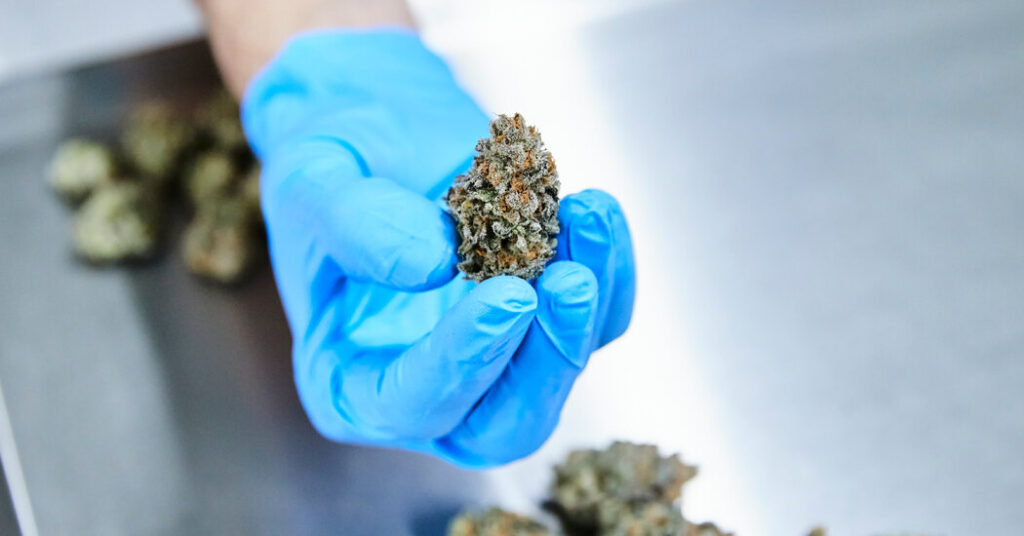
To treat their pain, anxiety and sleep problems, millions of Americans turn to cannabis, which is now legal in 40 states for medical use. But a new review of 15 years of research concludes that the evidence of its benefits is often weak or inconclusive, and that nearly 30 percent of medical cannabis patients meet criteria for cannabis use disorder.
“The evidence does not support the use of cannabis or cannabinoids at this point for most of the indications that folks are using it for,” said Dr. Michael Hsu, an addiction psychiatrist and clinical instructor at the University of California, Los Angeles, and the lead author of the review, which was published last month in the medical journal JAMA. (Cannabis refers to the entire plant; cannabinoids are its many compounds.)
The analysis arrives amid a surging acceptance and normalization of cannabis products, a $32 billion industry. For the review, addiction experts at academic medical centers across the country studied more than 2,500 clinical trials, guidelines and surveys conducted mostly in the United States and Canada. They found a wide gulf between the health purposes for which the public seeks out cannabis and what gold-standard science shows about its effectiveness.
The researchers distinguished between medical cannabis, sold at dispensaries, and pharmaceutical-grade cannabinoids — the handful of medicines approved by the Food and Drug Administration with formulations containing either low-grade THC, a psychoactive compound, or CBD, a nonintoxicating compound. Those medicines, including Marinol, Syndros and Cesamet, are available by prescription at conventional pharmacies and have had good results in easing chemotherapy-related nausea, stimulating the appetite of patients with debilitating illnesses like H.I.V./AIDS, and easing some pediatric seizure disorders.
The researchers found that doctors themselves do not have a firm understanding of medical cannabis. They cited a 2021 review in which only 33 percent of clinicians globally were confident in their knowledge about medical cannabis, and 86 percent said they needed more education.
Pain is a leading reason people use medical cannabis, but the review found no evidence to indicate that cannabis could ease acute pain. It cited the 2024 guidelines for the American Society of Clinical Oncology, which said there was insufficient evidence for, or against, recommending cannabis for cancer pain.
Treating chronic, noncancer pain produced more nuanced results. Several medical societies noted by the JAMA authors recommended against using cannabis as a first-line therapy because the evidence of its efficacy was limited. They specifically cautioned against inhaling cannabis, because of the risks of chronic bronchitis and exposure to toxic substances.
But they highlighted an analysis of eight trials which found that some formulations with a higher ratio of THC to CBD could ease pain, though it made no discernible impact on function. Even so, the analysts felt that quality investigations were needed before they could draw a definitive conclusion.
A desire to sleep is another popular reason that people turn to cannabis and cannabinoids. But the researchers said that sleep trials had also produced weak or inconclusive results, precluding major sleep organizations from making strong recommendations.
Yet many daily users who inhale or ingest cannabis before bedtime attest to its success, noting that if they skip a night, they sleep poorly — proof, they maintain, that cannabis works.
But Ryan Vandrey, a Johns Hopkins University professor who helps run its Cannabis Science Lab and was not involved in the JAMA review, said that the return of insomnia can suggest something else: the patient is in cannabis withdrawal.
“If they were to go back to not using cannabis for a month, they might find that their sleep improves. But most never get to that one month because after a day or two of not sleeping, they convince themselves, ‘Oh, this is the only thing that helps me sleep. So I’ve got to keep using,’” he said.
For anxiety treatment, the new study again showed cannabis’s mixed results. Researchers cited a trial of 80 veterans with PTSD that found no significant difference in outcome among those administered cannabis with a range of dosages of THC and those receiving placebos.
But oral CBD, such as that found in gummies, significantly reduced anxiety symptoms, compared with patients who took placebos, a 2024 analysis of 316 patients found. Overall, however, medical societies cautioned that treating psychiatric disorders with cannabis could exacerbate or initiate mental illness, including psychosis and suicidality.
Patients have also tried to treat Parkinson’s disease, glaucoma and rheumatoid arthritis with cannabis, but the researchers said there was insufficient evidence that cannabis or cannabinoids were effective for addressing those medical conditions.
State laws establish whether cannabis can be sold as medicine, for recreation or both. But in practical terms, the paper notes, the baseline ingredients of each type of product are largely indistinguishable, with some variation in dosing and potency. The term “medical cannabis” typically refers to a customer’s reason for using it, rather than indicating something unique about its properties.
“There are some legitimate purposes for these compounds,” said Dr. Kevin Hill, one of the authors of the JAMA review, who directs the Division of Addiction Psychiatry at Beth Israel Deaconess Medical Center in Boston. “And there’s a whole other group of people who are saying they’re using it medically, but they’re really not. They’re just rationalizing their recreational use.”
Aside from the approved prescription medications, cannabis is classified federally along with heroin and LSD as having no medical purpose and a high propensity for misuse. In 2024, the Department of Justice proposed moving it to a less restrictive category.
There is no national regulation of dispensary cannabis; supervision falls to individual states where it is legal. State standards for labeling, quality control and testing are highly variable and unevenly enforced, regardless of whether a product is promoted for recreational or medical use.
Without reliable monitoring, the JAMA review said, cannabis products sold at dispensaries remain at risk for contamination by mold, pesticides and heavy metals.
So even consumers who are responsible and diligent in seeking products for their ailments may be thwarted, Dr. Hsu said, “because you may not be necessarily getting what you’re hoping for.”
The increasing rates of cannabis use disorder was a major impetus for undertaking a review of the research, the researchers said. They pointed to a 2024 meta-analysis that showed that 29 percent of those who used medical cannabis had symptoms of the disorder. Earlier this year, research published in JAMA Psychiatry found that among cannabis users, 34 percent developed such symptoms, which were more frequent and pronounced among those who used the drug for medical rather than recreational reasons.
In the last few years, cannabis products generally have become more potent and more addictive. “That underscores the importance of getting the education right and having better information for both clinicians and patients,” Dr. Hill said.
Given the array of identified health risks associated with cannabis use, the researchers urged doctors to conduct more thorough screening of their patients’ use and also to monitor them for any potential dangerous drug interactions.
And they repeatedly called for robust clinical trials to determine the correct use and dosing, a critical safety measure for their patients.
Dr. Vandrey at Johns Hopkins is not holding his breath: “There’s no business incentive for a company to spend $20 million on a randomized controlled trial,” he said, “because they can sell their products without it.”
Jan Hoffman is a health reporter for The Times covering drug addiction and health law.
The post Review of Medical Cannabis Use Finds Little Evidence of Benefit appeared first on New York Times.