(1 star)
During a recent Reddit AMA (Ask Me Anything) promoting James L. Brooks’s comedic drama “Ella McCay,” someone asked the celebrated filmmaker how confusing it was for the lead actress of his film, Emma Mackey, to bear such a similar name to the character she plays. “I really should have done something about that,” Brooks responded, “but I had lived with the film title for so long I dewcided [sic] to slog along with it.”
After watching “Ella McCay,” you have to wonder whether he felt that way about writing the screenplay, as well. Brooks, whose storied career includes insightful gems such as “Terms of Endearment” and “Broadcast News,” turns in a halfhearted mess of a movie that spends its entire two-hour running time trying to figure out what it wants to be.
For reasons that aren’t entirely clear, the film takes place in 2008, when the charming Estelle (Julie Kavner), our narrator and Ella’s loyal secretary, claims everyone still liked each other. (If this raises your eyebrows, it should; many aspects of the story have that effect.) Ella is 34, one of the youngest people to ever hold office as lieutenant governor of an unspecified state (production took place in Rhode Island) and gets promoted to governor when her boss, whom the public quaintly refers to as Governor Bill (a great Albert Brooks), accepts a Cabinet position in President Barack Obama’s incoming administration.
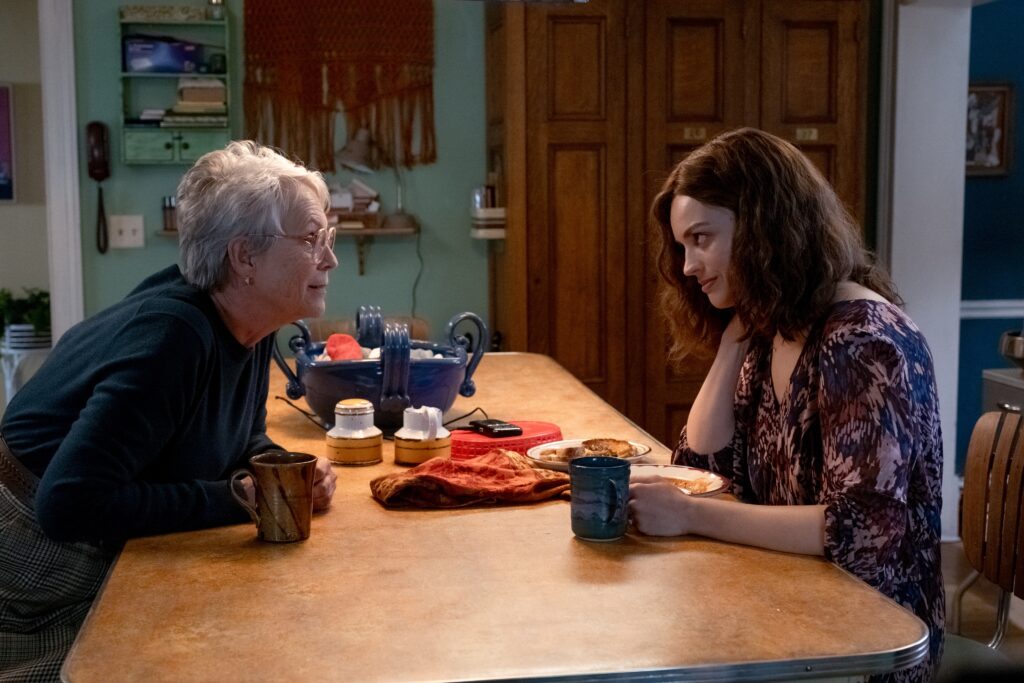
This is exciting news for Ella, but punctured by the distraction of a reporter discovering she and her husband (Jack Lowden) have been meeting for lunchtime quickies in a government-owned apartment because she is too tired for sex at the end of the workday. The ambitious politician is just trying to maintain a healthy marriage after growing up in a household where her deadbeat dad (Woody Harrelson) cheated on her mother (a brief Rebecca Hall, underused in flashbacks) up until the latter died of cancer when Ella was a teenager. At the time, Ella was living separately with Aunt Helen (Jamie Lee Curtis), her parents having decamped to California to save their own marriage.
Lost yet?
Anyhoo, on to the film’s pressing concerns: Will scandal keep Ella from presiding over her home state for the remaining 14 months of Governor Bill’s original term? If so, what would become of her supposedly brilliant policies, a controversial “moms bill” promising better child care and some sort of ridiculous plan to distribute toothbrushes to poor kids? How will she handle this amid the sudden reappearance of her father, who seeks his daughter’s forgiveness?
It has been 15 years since Brooks’s last film, “How Do You Know,” a belabored rom-com that, with “Ella McCay,” makes the 85-year-old director’s late-career instinct doubly baffling. Ella is a fitting protagonist for Brooks on paper: As a try-hard you can’t help but reluctantly root for, she most closely resembles Holly Hunter’s determined journalist in “Broadcast News.” But Ella’s rose-colored view of politics renders the depiction toothless. Nobody is naive enough to believe a few impassioned speeches can result in sustainable change, except for maybe Ella’s devoted driver (Kumail Nanjiani).
Ella makes little sense as a lead character — through no fault of Mackey’s, as she works overtime to make a young woman whose only flaw is caring “too much” seem relatable. We know Ella was traumatized by her father’s behavior, but that doesn’t manifest in any discernible way. Sure, her high school sweetheart turned husband turns out to be a loser — once caring, he pulls an inexplicable 180 and tries blackmailing her into giving him a role in her administration — but she never falters in how she handles the situation. Boring!
The supporting players in Ella’s life are more compelling, but there are too many for any one of them to be developed properly. Ella only briefly reckons with why her mom stayed despite knowing of her husband’s infidelity, depriving Hall of any meaningful scenes. Harrelson gets a few ha-ha moments, but they largely serve as fodder for Curtis to deliver zany responses. (Don’t worry, she reins it in more than usual.) Lowden, so good in Apple TV’s “Slow Horses,” has no idea what to do with his surprise villain. We catch a glimpse of a stronger storyline for him when the character’s mother (a hilarious Becky Ann Baker) bullies him into demanding a job from Ella, but she appears only that one time.
Oh, wait. I forgot to mention: Ella is also preoccupied by being the perfect older sister to her kid brother, Casey (Spike Fearn), who might have developed a form of agoraphobia in response to his tumultuous upbringing. There’s an unnecessary subplot where Casey tries to win back his girlfriend — played by Ayo Edebiri, a versatile comic actress who needs to have a come-to-Jesus conversation with her agent after a string of duds (this, “Opus,” “After the Hunt”).
Brooks squeezes this heap of clutter into a pretty package, thanks to cinematographer Robert Elswit, whose impressive résumé includes an Oscar win for “There Will Be Blood.” Together they create an atmosphere of nostalgia, unsubtly hammered home by a sappy score from Hans Zimmer (who previously collaborated with Brooks on films including “As Good As It Gets” and “Spanglish”). It’s enough to trick yourself into thinking you’re having a good time, until something snaps you out of it. Your heart warms as Ella bonds with her brother over their abnormal childhoods, for instance, and then freezes over as she launches into some weird stump speech about children’s dental hygiene.
If you do decide to watch “Ella McCay” — and I won’t completely advise you against it, as I need to process this with others — it’s best to try to stay in that wistful dreamland. Because once you start to contemplate whether Ella was even smart and accomplished enough to have been lieutenant governor in the first place, it all falls apart.
Brooks may want us to believe Ella has a strong sense of purpose and direction, but he can’t fool us into concluding the same of his film.
PG-13. At area theaters. Contains strong language, some sexual material and drug content. 115 minutes.
The post ‘Ella McCay’ is a huge mess. Can we pretend it never happened? appeared first on Washington Post.