They tried, but the tens of thousands of people who marched on the Pentagon on Oct. 21, 1967, to oppose the Vietnam War didn’t manage to get the world’s then-largest office building aloft.
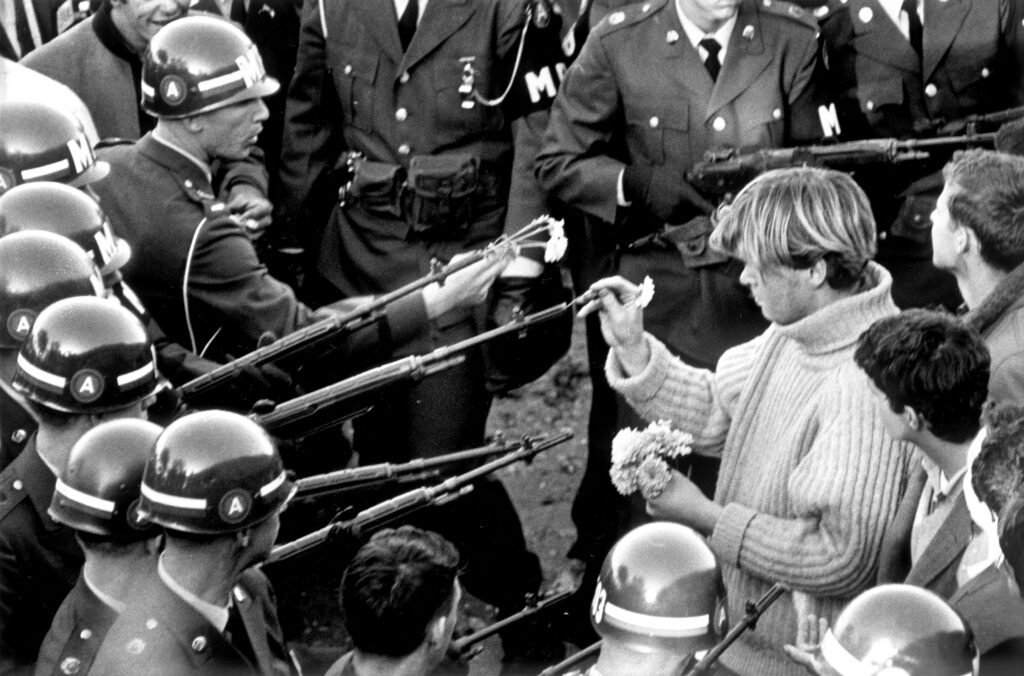
But in the first major demonstration of the war to confront the government directly, they did succeed in changing the strategy of the anti-war movement, in the organizers’ motto, “from protest to resistance” — and produced one of its most powerful images: A young man, the M14 rifles of the 503rd Military Police Battalion (Airborne) trained on him, delicately placing carnations in their barrels.
By October 1967, North and South Vietnam had been at war for a dozen years. Hundreds of thousands of combatants and civilians lay dead. The United States had drafted more than 725,000 of its young men for the effort, and lost more than 15,000.
The March on the Pentagon was organized by several of the most prominent leaders of the country’s radical left: The conscientious objector David Dellinger, imprisoned during World War II; the future Yippies Abbie Hoffman and Jerry Rubin; the beat poets Allen Ginsberg and Gary Snyder; LSD guru Timothy Leary.
Fifty-nine years ago Wednesday, 100,000 people gathered at the Lincoln Memorial; 35,000 to 50,000 joined the two-mile walk across Arlington Memorial Bridge to the headquarters of the Defense Department. Linguist Noam Chomsky, novelist Norman Mailer, poet Robert Lowell and pediatrician Benjamin Spock delivered speeches.
Musicians Phil Ochs and the Fugs performed. Hoffman and Rubin led the crowd in chants to exorcise the demons from the Pentagon and try to levitate the building. (Such antics reportedly kept Martin Luther King Jr. away from the event.) Mailer’s account of the demonstration, the nonfiction novel “Armies of the Night,” won a National Book Award and a Pulitzer Prize.
But the best-remembered and perhaps most eloquent act of the day was the quiet show of flower power, a phrase Ginsberg had coined two years earlier, by 18-year-old George Edgerly Harris III.
A New York-based actor — he had already appeared off-Broadway with James Earl Jones and Al Pacino — Harris appears to have understood the moment. Several rifles are pointing at him. Confronted with their lethal power, he adopts an expression of seemingly gentle attention and loads them with flowers.
The March on the Pentagon is seen as a turning point in the anti-war movement, when its protests went from passive to active, and the image of Harris captured by Washington Evening Star photographer Bernie Boston, in its jarring juxtaposition of gravity and whimsy, became an icon of the cause, widely reprinted, wielded at protests, now shown in exhibitions.
(Harris, who moved to San Francisco, adopted the name Hibiscus and founded the psychedelic gay-liberation collective the Cockettes, died in 1982, an early casualty of the AIDS epidemic. Boston died in 2008.)
The war would worsen — 1968 would be its deadliest year — but the protests would grow. The movement, alongside graphic television reports and mounting casualties, is credited with turning public opinion against the war, constraining U.S. leaders and hastening the U.S. withdrawal.
Photo Almanac is an occasional series from The Washington Post, using photo archives to examine where we’ve been to understand where we are.
The post When protesters tried to levitate the Pentagon — and produced an anti-war icon appeared first on Washington Post.