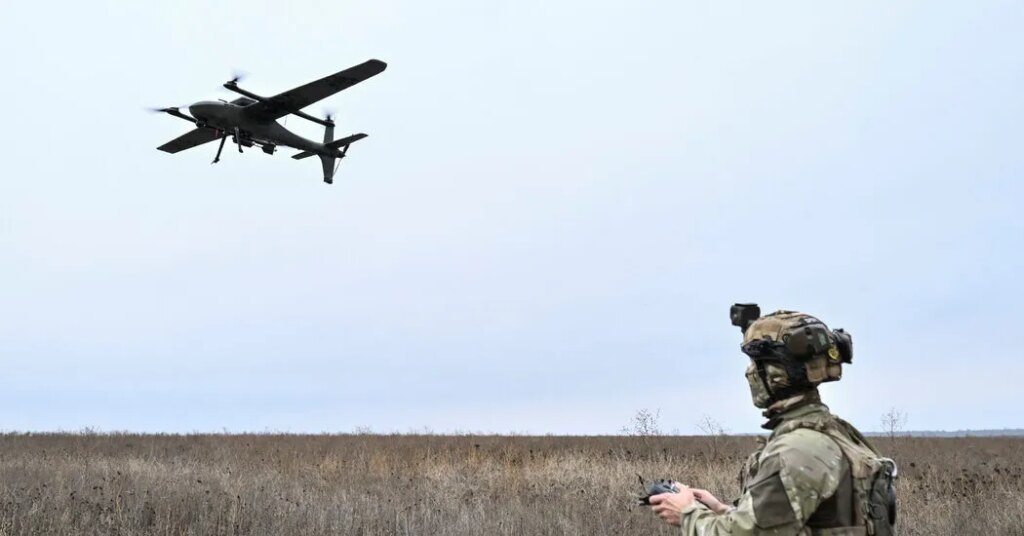
A senior Ukrainian commander said he had dozens of armed drones soaring toward Russian military targets last week when, all at once, the video feeds streaming their flight paths went fuzzy.
The drones had lost their connection to pilots on the ground through Starshield, a Pentagon-funded satellite internet service, said the commander, Oleh, who spoke on the condition that he be identified by only his first name to protect operational security. Many of the drones simply fell from the sky, he said: The effect cost his units more than $1 million worth of weaponry.
The Starshield disruptions forced Oleh to halt almost all operations for the next three days, he said, including strikes on Russian command posts and fuel hubs. Such attacks, he said, help save the lives of Ukrainian troops holding positions on the front and slow Russian advances.
Ukrainian accounts of Starshield’s abrupt throttling have become a flashpoint in a worsening feud between President Volodymyr Zelensky of Ukraine and President Trump. A week after the first problems were reported, Ukrainian troops said that the situation had improved but that connectivity issues remained. The Trump administration has offered mixed messages, both denying any change to Starshield service and saying that service has been restored.
Ukrainian officials fear that the Trump administration ordered the disruptions to punish Ukraine over its strikes on Russian oil refineries and to force Kyiv to capitulate in the war. Ukraine has also reported gaps in the sharing of U.S. military intelligence and delays in the delivery of American interceptor missiles. U.S. officials deny any such disruptions.
Starshield is a military-grade sister system to Elon Musk’s Starlink, and European countries pay for Ukraine’s access to it. The more advanced Starshield system is not available to all Ukrainian troops, but many rely on it to fly drones and use standard Starlink connections for more basic communications. Ukrainian officials have reported slowdowns with both Starshield and Starlink.
Mr. Musk has said that Starshield is controlled by the Pentagon. Secretary of State Marco Rubio added to the confusion on Wednesday when he asserted that it was Mr. Musk’s company, SpaceX, that determined access to Starlink and Starshield.
The initial Starshield throttling caused Ukrainian drones to lose their connection to the system when flying at speeds as low as 40 miles an hour, Ukrainian officials said. Connectivity has since improved, Ukrainian officials say, but drones still lose their connection when they exceed 100 m.p.h. Some models can operate normally under that speed, but others, including those used by Oleh’s troops, must fly faster to strike.
The speed limits have also thwarted interceptors used to take down Russian drones that attack Ukrainian cities, Mr. Zelensky said. Fearing that the systems may never be fully restored or could cut off abruptly again, Ukraine is searching for workarounds, a scramble that commanders say is diverting soldiers’ attention from the battlefield.
Ukrainian officials say they are seeking answers about who ordered the slowdowns of Starshield and Starlink — and why.
Asked for comment, a White House official said in a statement that there had been no changes to satellite internet in Ukraine. On Friday, Mr. Trump said that any change “wasn’t me” and that “from what I understand, it’s the same as it’s always been.” Mr. Rubio said a day later that a Starlink slowdown in Ukraine had “sort of happened” but added that “my understanding is it’s been restored.”
Mr. Zelensky has called the changes to Starshield “a planned operation.” On the NBC show “Meet the Press” on Sunday, Treasury Secretary Scott Bessent said that “President Trump and Secretary Rubio have categorically said that no one in the Trump administration did that, and I think it is very reckless for President Zelensky to make such a charge.”
In Washington, politicians from both parties called on Mr. Trump to restore Ukraine’s satellite connectivity.
After a group of lawmakers spoke by video call with Mr. Zelensky on Monday, Senator Thom Tillis, Republican of North Carolina, said that the Ukrainian leader “confirmed ongoing Starlink disruptions, reported interruptions to critical U.S. intelligence sharing and raised concerns about delays in air-defense interceptors.”
“Degrading Ukraine’s satellite communications, weakening its air defenses and easing sanctions against Russia only embolden Putin and prolong this war,” Mr. Tillis said, referring to a move by Mr. Trump to allow the United States to buy Russian diesel fuel.
On Tuesday, Mr. Zelensky said he and Mr. Rubio had a “substantive discussion” about Starshield, as well as about shortages of missile interceptors and recent disruptions to early warning systems about Russian ballistic missile attacks.
Any claim that the United States held back on warnings for Ukraine is “simply not accurate,” Mr. Rubio said after his call with Mr. Zelensky. He also noted that Patriot interceptors were in short supply around the world. “Nothing is being deliberately denied to Ukraine,” he said.
While the American political machinations over Starshield remained murky, Ukrainian commanders said the effects of restrictions on the system were clear on the battlefield.
Brig. Gen. Andriy Biletsky, who recently assumed command of thousands of troops of the Center Grouping of Forces in eastern Ukraine, said troops were adapting to the new speed limits.
Before now, Ukrainian drones using Starshield flew as fast as 250 miles an hour with a stable connection, he said. The formal limit had already been 100 m.p.h., but it had not been enforced, General Biletsky said.
That leaves open the possibility that the United States could assert that no change had occurred in the system even as Ukraine experienced changes on the front.
Even if Ukraine can adapt to allow its attack drones to work under the limits, General Biletsky said, interceptors that used Starshield to counter Russian jet-powered drones would still be hindered. The only way to take down an incoming drone is to outrace it, and jet-powered Russian weapons fly far faster than 100 m.p.h.
Reducing the speed limits for air defense “is a painful decision that literally undermines the protection of our cities, first and foremost,” General Biletsky said. “So when the Pentagon took this step, it was undoubtedly an unfriendly move toward Ukraine’s civilian population.”
In command posts across Ukraine, there was little doubt that the Starshield restrictions were the result of a political decision, not a technical glitch. Ukrainian troops had long feared that Washington would pressure Kyiv into concessions by cutting off satellite connections.
As Oleh’s drones fell last week, his three phones buzzed with expletive-laden calls from stunned troops, who rushed to redirect and save as much of their gear as they could.
Oleh recalled soldiers telling him that they felt abandoned. He said that it was well past time for Ukraine to take off its rose-colored glasses and stop seeing the United States as an ally.
Lt. Yuriy Butusov, company commander of the 23rd Assault Regiment in Ukraine’s Khartia Corps, said his troops had been hamstrung by the slowed connections, which essentially gave the Russian military “a vacation day.”
“This day without Starlink saved many lives and many trucks for Russia, unfortunately,” Lieutenant Butusov said.
“It’s a big cost for us,” he added. “And much more blood. Our blood.”
The post When Starshield Cut Out, Ukrainian Drones Fell From the Skies appeared first on New York Times.