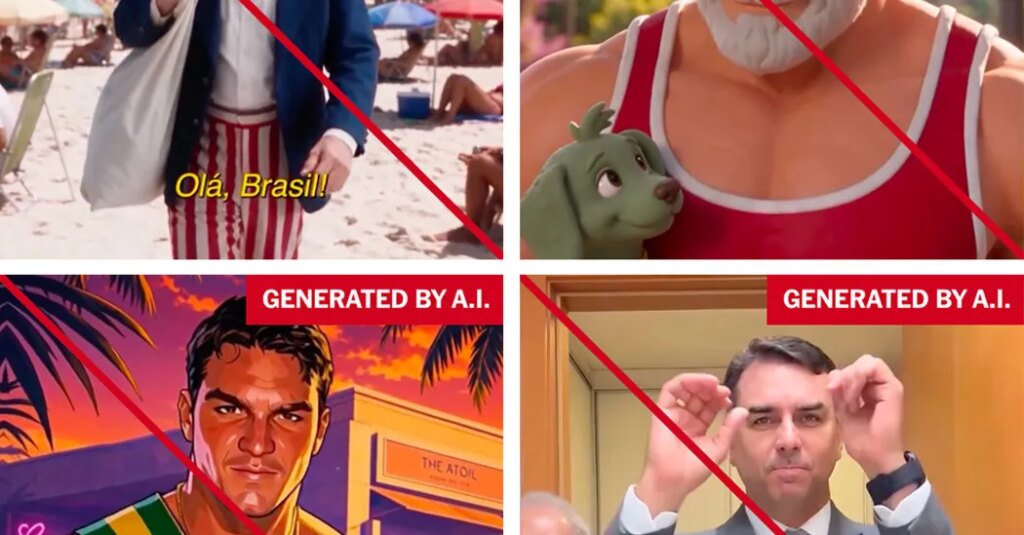
Videos made with artificial intelligence, ranging from the amusing and absurd to the grim and deceitful, have flooded the Brazilian internet ahead of a high-stakes presidential election on Sunday.
This has turned Latin America’s largest democracy into a real-time laboratory for the electoral use of A.I., offering parallels to the United States, where critical midterm elections approach, and to other nations grappling with the effect of powerful new technologies on political life.
But in Brazil, a chronically online nation of 214 million where disinformation has defined elections for nearly a decade, the deluge of A.I. — made by candidates, strategists and ordinary citizens — has become a stark gauge of the nation’s capacity to police online content.
Online disinformation is already a hallmark of Brazil’s electoral season, but A.I.’s prevalence and advancing sophistication are posing a major new challenge for the Brazilian authorities working to protect the integrity of the country’s vote.
Brazil, which has some of the world’s strictest regulations against electoral falsehoods, has issued equally stringent rules on A.I. use during elections. But these guardrails have remained largely untested until now.
“We made the rules, now we’re watching to see what happens,” said Kássio Nunes Marques, chief justice of Brazil’s electoral court, which oversees the vote.
The Brazilian election is pitting President Luiz Inácio Lula da Silva, a leftist, against Flávio Bolsonaro, a right-wing challenger, in a tight contest for the presidency. It is also the biggest test in the region for an ascendant right, which has won seven straight presidential votes in the past 18 months.
In the race to sway a deeply divided Brazilian public, social media has become a key political battleground. And in Brazil, like elsewhere around the world, A.I. has emerged as a potent tool for spreading political messages and shaping the online conversation.
Or just for plain amusement — as in the memes below.
Brazil’s electoral court bars candidates from using “deepfakes,” synthetic but realistic videos or audio messages, while campaigning. It also requires campaigns to clearly label videos generated by A.I.
“When a voter hears a candidate who has been enhanced through artificial intelligence, are they truly hearing the candidate?” said Justice Nunes Marques. “Something that might appear harmless could, in fact, cause harm to the electoral process.”
Tech companies, including Meta, Google and OpenAI, complying with a court request, provided detailed plans about how they would handle A.I. produced and shared on their platforms.
And, ahead of the elections, the electoral authorities banned companies from allowing chatbots from ranking or recommending politicians, though independent watchdogs have found that some platforms have broken that rule.
The country’s broader social media regulations also require digital platforms to swiftly remove posts by regular users who spread electoral lies, attack democratic institutions or otherwise break Brazilian laws.
But the rules haven’t been fine-tuned to distinguish A.I.-generated content meant to mislead from A.I. used for creative expression, according to André Giacchetta, a lawyer who represents social media platforms in Brazil.
“The regulation,” said Mr. Giacchetta, “doesn’t set a threshold for when exactly the use of A.I. begins to constitute potential interference in the electoral process.” This, critics argue, can lead to the overzealous policing of A.I.-generated content that may limit freedom of speech.
To address the new challenges posed by A.I. disinformation, companies like Google and OpenAI have developed ways to flag videos made with their chatbots, such as automatically adding watermarks. Platforms like YouTube are also using biometric identification to catch and remove electoral deepfake videos.
In reality, though, curbing the rapid spread of A.I. falsehoods has been difficult.
If platforms fail to spot and remove deceptive content generated by A.I., the electoral court can and has ordered them to take it down. Yet, experts say that process, sluggish and bureaucratic, is no match for viral A.I. videos that can spread like wildfire across the internet.
“The bad guy we’re now up against is really, really fast,” said Cristina Tardáguila, a disinformation scholar and founder of Agência Lupa, a Brazilian fact-checking agency. Companies are also failing to catch infractions on their own platforms, she added, with a survey by her organization identifying roughly 10 percent of A.I. content created by political candidates was missing a label.
And the sheer volume of content being churned out by bots is making it harder to track A.I. disinformation and its true effects, according to Tai Nalon, head of Aos Fatos, a research group monitoring misinformation in Brazil.
Experts say that the work of policing A.I. is complicated by the way social media platforms have changed. While they once showed users linear timelines of posts, they now rely on highly personalized and secretive algorithms that can aggressively push content onto people’s feeds and widen the reach of A.I. disinformation.
The impartiality of tech companies has also come into question in recent days, after Mr. Lula and independent watchdogs accused Meta of favoring his rival.
At the same time, tech companies have scaled back their moderation efforts, Ms. Nalon added. “We are at a point where the problem has ballooned, while the tools we have on hand are diminished,” she said.
Experts say Brazilians, with their deep love of memes and one of the heaviest social media usage in the world, have been particularly susceptible to the allure of A.I. Some 56 percent of Brazilians say they trust A.I., compared with 40 percent of Americans.
This has made A.I.-generated videos especially effective, and popular, in Brazil.
Seeking to mislead, some of these videos present fake polls or fictitious voters bashing candidates in segments that resemble news reports. Others exaggerate the popularity of each candidate using realistic A.I. videos of fake crowds filling the streets of Brazilian cities.
Jair Bolsonaro, the former right-wing president who is still adored by millions, also features prominently. At a farmer’s market and in front of the presidential palace, an A.I. version of Mr. Bolsonaro has been rallying support for his son, even though he is, in fact, under home confinement as part of his 27-year prison sentence for plotting a coup after losing the last election.
The elder Mr. Bolsonaro’s own use of disinformation about election fraud inspired thousands of his supporters to storm Brazil’s capital after his defeat, demanding the military overturn the result.
This time around, many viral election videos have seized on, and amplified, accusations of corruption or fears that the United States may be meddling in the Brazilian elections to help the younger Mr. Bolsonaro.
In one video viewed over 800,000 times, a buff Mr. Lula saves a dog bearing the name of Brazil’s instant payment system, PIX, which the Trump administration has attacked and used to partly justify tariffs.
Mr. Bolsonaro’s supporters, for one, have employed A.I. to cast him as a superhero who will save Brazil by cracking down on crime and kick-starting the economy, while painting his rival as corrupt.
In one video linking Mr. Lula to graft, the president is shown running from the police alongside a Supreme Court justice linked to a corruption scandal hanging over the elections. The crisis in the nation’s top court has damaged Mr. Lula’s image among some voters.
In a different video, the imprisoned banker at the center of that corruption scandal sheds tears over a photo taken with Mr. Bolsonaro, as the candidate frolics in a tub full of cash. Mr. Bolsonaro is being investigated for raising millions of dollars from the banker, Daniel Vorcaro, to finance a biopic about his father.
(In a nation with a rich history of soap operas, dramatic chronicles told by A.I. fruit have also gained popularity, including one featuring an orange as President Trump and an avocado as Mr. Bolsonaro.)
Ultimately, scholars say, A.I. has simply made it faster, cheaper and easier to create misleading or false political narratives that were already circulating online.
And beyond the proliferation of disinformation on the internet, A.I. also holds a different, perhaps more powerful, kind of sway. The popular chatbots dishing out personalized advice to millions of people each day can easily influence political decisions, according to Luiz Alexandre Reali Costa, who runs the Brazilian Observatory for Artificial Intelligence.
“No problem that A.I. brings is totally new,” said Mr. Costa. “But it multiplies the challenges that we already faced.”
Videos at the top of this article by Brazil’s Liberal Party, @filmeiroSource and @iamsmoother via Instagram.
Reporting was contributed by Thayz Guimarães from Brasília, and by Leonardo Coelho, Isabela Cruz and Lis Moriconi from Rio de Janeiro. Additional work by Gray Beltran.
The post A.I. Election Videos Are Flooding Brazil. Could They Sway the Vote? appeared first on New York Times.