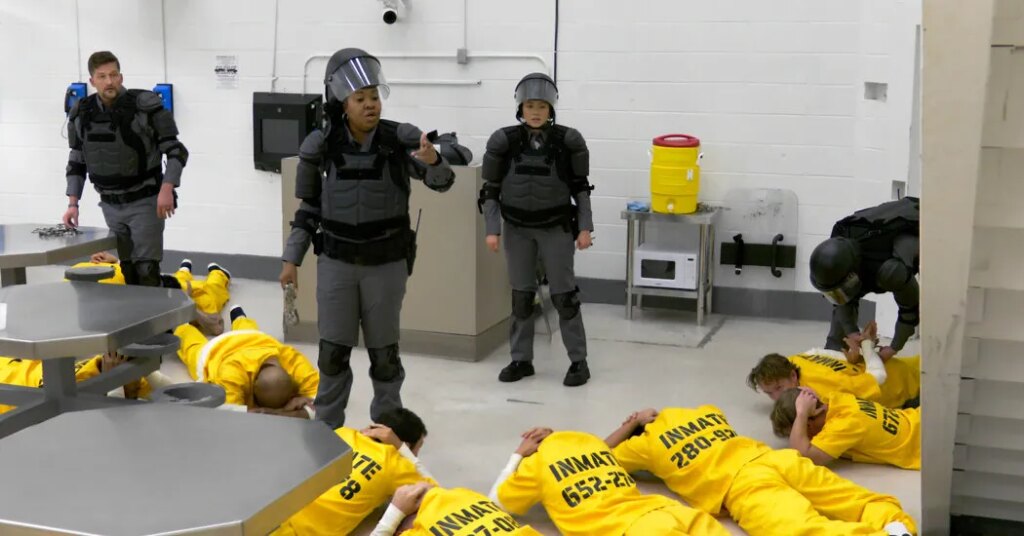
It seems there is nothing these days that can’t get revived or remade on streaming. So it was only a matter of time before they started rebooting debacles.
Enter “The New Stanford Prison Experiment,” a six-episode unscripted series on Netflix. The title refers to a notorious 1971 psychological study in which two groups of Stanford students were designated “inmates” and “guards” in what was intended as a simulated, two-week-long incarceration.
It ended after six days. The scenario devolved into chaos and cruelty. Guards tormented and humiliated prisoners. Inmates experienced breakdowns. The study’s designer, Philip Zimbardo, held it out as an investigation of how power dynamics can make ordinary people perpetrate evil. But it has since been criticized as ethically and scientifically flawed, and Zimbardo was accused of pushing the guards toward aggression.
You would think, then, that a “New Stanford Prison Experiment” would have all the appeal of “The New Donner Party Expedition.” And you would not be wrong.
The premise — people behave badly in extremis — has plenty in common with reality shows like “Survivor,” which long styled itself a “social experiment,” and scripted hits like “Squid Game.” Prison, with its built-in tensions and conflicts, has been a setting not just for drama but for reality shows like the long-running “Lockdown.”
So: lights, camera, incarceration. The producers include Dan Cutforth and Jane Lipsitz, whose high-end reality productions include “Top Chef.” The new series puts itself forward with a sense of sober purpose and a tense, heartbeat-like soundtrack. Alison Wood Brooks, a behavioral scientist, talks about the impulse to rerun, and perhaps improve on, the “infamous” original.
The series resembles high-production-value reality TV more than a dry academic exercise. Brooks sits on a three-person panel, observing and commenting with Trymaine Lee, a journalist who has worked for outlets including The Times-Picayune, The New York Times and MSNBC, and Michael Cantrell, a federal corrections professional; the setup can’t help but recall a cooking show judges’ table. We meet the participants through reality-style confessionals that establish their backgrounds, personalities and hopes for the experience.
The cast members — sorry, test subjects — arrive at a working prison, where space has been put aside as a production set. Like their Stanford forebears, they are divided into prisoners (all men) and guards (who include three women). Curiously, some have actually been in prison or had run-ins with the law.
The prisoners are given uniforms and a safe word (“pineapple”) they can use to exit the experiment. They are referred to by number. The guards are divided into day and night shifts, assigned responsibilities and told what they can and can’t do to control or discipline inmates.
I will not give away the developments — did B.F. Skinner’s experiments have spoiler embargoes? — but the production does not collapse into the mayhem of the original. Under the strain of confinement, bad food and powerlessness, some prisoners begin to act out, but it seems as much an urge to test the rules of the show as rebellion against authority. Some see the confinement as a puzzle, others a personal test.
The most interesting conflict is not between captors and captives but among the guards themselves. The day shift is led by an oil-rig supervisor who says he’s willing to find the “breaking point” of any inmate with authority issues. The more permissive night shift includes an upbeat entrepreneur with a Michael Scott-ish bent (“I’m influence hungry, not power hungry”) who leads the prisoners in a paper-airplane contest. The clash of working styles develops into a kind of side battle between blue-collar respect culture and white-collar team-building culture.
While the series doesn’t fall into barbarity, it fails as TV and isn’t persuasive as an experiment. The possibility of disaster, of course, is what draws viewers’ curiosity. The episodes tease that interest with cliffhangers and introduce a number of change-ups that are framed as “phases” in the experiment but play like drama-spiking twists out of “The Traitors.”
On that series, at least, you can count on sharp one-liners and some outrageous Alan Cumming outfits. Here, you are mainly sentenced to tedium, watching a show that is neither as scandalous as you might fear nor as edifying as its makers might hope. It’s not cruel, but neither is it unusual. And the attempts to inject surprise muddy what, exactly, the experiment is testing. “I just can’t take it serious,” says an inmate, speaking for us all.
The series does its time and limps to a finish. What is the point, ultimately, of proving that people will act out in stressful scenarios, when reality shows have been running those lab trials for a quarter-century? If you fly a kite in the rain today, you’re not Benjamin Franklin — you’re just hoping for a shock.
Viewers interested in the aims and ethics of the original experiment might do better to stream “The Stanford Prison Experiment: Unlocking the Truth,” a 2024 National Geographic docuseries, now on Disney+. “The New Stanford Prison Experiment” only proves — as Karl Marx might have said, if he had Netflix — that psychology repeats itself, the first time as tragedy, the second as farce.
The post Review: ‘The New Stanford Prison Experiment’ Is a Stiff Sentence appeared first on New York Times.