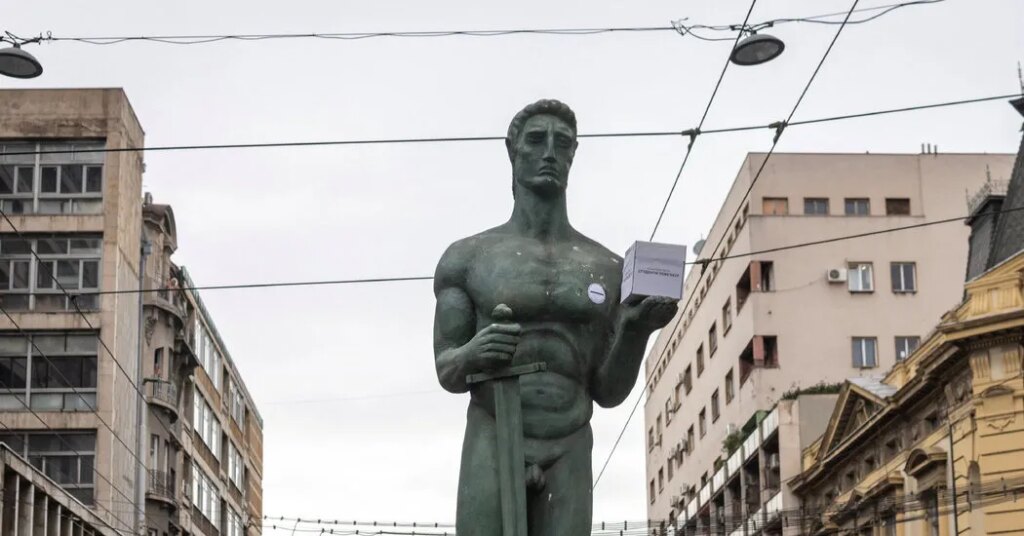
It may sound like a David-and-Goliath story. But on Sunday, Serbia’s inspiring student movement will run in snap parliamentary elections against the party that has ruled the country for 14 years. At the head of the ruling coalition’s list of candidates is Serbia’s longtime autocratic leader, Aleksandar Vucic. After nearly two years of protests, the showdown between the students and Mr. Vucic is about to enter its final stage.
The students’ list of 250 candidates is remarkable in itself. Comprising professors, scientists, doctors, workers, actors and activists, the candidates — most of whom had been unknown to the public — were selected through a lengthy sequence of scrutiny and interviews. University faculties proposed candidates, then reviewed nominees from across the country. After discussing the options, student assemblies made their choices. Thousands participated in this decision-making process — an extraordinary experiment in bringing direct democracy into mainstream politics.
The established opposition, meanwhile, has been pushed aside, with many of its parties backing the student list. The student movement has turned the election into something like a referendum on the regime, captured in its slogan: “Serbia or the mafia.” Many assumed the students were too inexperienced or naïve for electoral politics. But with some polls putting support for the student list above 40 percent, the race appears to be tight.
The students are coming for the machine. And, astonishingly, they might win.
The movement has come a long way. It started in 2024 with the collapse of a railway station canopy in Novi Sad, Serbia’s second-largest city, that killed 16 people. Students took to the streets to demand accountability for the disaster. So began a cycle of demonstrations, university blockades, road closures and other acts of civil disobedience that forced Mr. Vucic onto the back foot. The pressure grew so great that he brought forward elections, cutting short his second and final presidential term to run for prime minister.
The students are too young to remember Mr. Vucic in the 1990s, when he made inflammatory wartime comments, declaring that 100 Muslims would be killed for every Serb death. Nor can they recall his attacks on the media as information minister in the late 1990s. But they have grown up under his long tenure, during which critics and independent journalism have been suppressed and propaganda has flourished.
The students know firsthand what happens to those who challenge Mr. Vucic’s rule. They have been struck by cars at peaceful gatherings, spied on, arrested and beaten by both the police and groups with ties to organized crime — some suffering injuries such as broken jaws and skull fractures. During the election campaign, they have experienced increased intimidation and surveillance. Dozens of students have faced criminal charges; some have gone into exile for fear of reprisal.
For years, Mr. Vucic seemed to have an answer to everything. At home, he paired repression with promises of progress, channeling the opposition into institutions he controlled. Abroad, he condemned Russia’s invasion of Ukraine and refused to take part in sanctions; he welcomed Volodymyr Zelensky and allowed the convicted war criminal Ratko Mladic to be buried with military honors; he opened an Israeli drone factory and sent a representative to the funeral of Iran’s supreme leader, Ali Khamenei. He boasts of having both White House ties and Vladimir Putin’s endorsement.
The student movement has disrupted this balancing act. Unlike for much of the past 14 years, Mr. Vucic is not facing a fragmented, sluggish opposition. He is facing a generation that has built a collective identity without a single figurehead. Almost two years in, it is remarkable that this ideologically diverse movement has neither split nor formed rival factions. Unable to focus his attention on a leader, Mr. Vucic has unconvincingly spoken on behalf of “students who want to study,” in opposition to those blockading universities.
Yet the students keep laughing in the face of power. When Mr. Vucic invited Ilija Srdanovic, the cardiologist on the medical faculty in Novi Sad who heads the student list, to a televised debate, the professor answered in the language of prepaid mobile phones: “You do not have enough credit for this call.” In a bizarre response, Mr. Vucic recorded himself debating a photograph of Mr. Srdanovic and a stone — a misfired reference to the joke that even a stone would be better than Mr. Vucic.
The students have certainly earned their credit with voters. On Nov. 1, 2025, the anniversary of the Novi Sad canopy collapse, some walked hundreds of miles to the commemoration service. I watched them arrive with bloodied feet, bandaged and utterly exhausted. Some smiled through tears, as did the thousands who welcomed them. Their election campaign has been similarly courageous, calling out state corruption and promising free school textbooks, permanent employment contracts after 12 months, affordable housing and a doctor in every village.
The second anniversary of the Novi Sad tragedy falls on Nov. 1. By then, we will know whether Serbian society is ready to turn the students’ radical democratic experiment into political reality. Election Day — and election night — may be tense. Mr. Vucic says he has indications that “some from outside and some from inside” Serbia will try to spur unrest, appearing to shift responsibility for turmoil away from himself before a vote has even been cast. Given the regime’s reported role in provoking violence at protests, we are in dangerous territory.
Yet through their courage and political imagination, the students have shown that another Serbia, and another democracy, is possible. David has grown stronger and Goliath has lost his footing. The world should take note.
Filip Balunovic is a research fellow at the University of Belgrade’s Institute for Philosophy and Social Theory and an assistant professor at Singidunum University. He is the author of “The Revival of the Left in the Balkans” and “The Obsolescence of Human Rights.”
The Times is committed to publishing a diversity of letters to the editor. We’d like to hear what you think about this or any of our articles. Here are some tips. And here’s our email: [email protected].
Follow the New York Times Opinion section on Facebook, Instagram, TikTok, Bluesky, WhatsApp and Threads.
The post My Country Is Going Through an Extraordinary Experiment appeared first on New York Times.