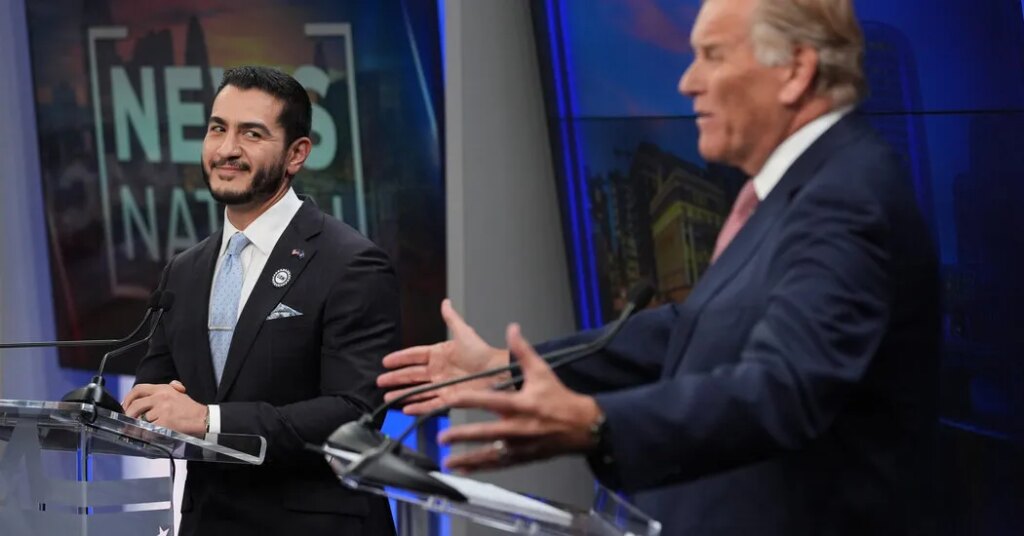
Mike Rogers, the Republican Senate candidate in Michigan, argued on Tuesday that lower taxes and energy bills would make the state more attractive to businesses. About 25 minutes later, on the same stage in Detroit, Dr. Abdul El-Sayed, the Democratic candidate, maintained that the concentration of power in large corporations was driving economic problems.
In dueling appearances, Mr. Rogers and Dr. El-Sayed defended their economic policies before members of the business community, detailing how they would legislate were they to emerge victorious in one of the closest and most hostile Senate races in the country. Each went onstage separately and had an equal amount of time to answer the same set of questions at the Detroit Economic Club, which has hosted interviews with Michigan Senate candidates over the past decade.
Here’s how the candidates, who are scheduled to debate each other on Wednesday night, discussed the topics chosen by the moderator.
Economic policy
Mr. Rogers maintained that Michigan should become more attractive to businesses by improving education so workers could fill available jobs. He cited manufacturing job losses, rising costs and weak literacy as problems that undermined the state’s work force and economy.
Dr. El-Sayed argued that the power imbalance among large corporations was limiting competition, placing consumers, workers and new businesses at a disadvantage. He called for stronger antitrust enforcement and more support for small businesses.
President Trump’s tariffs
Mr. Rogers said he supported tariffs that would encourage production in the United States, but opposed those he thought harmed Michigan. He cited vehicle production returning to the United States as a benefit, while again distancing himself from President Trump’s trade war with Canada, criticizing those tariffs because many auto parts and vehicles are sold across the border from Michigan.
“If it’s good for Michigan, I’m going to be for it,” Mr. Rogers said. “If it’s bad for Michigan, I’m going to be against it.”
Dr. El-Sayed said he supported some tariffs, but wanted them tied to a longer-term industrial plan rather than applied broadly or unpredictably. He proposed using temporary subsidies and tariffs to help develop a lower-cost electric vehicle built in the United States — a vehicle with a 300-mile range that could cost around $25,000 — and then compete in the global market.
Health care
Mr. Rogers argued that being more transparent about prescription drug prices and insurance denial rates could put pressure on providers and help address costs.
Dr. El-Sayed argued for the single-payer health care system “Medicare for all,” framing universal health insurance coverage as an issue for both employees and employers. He said such a system could reduce small businesses’ administrative and cost burdens, and that it could be funded by taxing billionaires’ wealth. He acknowledged that passing “Medicare for all” would require Democrats to be in control of Congress and in the White House.
“Guaranteeing health insurance to everybody in this country would be the single most important thing we could do for small business,” Dr. El-Sayed said.
Incomes and wages
Mr. Rogers argued that dwindling manufacturing jobs in Michigan had caused wages to fall, and that restoring higher-wage manufacturing work, especially in the defense industry, could help reverse that trend.
Dr. El-Sayed called for more unions, which could push for better wages and benefits, and proposed cutting the employer-side payroll tax so businesses would have more incentive to hire people as artificial intelligence affects the labor market.
Artificial intelligence
Mr. Rogers, who has warned that A.I. presents a national threat, said he supported safety guardrails, including a national-security framework. He also proposed a narrowly limited antitrust exemption that would allow A.I. companies to share information about safety risks. He described the goal as enabling companies to warn one another about dangers.
Dr. El-Sayed is the only Democrat running in a battleground Senate race who has publicly called for a pause on A.I. development or outlined a comprehensive policy program to regulate it. He called on Tuesday for stronger public oversight, citing risks to jobs, human control and communities affected by data centers. He proposed an agency with a role similar to the Securities and Exchange Commission or the Food and Drug Administration to oversee A.I. development.
Economic models
Mr. Rogers closed with a denunciation of democratic socialism.
“I’ll be damned if I’m going let Detroit become a democratic socialist city,” he said. “It doesn’t work. That’s what’s on the ballot. They’re talking about big government, government control, more rules, more regulation, another Green New Deal.”
Dr. El-Sayed appeared to respond, saying that he supported capitalism.
“As I’ve been very clear about, I am a capitalist, but I do not believe we live in actual capitalism,” he said. He added that he supported making the economy more competitive, instead of allowing a few large corporations to dominate the economy — a central pillar of his platform.
“We need to actually start standing up to monopolies and oligopolies and start regulating them, so we can get back to a system where there is competitiveness in a market,” he said.
The post Michigan Senate Candidates Make Dueling Pitches to Business Leaders in Detroit appeared first on New York Times.