In the sprint toward Election Day, much has been said about the many contested House and Senate races. But what about the gubernatorial contests across the country? Five writers share which ones they’re watching.
A safe Republican in New Hampshire
In a year where Republicans find themselves in trouble in a surprisingly wide selection of red states, you would figure New Hampshire would be turning blue, too. The Granite State hasn’t preferred a Republican over a Democrat in the presidential race since 2000. Democratic candidate Chris Pappas has consistently led the Senate race, and Democrats are favored in both of the state’s House seats.
And yet, incumbent Republican governor Kelly Ayotte is looking quite safe in her bid for a second term here against Cinde Warmington (D). The Trump era is approaching its finale, and after the midterms, Republicans are going to have to take a long look in the mirror and ask what kind of party they want to be. A former state attorney general and senator, Ayotte is experienced, even-keeled, deliberate and just blissfully normal — everything President Donald Trump isn’t. If the polls are correct and Ayotte wins handily while Republicans across the country get walloped, maybe other Republicans running in 2028 will want to emulate what she is doing right.
— Jim Geraghty, contributing columnist
Can Democrats take back Iowa?
Iowa will offer a useful gauge of the backlash to Trump’s economic protectionism and the extent to which Democrats can win back rural areas by distancing themselves from the national party’s cultural agenda.
Democrat Rob Sand, the two-term state auditor, is widely considered the favorite to win the governor’s race in a state Trump carried two years ago by 13 points. The last time Democrats won Iowa’s governorship was in the blue wave of 2006, and the state has shifted markedly rightward since then. But farmers in the Hawkeye State have been battered by Trump’s tariffs, and the Iran war has pushed up diesel costs.
Sand presents as moderate. He supports the state’s restriction on transgender girls playing girls’ sports, calls himself “a big believer in the Second Amendment” who loves to hunt and expresses discomfort with Democrats trying to rebrand abortion as just health care.
Barack Obama won Iowa twice, and the state has a history of electing prairie populists. Sand is polling ahead of Democratic Senate candidate Josh Turek, and it will be fascinating to see how many voters split their tickets. Democrats don’t need to win rural Iowa to prevail in both contests, assuming they run up the score in the Des Moines suburbs, but they cannot afford to get blown out.
— James Hohmann, deputy opinion editor
Texas and the Democratic Party’s 2028 hopefuls
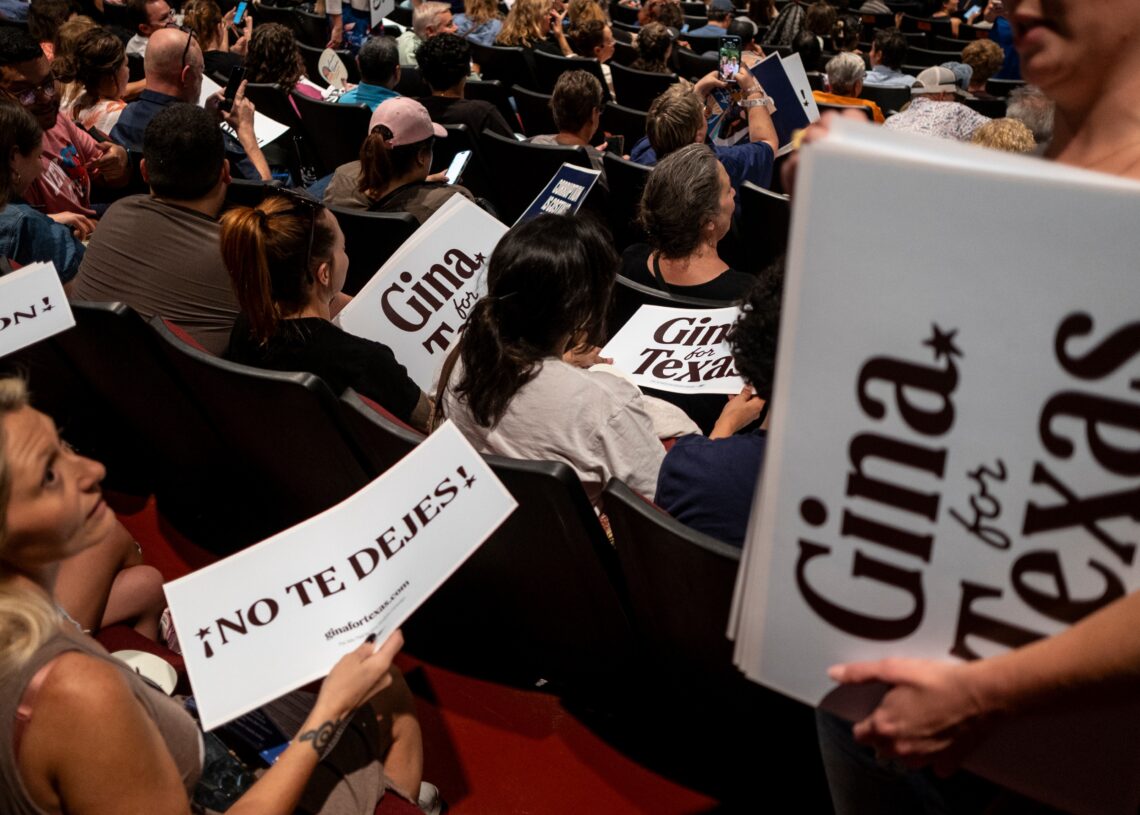
Lone Star Democrats have failed to clinch a statewide victory for more than three decades. A competitive Senate race is giving Democrats their best chance yet to achieve the elusive blue flip. But Democrats are also hoping that a surprisingly close governor’s contest will be the cherry on top. State Rep. Gina Hinojosa (D) is within striking distance of Texas Gov. Greg Abbott (R), who leads by only three points despite having more than four times as much cash on hand.
The race is notable not only for what it tells us about Texas, but for what it signals about Democrats’ 2028 jockeying.
Conventional wisdom says a three-term Republican incumbent with more cash would glide to victory in a red state that Trump won by 14 points in 2024. But at the Texas State Fair in Dallas last month, Hinojosa told me that a blend of national and local issues has yielded a special opportunity.
“The national political environment definitely helps,” she told me. “Because of the war, prices of gas are very high. Because of the tariff, prices of groceries — and everything — are very high, and people are angry about that.”
A major issue in the race is the Trump administration’s treatment of Latinos. Hinojosa told me that “everybody wants border security,” but she said immigration enforcement operations in the United States have gone too far.
Hinojosa, who grew up in the Rio Grande Valley, is hoping to harness Latino voters’ frustrations in the wake of the GOP’s gain under Trump. Some Democrats with possible presidential ambitions are taking note. Earlier this month, Illinois Gov. JB Pritzker sent Hinojosa $1 million. Maryland Gov. Wes Moore and California Gov. Gavin Newsom have also helped her.
Kentucky Gov. Andy Beshear (D), another potential 2028 hopeful, is catching heat from Latino Democrats for not investing more in the Texas race from his perch as chair of the Democratic Governors Association. The DGA this month sent $1 million — only 10 percent of a request that came from Latino politicians and operatives. Some Latino Democrats say they won’t forget the snub in 2028.
— Carine Hajjar, opinion journalist
Can money fix GOP woes in Georgia?
What does it cost to shake off the electoral anchor that is Donald Trump? Apparently, $200 million. That’s how much Republican Rick Jackson is spending in the governor’s race against the controversial former Atlanta mayor Keisha Lance Bottoms (D). Bottoms isn’t likely to spend more than $25 million in total. And the race is still a dead heat.
At least Jackson’s cash — plus a robust ground game — is putting him in a better position than his counterpart in the Senate race. Sen. Jon Ossoff (D) is trouncing Rep. Mike Collins (R), and both parties are pulling back their funding, a sign that the contest has wrapped up.
Whether Ossoff is popular enough to drag Bottoms over the finish line is another question. Ossoff is good, but Collins is a particularly poor candidate — especially given the white nationalists who keep popping up in his orbit. And Bottoms has her own problems: She’s the Atlanta mayor associated with the chaos and crime of 2020.
Still, the race is close. If Bottoms ekes out a win, it will mean that voters’ revulsion toward Trump is greater than many thought — and that a star is born in Ossoff. If Jackson wins, it will mean that the suburban voters splitting their tickets between Ossoff and Jackson are less upset at state Republicans than the national party. After all, Gov. Brian Kemp (R) is still popular — and the Jackson campaign shouldn’t forget that even Kemp barely squeaked by against Stacey Abrams (D) in 2018. Jackson has a good shot, but I bet the GOP wishes winning were cheaper.
— Cole Murphy, assistant op-ed editor
The weirdest contest of them all
Rhode Island might have the weirdest governor’s election. Democratic incumbent Dan McKee lost his primary, the first sitting governor since 2018 to do so. He was defeated, not by a socialist-adjacent outsider, but by multimillionaire former CVS Pharmacy executive Helena Foulkes, who lost to McKee in the primary in 2022.
Foulkes exacted her revenge after a debate where McKee said “I am the state of Rhode Island,” which is the sort of thing you can get away with saying when you’re Louis XIV, but not when you’re the abysmally unpopular governor of America’s smallest state.
While the Democrats fight each other, some polls show independent candidate Ken Block topping 20 percent. A key issue in the race: the Washington Bridge, which connects Providence with East Providence. After decades of poor state maintenance, it was closed in 2023. Then, the state said it would need to be demolished and rebuilt, with projected completion in 2028.
Five years without this bridge in the tiny Ocean State has people mad at a government that levies a large tax burden but can’t seem to do the basics. Given that Block is attracting substantial support with Republican Aaron Guckian in the race, the election could be won with well under a majority of the vote. Foulkes is still the heavy favorite to win, but not for the reasons Democrats are likely to win elsewhere. It’s refreshing to see a state election being defined almost entirely by state issues rather than being sucked into national narratives — so don’t expect to see much coverage of it unless you live in Rhode Island.
— Dominic Pino, editorial writer
The post ‘A dead heat’: Five governors’ races to watch appeared first on Washington Post.