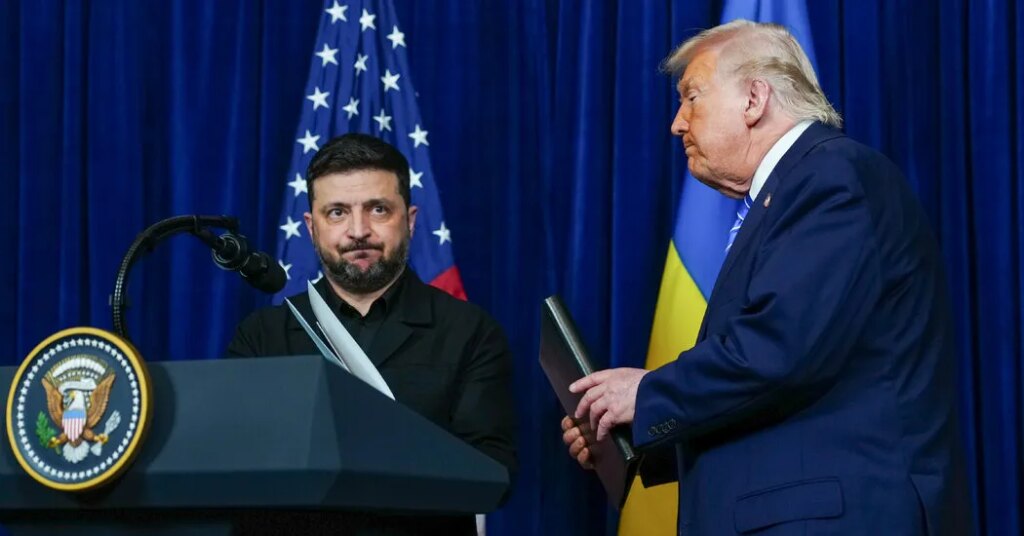
Donald Trump not only wants to buy diesel from Vladimir Putin — he’s suggesting Europeans start buying energy again from Russia, too. It’s a stunning reversal: Just a few years ago, major European countries like Germany were dangerously dependent on Moscow for cheap energy. It was the United States that called out that dependence.
Europe’s governments, some of them deeply unpopular, were predictably dismayed by Trump’s recent comments. But the continent’s ascendant and Russia-friendly far right cheered. Today I write about why this might be less a story about a surprise reversal of U.S. strategy and more one about Putin’s long-term strategy paying off.
Is Putin’s Ukraine strategy finally about to pay off?
For years, the war in Ukraine has effectively been a stalemate. The front has moved at a crawl, and at an appalling cost.
Western countries remained more or less united in supporting Ukraine against Russia, until Trump returned to office early last year. Since then, American military and financial aid to Ukraine has fallen sharply, shifting much of the burden to Europe.
Now, another turning point may be at hand.
Over the weekend, following his decision to waive some U.S. sanctions and buy Russian diesel, Trump went a step further. As my colleagues report, he has proposed that European countries resume buying Russian natural gas.
That idea has been categorically ruled out in many corners of Europe. But not in all of them. Alice Weidel, a leader of the far-right AfD party, told the German Parliament last week that sanctions on Russia were “ruining our own economy.” Marine Le Pen, the leader of France’s far right, criticized the European Union for leading “an energy war against Russia, when we haven’t got any energy.”
Putin has long believed that his commitment to waging war on Ukraine would outlast the commitment of Western allies to defending Ukraine.
It’s cost him more than a million troops killed or wounded, and counting. But his strategy might finally be paying off.
Putin’s waiting game
When Putin launched the full invasion of Ukraine in 2022, he expected it to be a quick war. One reason that didn’t happen was the resolve and unity of Ukrainians to put up a fight. Another was the resolve and unity of Western allies to help.
I spoke with my colleague Anton Troianovski, who covered the invasion as Moscow bureau chief and is now our global affairs correspondent. Anton told me that Putin was taken by surprise that Western countries managed to construct a united front.
That meant not only supplying Ukraine with weapons, money and intelligence. It also meant weaning European countries off cheap Russian gas at a major economic cost to Moscow, but to Europe as well. Germany, the continent’s biggest economy, relied on Russia for more than half the gas it used before the invasion; it now pays more for gas from other countries.
The resulting rise in energy costs, and its economic and political fallout in Western countries, have been at the core of Putin’s strategy to drag the war out, Anton said.
“It’s taking far longer than Putin anticipated,” Anton told me. “But he’s always been convinced that it’s only a matter of time until Western unity on Ukraine splinters.”
That explains why Putin has refused to end the war, time and time again, even as Trump has gone out of his way to offer him concessions.
On the campaign trail, Trump boasted that he could end the war within 24 hours. Three weeks after returning to the White House, he had his first phone call with Putin, followed by more promises of ending the war.
Six months later, Trump gave Putin the red carpet treatment in Alaska and said a cease-fire deal was close.
Then in November, Trump promoted a 28-point peace plan widely seen as favorable to Russia, again promising to end the war.
This shows two things, Anton told me: how far Putin is prepared to mortgage his own country to keep fighting this war in pursuit of his core demands — annexing territory, disarming Ukraine and ruling out any NATO involvement there. And how far Trump is prepared to go to give him what he wants.
The West’s pivot?
Putin has already gotten some of what he wants. Trump is buying Russian diesel, he’s getting even tougher on Ukraine and he’s leaning on Europe to buy Russian gas.
At the same time, many European governments are becoming weaker as populist parties friendlier to Russia are getting stronger (aided by Russian disinformation campaigns aimed at eroding trust in Western governments).
In France, Le Pen is the front-runner in presidential elections next year. In Germany, the pro-Russia AfD is now the most popular party. The rise of far-right parties in Europe has its own homegrown dynamic. But, as Anton put it, “it clearly dovetails with Putin’s efforts to splinter the Western coalition.”
In Washington, the splintering seems far advanced. Trump blames Ukraine’s president, Volodymyr Zelensky, for the ongoing war (Zelensky “doesn’t want to end this war, and probably never did,” he posted on social media Sunday) and shrugs off Russian bombardments that are causing sharply higher civilian casualties (“Russia, frankly, has been fine on Ukraine,” he said Monday).
The language matters. It points to Trump’s increased determination to force a deal on Zelensky, my colleague David Sanger wrote, “even one written largely on Russia’s terms.”
Which would be the greatest vindication of all for Putin’s strategy.
The latest: More than a week into his war of words with Trump, Zelensky met in Oslo yesterday with Steve Witkoff, Trump’s envoy.
MORE TOP NEWS
-
France extended curfews in parts of Paris and other cities for a second night following weekend riots. But the government is in no position to use money to bring calm to the streets. That’s because it’s also fighting a potential crisis in its bond market.
-
The British police rearrested two men in connection with an alleged terror plot at a British air base and said that they believed the men were working on behalf of Iran.
-
Residents of Alberta voted overwhelmingly to remain part of Canada. Prime Minister Mark Carney called it “a great result for Canada.”
-
Britain will send fighter jets to help defend Saudi Arabia from missile and drone attacks from Houthi rebels in Yemen.
-
Officials in Taiz, one of Yemen’s largest cities, warned of a humanitarian disaster as a Houthi siege of the city entered its third week.
-
A 43-year-old man was charged in Australia in connection with an attack on an independent lawmaker who remains in critical condition.
-
Defense Secretary Pete Hegseth met with Prime Minister Benjamin Netanyahu on an unannounced visit to Israel on Monday.
-
Secretary of State Marco Rubio is in India for meetings with business executives including Asia’s two richest men, Gautam Adani and Mukesh Ambani.
-
Trump is on the campaign trail ahead of the midterms, talking up his record even as political turmoil engulfs Washington. Tyler Page, one of our White House correspondents, explains in the video below.
WHAT ELSE IS HAPPENING
-
Global philanthropic organizations are in a race for dollars from A.I. fortunes that could bring a monumental wave of new funding for health aid.
-
Dolly Parton’s nephew is in a legal battle with her longtime manager. Text messages unveiled by the lawsuit show how bitter it has become.
-
A man was found guilty of animal cruelty for stealing a flamingo at a Las Vegas hotel.
TOP OF THE WORLD
The most clicked link in your newsletter yesterday was about a renovated Italian villa near Lake Como.
CHART OF THE DAY
A drop in U.S. visas
Legal immigration has fallen sharply as a result of Trump’s policies, which have made it all but impossible to immigrate from 91 countries. These charts show the drop in visas and green cards.
MORNING READ
A plan to build one of Europe’s largest data centers on a patch of farmland in Devon, southwest England, has run into strong opposition from residents, who quickly organized to oppose the project.
Banners protesting the “Devon data monster” hang in shop windows, and it’s hard to find anyone with a positive word for the project. Yet the data center also promises a surge of investment in Britain’s sputtering economy. Read more about the data center backlash.
AROUND THE WORLD
The ideal dog? He thinks he’s found it.
The fox collie has roots in the Scottish Highlands. It can work a ranch and run all day, but it can also play fetch, hang out on long car rides and relax next to you in bed. Unlike Border collies, which seem unable to sit still, fox collies are pros at the art of chill.
The fox collie is not a widely known breed, but Andy DuVigneaud, a winemaker in California, is out to change that. He sees the dog as the ideal pet for lonely and flailing humans in 2026. Read more to meet DuVigneaud and some very nice dogs.
RECOMMENDATIONS
Discover: The chef Daniel Boulud shared his five favorite places in Lyon, France.
Read: The works of the British art critic John Berger offer an antidote to our age of infinite scrolling.
Style: These stylish, hard-wearing boots are for city living.
Guess: Can you link these distinctive objects to the popular novels they’re from?
RECIPE
This exciting take on a fried egg features the mesmerizing sound of bubbling oil, the satisfying crunch of golden brown panko and the seductive reveal of an oozing yolk.
WHERE IS THIS?
Where is this castle?
TIME TO PLAY
Here are today’s Spelling Bee, Mini Crossword, Wordle and Sudoku. Find all our games here.
That’s it for today. See you tomorrow! — Katrin
We welcome your feedback. Send us your suggestions at [email protected].
The post Is Putin’s Waiting Game Working? appeared first on New York Times.