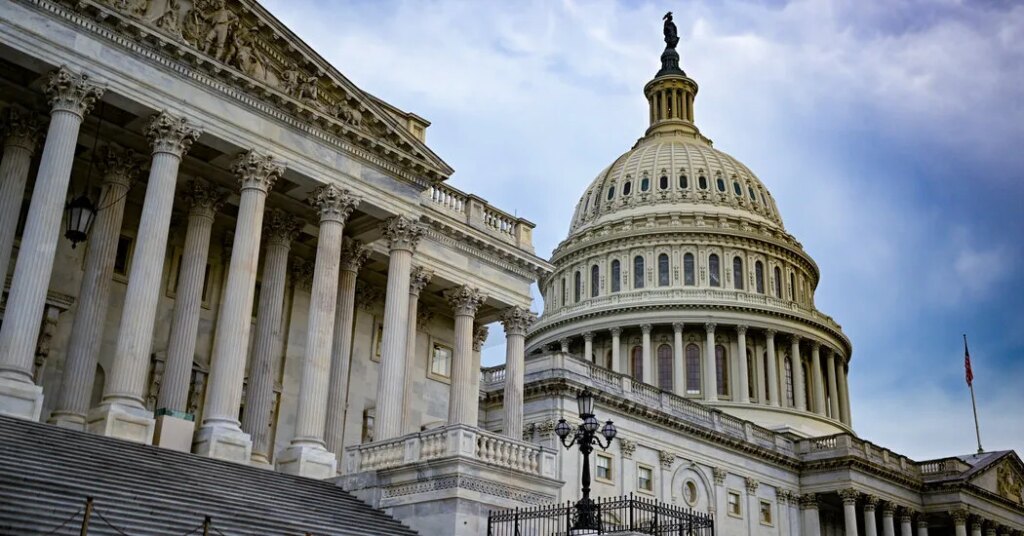
President Trump’s unfounded claims of large-scale voter fraud have Democrats bracing for what they worry could be substantial interference by the federal government in the midterm elections.
But with polls showing that Democrats are likely to win control of the House, some lawmakers and commentators have turned their attention to a different scenario that could unfold after the voting: Republicans in Congress, egged on by Mr. Trump, could try to block them from assuming the majority by refusing to seat elected Democrats.
The possibility sounds far-fetched and is regarded by many legal scholars as a vanishingly remote one.
“It requires a lot of ducks to be in a row that I don’t think would be in a row,” said Brian C. Kalt, a law professor at Michigan State University.
But the same might have been said in 2020 of the possibility that Republican lawmakers, under pressure from Mr. Trump, would challenge the Electoral College results that confirmed Joseph R. Biden Jr.’s victory. That is precisely what a majority of Republicans voted to do on Jan. 6, 2021, an effort in which Representative Mike Johnson, who has since become speaker, played a major role.
That is among the reasons that two moderate House members, one from each party, have asked their colleagues to pledge to accept certified election results and block efforts to refuse or delay seating winners.
Representative Hakeem Jeffries, Democrat of New York and the minority leader, said this month that his party was “preparing for all eventualities, including making sure that the results of the American people that emerge from the Nov. 3 general election are brought to life on Jan. 3 in the new Congress.”
That is the day that the next Congress is scheduled to convene. Here’s a closer look at what could happen.
State officials could contest election results.
The Constitution gives states the authority to administer their elections, and each one sends certificates of election verifying the winners to the House and Senate.
For decades, those certifications were part of a largely routine process, but since the 2020 election, a small number of state officials have voted against certifying elections or threatened to refuse to do so. Those efforts have been unsuccessful but at times have required other officials and courts to intervene.
Some federal election experts believe that this could be the greatest pressure point for efforts to reverse or sow doubt about the midterm election results. Democrats have said they are concerned that Mr. Trump has promoted false claims about election integrity to lay the groundwork for challenges to the counting, canvassing and certification of ballots.
If races are not certified, seats could remain unfilled when the new Congress first meets, which could affect the balance of power in the House. In 2021, a seat in upstate New York was left vacant for more than a month as an election dispute played out in court.
A congressional changing of the guard could leave room for disputes.
Because every House seat is up for election every two years, newly elected representatives must be sworn in at the start of the new Congress. The outgoing House of Representatives — and the majority in control of it — ceases to exist at noon on Jan. 3, and the chamber has to reconstitute itself.
In the interim, while nobody is in charge, federal law gives the clerk of the House, the chamber’s chief administrative official who is chosen by the speaker and then elected, the duty of assembling the list of new members. The statute directs the clerk to include only people “whose credentials show that they were regularly elected in accordance” with state and federal law.
The current clerk is Kevin F. McCumber.
Most election law experts believe this is essentially a bookkeeping task in which the clerk is required to recognize valid certificates of election that have been sent by the states. Professor Kalt said that clerks traditionally make sure that “the paperwork is right” but do not evaluate how an election was called or conducted.
“There’s not a lot of judgment happening here,” he said. “They’re just saying, ‘OK, the rules were followed. This person was elected. This person is on the roll of the members-elect.’”
But some commentators have speculated that Republicans could seek to intervene by pressuring the clerk to refuse to recognize Democratic winners — as Mr. Trump leaned on Vice President Mike Pence to do in 2021 — or seek to replace him with someone who would.
Such an action would likely prompt legal challenges, and many election law experts believe the courts would intervene.
But some Democrats note that Mr. Johnson has in the past resorted to extraordinary measures to bar a member of their party from being seated in the House, as he did when he delayed for nearly two months last year before swearing in Representative Adelita Grijalva of Arizona. (Mr. Johnson said he had done so because the House was not in session, though there is no rule barring the seating of a member during such a period.)
The House adjudicates its own election disputes.
While states control their elections, the Constitution also says that each house of Congress “shall be the judge of the elections, returns and qualifications of its own members.”
The new Congress — not the outgoing one — is responsible for settling contested races.
The House has faced hundreds of contested elections over its history, and Congress passed a law in the 1960s, the Federal Contested Elections Act, that establishes a procedure for doing so. (The law does not address the Senate.)
After a winner has been declared, the losing candidate has 30 days to contest the result with the House clerk. The burden is on challengers to prove that the results “entitle” them to the seat.
The House Administration Committee adjudicates contested elections. It can conduct an investigation and make a recommendation to the full House on which candidate to swear in.
Derek T. Muller, a law professor at the University of Notre Dame, said that members whose elections were certified had often been seated provisionally while their contests were being adjudicated.
“If somebody shows up to Congress with a certificate saying, ‘I am the member who’s been elected from this district,’ they still get seated,” he said.
In 2021, Representative Mariannette Miller-Meeks, an Iowa Republican, came to the Capitol after a recount showed she had just won her race by six votes. The Democratic candidate, Rita Hart, had filed a contest, but Ms. Miller-Meeks was allowed to take her seat while the committee investigated. Ultimately, Ms. Hart withdrew her challenge.
Any lawmaker can object to election results.
There’s another way that elections can be challenged in the House. After a speaker is selected and sworn in, any member-elect can challenge the right of another representative-elect to be sworn in.
Under the House’s precedents, the person being challenged is asked to step aside while the rest of the members take their oaths of office. After that, the lawmakers vote on whether to swear in those who were asked to step aside, or they can refer the question of seating them for investigation to the Administration Committee.
This avenue has been used less frequently since the Federal Contested Elections Act was enacted. But in 2021, Representative-elect Chip Roy, Republican of Texas, challenged the seating of 67 members-elect from the battleground states where Mr. Trump focused his false claims of voter fraud in the 2020 election.
Mr. Roy, who later voted against Mr. Trump’s efforts to overturn his election loss, appeared to be trying to make a point by arguing that Republicans who questioned the presidential results should be willing to lodge similar objections in House races in the same states.
But Democrats immediately brought a vote on whether to swear in the 67 members-elect, and it passed overwhelmingly, with just two Republicans, neither of them Mr. Roy, opposing it.
Notably, the disputed members-elect from those six states were allowed to vote on whether they could be seated.
The last time the House refused on the first day of a new Congress to seat a member whose victory was certified was in 1985.
Democrats — who already held a large majority — objected to seating a Republican from a hotly contested district in Indiana, citing issues with vote counting and the certification process that they contended needed to be investigated.
Voting mostly along partisan lines, the House left the seat vacant and referred the issue to the administration panel. A task force led by Democrats oversaw its own recount and after four months concluded that the Democratic candidate had won by just four votes. The House gave him the seat.
Things are murkier in the Senate.
In the Senate, where only a third of senators are up for election every two years, federal law requires states to send certificates of election to the vice president, who is the president of the Senate.
Unlike in the House, no federal statute governs how the list of new senators is compiled. The Senate’s rules put the secretary of the Senate in charge of compiling the certificates of election, but they do not make clear whether and on what grounds the secretary or vice president can reject them.
The Senate has dealt less frequently with election disputes in recent history, in part because statewide elections tend to have larger voting margins. It has fewer established procedures and has tended to operate on precedents when considering contested elections.
As in the House, the new Senate adjudicates election disputes, and challenges are usually referred to the Rules Committee while the senator-elect in question is seated “without prejudice.” If the investigation finds in favor of the challenger, the seated senator could then be removed from the Senate by a simple majority vote rather than the two-thirds majority typically required to expel a senator.
In 1997, the Senate provisionally seated Senator Mary Landrieu, Democrat of Louisiana, while the Rules Committee investigated accusations of voter fraud in her state. After months of investigating, the committee found in her favor.
Election disputes have led to lengthy Senate vacancies.
The Senate has also left seats vacant while election disputes were being fought. Senator Al Franken, Democrat of Minnesota, was not sworn in until seven months after his 2008 election, after a long recount and court battle.
But a Senate race in New Hampshire in 1974 made Mr. Franken’s path look easy. In the Election Day vote, the Republican, Louis C. Wyman, won by 355 votes. After a recount, the Democrat, John A. Durkin, was ahead by 10. After another recount, Mr. Wyman was ahead by two votes and was certified the winner.
Mr. Durkin asked the Senate to review the election, but the Rules Committee deadlocked and asked the full Senate to vote.
Instead, the Senate sent the disputed election back to the panel, which spent months reviewing 3,500 disputed ballots that it had shipped from New Hampshire. Still, senators were deadlocked on several issues that would have swayed the outcome, so the committee sent the full Senate a list of 35 disputes.
After six weeks of debate, senators had resolved just one of them. With lawmakers set to leave for their August recess and no clear end in sight, both Mr. Wyman and Mr. Durkin agreed to a new election, and the Senate declared the seat vacant.
Mr. Durkin ultimately won.
The post If Democrats Win Congress, Could the G.O.P. Refuse to Seat Them? appeared first on New York Times.