ABU FALAH, West Bank — Ehmeid Hamayel trod cautiously along an olive grove strewn with spent tear gas canisters and burned shrubs. He motioned to his neighbor, Raed Hamayel, to hop on a ledge and yell if he saw Israeli settlers coming down the mountain as they had on four of the previous six days.
An attack on Friday by settlers, which left a Washington Post photographer, Heidi Levine, with four fractured vertebrae and a broken rib, drew international attention and sharp condemnation from Israeli opposition leaders and U.S. officials.
But to the exhausted residents of Abu Falah, surrounded by rocky hills dotted with three new settler outposts, it was just another day in a week of similar attacks, in a year spent under unrelenting siege.
On Oct. 13, dozens of masked settlers hurled rocks and tried to storm the village, northeast of Ramallah, in the Israeli-occupied West Bank.
Then, around 2 a.m. Wednesday, the settlers sneaked as far as Nader Abu Murrah’s trailer, on the outskirts of the town, and poured gasoline on the farmer as he slept in bed.
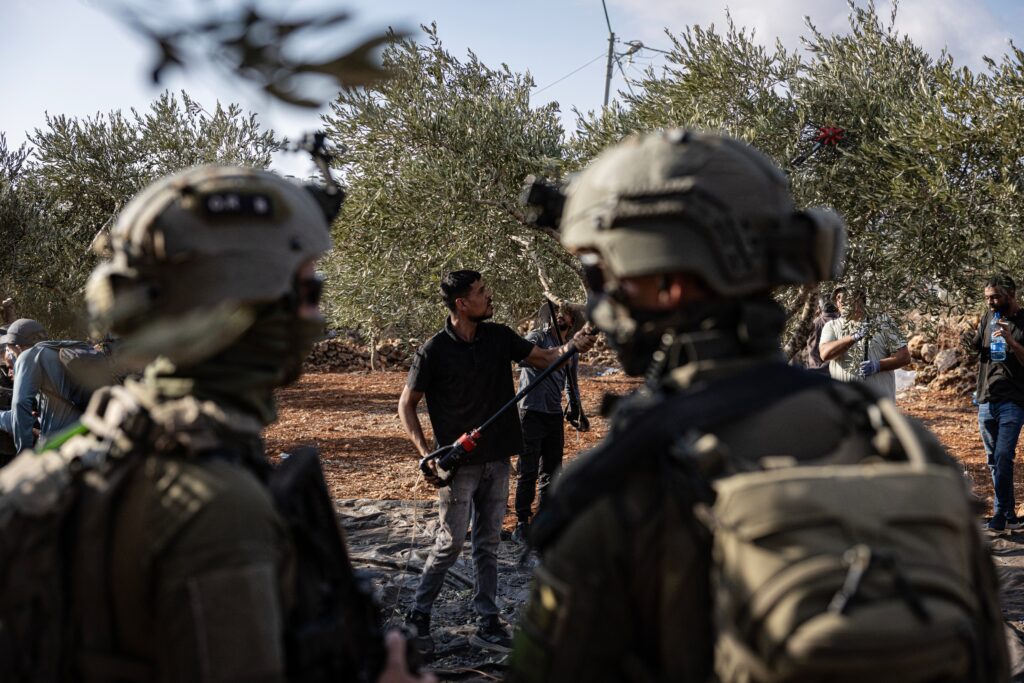
On Friday, in what appeared to be a coordinated assault, dozens streamed down the incline and attacked farmers, activists and journalists during an olive harvest. In the clash that followed as Palestinians fought back, the settlers kicked and beat Levine while she lay on the ground. She wore a vest marked PRESS on front and back.
On Saturday, the settlers were back again, harassing farmers in the same grove until Israeli security forces arrived and dispersed everyone with tear gas.
“We’re tracking them,” said Ehmeid, squinting at the tent pitched by settlers on the hilltop a few hundred yards away. If he saw movement, he and Raed, 35, a carpenter, would update a WhatsApp chat group with other villagers who volunteered to be lookouts on round-the-clock shifts.
“They’ve even tried to attack us inside our homes at least 12 times,” said Ehmeid, 38, who is a political activist and member of Fatah, the party led by Palestinian Authority President Mahmoud Abbas.
With Israelis facing a pivotal national election on Oct. 27 and Palestinians kicking off their month-long olive harvest, the West Bank has become a battleground.
From the outskirts of Nablus in the north to the south Hebron hills, Palestinian residents and Israeli and international monitors are reporting unprecedented numbers of settler raids, arson attacks, land seizures and theft — all largely unchecked by Israeli security forces and Prime Minister Benjamin Netanyahu’s government, which counts settlers as a key voter base.
On Saturday, a day after the violence in Abu Falah, settlers assaulted a delegation of European diplomats outside the West Bank town of Taybeh.
Netanyahu’s office initially questioned reports of both attacks, which were recorded on video, and warned that there was a “coordinated campaign to smear Israel and the Jewish residents of Judea and Samaria during the annual olive harvest.”
A day later, Israeli security officials announced that they had launched an investigation, demolished two outposts and arrested 10 people in connection with the assaults on Levine and the Europeans.
When victims are solely Palestinians, however, such a response is rare. And Netanyahu’s critics and many in Israel’s security establishment say the frequency and brazenness of settler attacks is unlike anything they have seen in decades.
“This is the worst period ever,” said Ilan Paz, a retired Israeli general who commanded an infantry brigade in the West Bank and later headed the Israeli civil administration of the occupied territory. “The reason behind it is that the Israeli government supports it. The ministers who have the power to control it don’t want to use it — especially now, two weeks before the election.”
In the wake of the recent high-profile attacks, Defense Minister Israel Katz, who is from Netanyahu’s Likud party, reiterated that the military would not impose administrative detention on settlers charged with crimes — because law enforcement is the responsibility of the police.
Meanwhile, Itamar Ben Gvir, the National Security minister who leads the police, said that a handful of “hilltop youth” may have crossed the line in their recent attacks on Levine and diplomats but that the victims in the West Bank were Jews — not Palestinians forced from their homes.
“Let’s not forget who the real victim is here, and who the attacker is,” Ben Gvir told Israeli television.
In the rocky hills and olive-dotted plains of the West Bank, the result of the government’s indifference has been a steady crescendo of violence.
Palestinians once considered the autumn harvest a yearly celebration, marked by families sharing a cast-iron pan of sajiyeh, a meat and pepper dish, under their olive trees after a day in their orchards.
But since 2023, settler attacks and land closures ordered by the Israeli military have led to drastically downsized harvests. Palestinian farmers say they were desperate to gather this year’s crop.
To provide a protective presence in the fields, they have coordinated with Israeli and international activists, including members of the Jewish diaspora, retired Israeli officials and foreign dignitaries. But militant settlers have not been deterred.
On Saturday, Hussain Kaabneh, 50, watched from his hillside grove in Taybeh as more than a dozen settlers hurled rocks and intercepted the delegation carrying activists and European officials through the valley below. In videos posted on social media, a man speaking Hebrew was shown punching a visiting mayor from France.
A day later, Kaabneh, his wife and three sons were still on edge. Neighborhood boys were posted nearby, they said, ready to whistle if they spotted encroaching settlers. Kaabneh parked his car up the hill nearby so his family could flee without being cornered.
Even if they managed to safely gather their crop, the family said, they would return to a miserable daily existence. They park their car far from their house, because one was already burned. They sleep in shifts at home, because their windows have been smashed once before.
“I live in a prison,” Kaabneh’s wife, Muntaha, said.
Even though Netanyahu’s ministers and the government’s supporters have decried an influx of foreigners, accusing them of provoking confrontations and destabilizing the West Bank, many Palestinians say attacks have become so pervasive that they only venture into the fields when accompanied by sympathetic Israelis and international monitors.
Jill Jacobs, chief executive of the human rights group T’ruah, which brings groups of American rabbis to volunteer during the harvest, said the presence of Jewish activists sometimes helped prevent violence, sometimes not.
During the harvest last year, she recalled, settlers fired gunshots in the air and crashed a drone onto the volunteers, then reported to Israeli soldiers that people had thrown rocks at their drone. Had activists not been present, Jacobs said, Palestinian farmers might have been wrongfully arrested.
“This is how we practice our Jewish values, by accompanying the farmers,” Jacobs said. “It’s 100 percent legal for Palestinians to harvest their olives, and it’s 100 percent legal for them to bring friends and partners. Nobody is interested in provoking violence.”
Ten miles up the unusually deserted road from Taybeh, residents in Abu Falah said that Friday’s attack — just one of many since March 8, when settlers first appeared on the hilltop overlooking their village.
That first night in March, settlers descended into the olive fields and set trees on fire. When Palestinians tried to stop them, leading to a clash, settlers shot two villagers in the head, residents said.
A third villager died after he inhaled tear gas fired by soldiers attempting to clear the area, according to the Palestinian Health Ministry.
The next day, the Israeli army commander in charge of the West Bank, Avi Bluth, condemned the shootings as “unacceptable” and declared “zero tolerance” for vigilantes who “do not represent the Jewish people or the State of Israel.”
But no one was ever arrested, locals said, and within days, the raids continued.
When scores of settlers descended again on Friday morning, days after an even larger attack earlier in the week, Israeli security forces rushed to the scene. Instead of arresting the rampaging settlers, they fired tear gas into an olive grove that was quickly turning into a chaotic battlefield.
Masked settlers hurled rocks. Palestinians fought back.
Shortly after 9:30 a.m., masked men pulled up in a white pickup truck on the settlers’ side and disappeared behind a cloud of tear gas and smoke from olive trees that had been set ablaze, according to a video of the incident taken by Ehmeid Hamayel.
Jasper Nathaniel, an American freelance journalist and activist who was at the scene, recalled seeing the men in the truck bed toting M-16 rifles, which are frequently issued by the Israeli government to settlement security forces in the West Bank.
Moments later, more than a dozen gunshots rang out from the direction of the truck, but the shooter was not easily identifiable, according to eyewitnesses and videos. The Palestinians, activists and journalists scattered.
Levine, who was on assignment for The Post, fell on a dirt path and was left behind.
For several minutes, Ehmeid Hamayel watched as Levine laid in a fetal position on the ground, pleading with settlers who surrounded her and pummeled her with batons and kicks.
At one point, they dragged her about 10 yards back before continuing to beat her and stripping her of her cameras and phone. After several minutes, her screams suddenly stopped.
“We were worried we lost her,” Ehmeid recalled.
Fearful of Levine’s condition, Palestinian men began hurling rocks in a coordinated counterattack that briefly pushed the settlers back. At that point, a video filmed by the Russian-Israeli activist Andrey Khrzhanovskiy showed, Nathaniel rushed forward to help Levine to her feet. As settlers closed in again, Adele Shoko, another Russian-Israeli activist, urged her to run.
“I can’t,” Levine, seemingly in shock, told her rescuers. “Let me die.”
Chaos raged on. About 30 minutes later, a Abu Falah resident, Abdel Jaber Shoman, 54, was shot in the leg by Israeli soldiers as he ran away from them, according to Azam Ahmed, a New York Times journalist who witnessed the shooting.
A few days later, shortly before Israeli security forces dismantled one of the outposts and arrested several settlers involved in the attack, Ehmeid surveyed the scene.
He had recovered some of Levine’s belongings that had been left in the dirt and stepped around spent Israeli tear gas canisters on the ground.
He walked past a row of shrubs blackened by an arson attack, then paused outside the home of Mustafa Za’atar, a 78-year-old U.S. citizen whose three cars were burned last month.
A few months ago, Ehmeid said, the settlers got reinforcements: Another outpost was set up on the ridge just to the south.
“It’s every day, every day,” he muttered. “We are surrounded.”
The post For West Bank Palestinians, settler attack on journalist is part of ongoing siege appeared first on Washington Post.