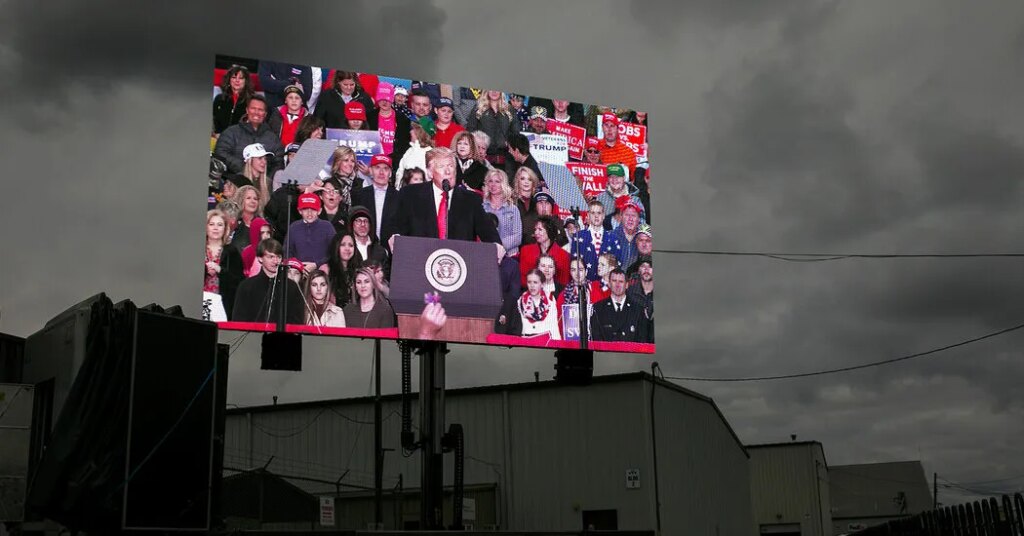
One of the most memorable lines in President Trump’s first Inaugural Address on Jan. 20, 2017, was: “The forgotten men and women of our country will be forgotten no longer.’
It was so good, in fact, that he recycled it in his speech accepting the Republican presidential nomination for the third time, on July 18, 2024: “To all of the forgotten men and women who have been neglected, abandoned and left behind, you will be forgotten no longer.”
Politicians routinely overpromise, with the candidate and the voters privately recognizing that there will be no land of milk and honey on the other side of the election.
Trump, however, is anything but a routine politician. Throughout his three presidential campaigns, he claimed again and again to be the savior of working-class America. Those claims, however, mask his real agenda: to protect and enhance the wealth and income of the superrich — most importantly himself — while leaving driblets behind for the struggling working class.
The actual policies Trump has enacted, given the chance to make good on his promise to remember the forgotten, show that he has little or no regard for America’s forgotten men and women unless by forgotten he means himself.
If Trump felt any obligation to truth — ha, ha, ha — he would place himself in the same tradition as King Louis XIV of France, not in the line of Andrew Jackson and Bernie Sanders.
In reply to my inquiry about Trump’s regressive policies, Emmanuel Saez, an economist and director of the Stone Center on Wealth and Income Inequality at the University of California-Berkeley, wrote by email:
Our real-time inequality data show that since the beginning of 2025, when Trump returned to the White House, incomes of the bottom 90 percent of Americans have stagnated after taking into account price inflation. Incomes of the top 10 percent have grown 6 percent with even higher growth for upper-income groups such as the top 1 percent.
The regressive redistribution income is more striking when analyzed in terms of actual dollar changes.
Adults in the bottom half of the income distribution experienced a modest loss of $31 dollars.
Those in the middle gained $570 on average.
It’s a very different story for those in the top rungs. For the top 10 percent, a gain of $17,000; the top 1 percent, $110,000; top 0.1 percent, $520,000; top 0.01 percent, $2.8 million; top 0.001, $20 million each.
Even more striking, Saez wrote, “has been the surge in the wealth of the billionaire class (top 001 percent, or top 2,600 richest American families) with wealth increases of about 18 percent since January 2025.”
The Federal Reserve has data comparing changes in net worth by income group.
The net worth of roughly 136,800 households in the top 0.1 percent grew to $27.87 trillion in the second quarter of 2026 from $22.27 trillion in the first quarter of 2025, a gain of $5.6 trillion.
Trump and his family are leading this charge. He increased his wealth by at least $2.2 billion since returning to office, The Times reported.
He had, of course, one big advantage: the White House and the legions of men and women seeking pardons, regulatory relief, access to top officials, contracts and so on. For Trump, the presidency is an A.T.M. handing him steady withdrawals, with no fees — in fact, no obligation to pay back at all.
How well did the constituency realistically described as forgotten do during the same period, the roughly 67,600,000 households in the bottom 50 percent of the income distribution?
Their net worth grew by a total $403 billion, to $4.278 trillion from $3.875 trillion, or a gain of $6,000 each.
Bottom line: During the second term of Trump’s Robin Hood regime, the net worth of the top 0.1 percent has grown 6,800 times faster on average per household than for those in the bottom half.
The comparison for Trump himself is astronomical: His riches grew at a rate more than 367,000 times faster than for a household in the bottom half.
The question: Is Trump’s One Big Beautiful Bill Act more regressive than the tax bills enacted during the administrations of George W. Bush and Ronald Reagan, both no slouches when it comes to pushing through trickle-down legislation?
I posed this question to Jason Furman, a chairman of the Council of Economic Advisers during the Obama administration and now a professor of economic policy at Harvard’s Kennedy School. His response:
President George W. Bush’s tax policies alone were more regressive than President Donald Trump’s, including cutting the top rate to 35 percent whereas President Trump only cut it to 37 percent.
But President Trump’s tax and spending policies combined — which is the more important way to look at it — are much more regressive than President Bush’s largely because of President Trump’s cuts to Medicaid, the Affordable Care Act and other low-income programs. In contrast President Bush actually slightly expanded all of those programs.
President Reagan’s initial tax and spending policies were even more regressive than President Trump’s but the cumulative impact of his eight years was much less regressive largely because he signed multiple tax increases starting in 1982 that partly undid his huge 1981 tax cut and, even more important, he signed a series of Medicaid expansions starting in 1984 that were pushed by Henry Waxman and other Democrats.
In their June 2026 paper, “Bucking Backlash? Why Republicans’ Hyper-Inegalitarian Tax and Budget Bill Passed,” Patrick Sullivan, a postdoctoral research associate, and Jacob S. Hacker, a professor of political science, both at Yale, show no doubt in crowning Trump the king of regression: “In July 2025, congressional Republicans and President Trump enacted the One Big Beautiful Bill Act, the most regressive tax and budget legislation in modern American history.”
How did Trump pull it off?
First, according to Sullivan and Hacker, was the inclusion of “populist but fiscally trivial tax provisions” — no taxes on tips — which “dominated media coverage and public awareness, while welfare state cuts were recast as fraud elimination and work promotion.”
“Second, Trump exercised greater coercive hold over his allies in Congress, increasing their fear of base-voter retribution — fear rooted not just in elite polarization but also credible threats of primary challenges and even personal harm.”
Sullivan and Hacker warn that the successful strategy used to enact the One Big Beautiful Bill Act appears to have given Republicans new strategies to minimize opposition while enacting regressive tax and spending legislation, what they call an “OBBBA playbook.”
“As the 2026 midterm approaches,” they note,
Republicans’ electoral vulnerabilities are manifest. Yet they appear to reflect broader negative reactions to the Trump presidency, especially his tariffs and foreign military actions, not backlash against Republicans’ inegalitarian legislative achievements.
In fact, the part of the O.B.B.B.A. that may pose the greatest risk elicited comparatively little controversy in 2025 — massively increased spending for Immigration and Customs Enforcement.
It would be ironic if Republicans who skillfully deflected attention away from the historic regressivity of their One Big Beautiful Bill found themselves vulnerable for elements of that bill they had proudly touted.
Stepping back to encompass a wide range of political and policy factors, Steve Wamhoff, the federal policy director at the Institute on Taxation and Economic Policy, published an expanded report, “Impact of Key Trump Policies on Taxes and Costs: National and State Estimates,” this month.
Wamhoff makes the case that Trump’s policies have been an across-the-board disaster for everyone except the very well-to-do: “The main policies of President Trump during his second term in office have had the net effect of raising taxes and costs in 2026 for the typical American in every income group except for the richest 1 percent.”
Wamhoff writes that the causes of this maldistribution included the centerpiece of Trump’s second term, the One Big Beautiful Bill Act, Trump’s tariffs, the effect of the Iran war on fuel prices, Trump’s immigration policies and the end of an expanded tax credit for health care.
Wamhoff’s conclusion: With the exception of the top 1 percent, every income group ends up losing ground through higher taxes, lost benefits and higher costs. The bottom 20 percent will lose $750 in taxes and consumer costs, while the losses for the other income groups range from $1,120 to $1,730.
In contrast, those in the top 1 percent come out ahead by $12,560.
The best evidence of presidential priorities can be found in the distributional tables in the analyses of legislation by the Congressional Budget Office.
In Trump’s case, data from a 2017 Urban-Brookings Tax Policy Center report, “Distributional Analysis of the Conference Agreement for the Tax Cuts and Jobs Act,” and the Congressional Budget Office’s June 2025 report “Distributional Effects of H.R. 1, the One Big Beautiful Bill Act” provide crucial insight into his priorities.
The Tax Policy Center found that Trump’s 2017 tax legislation was decisively regressive.
Those in the bottom 60 percent of the income distribution were projected in the study to receive benefits of less than $1,000 in 2018, $60 for the bottom quintile, $380 for the second quintile and $930 for the middle quintile — nowhere near enough for three days at Disneyland for a family of four.
For those at the top of the ladder, there was projected to be an abundance of joy that year. The top 1 percent got a tax break of $51,140 and those in the top 0.1 percent got $193,380 — enough to spend months at Disneyland.
Trump has demonstrated his increasingly sophisticated mastery of regression during his six years in office. Now, however, the polls suggest that voters are catching onto him with increasing vengeance. The Fox News poll released this month showed Trump’s approval rating falling to 36 percent, “his lowest ever in a Fox News survey.”
What remains worrisome is how this godawful man will react to a severe rebuke on Election Day, Nov. 3., with two years still to go on his presidency. He has, after all, devoted much of his adult life to seeking revenge against those who dissed him, and on Nov. 4 the target of his lust for vengeance may well be the American voter.
Matthew Tobin contributed research to this article.
The Times is committed to publishing a diversity of letters to the editor. We’d like to hear what you think about this or any of our articles. Here are some tips. And here’s our email: [email protected].
Follow the New York Times Opinion section on Facebook, Instagram, TikTok, Bluesky, WhatsApp and Threads.
The post Trump Can No Longer Mask His Real Agenda appeared first on New York Times.