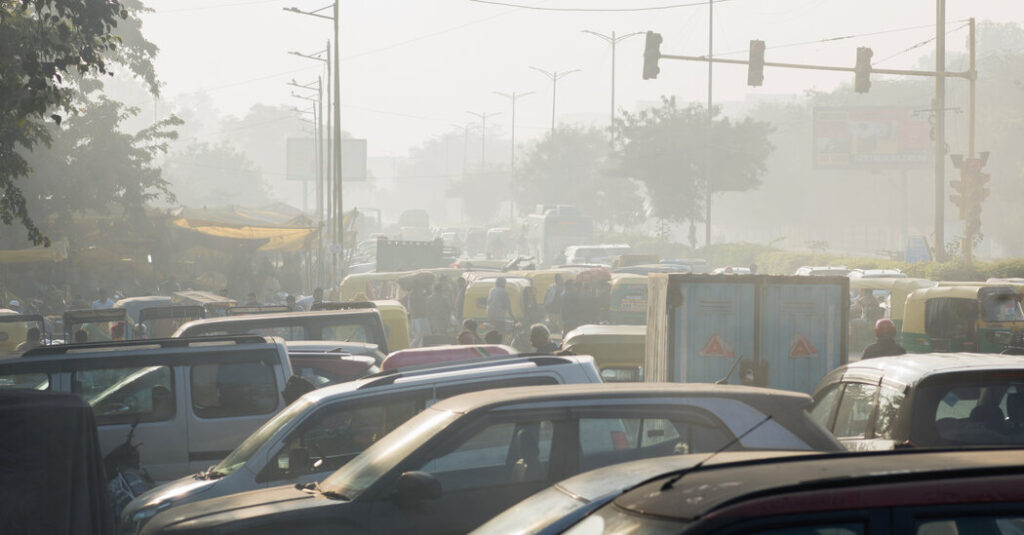
After the long, torturous summers that bake northern India in 40-degree Celsius (104 degree Fahrenheit) heat, winter should be welcomed as a reprieve. Instead, it is our season of sadness.
The annual pollution emergency faced by hundreds of millions of Indians is upon us — three months of physical and emotional suffocation.
I live in Delhi, one of the most polluted major cities in the world, which is wrapped during winter in a dull sepia more befitting a vintage photograph than a place alive in the present. The air smells toxic, leaves a metallic burn in the throat and stings the eyes.
This health crisis has become a built-in feature of life, as predictable as the annual choreography of public fear and government paralysis that comes with it. Once again, Delhi’s pollution levels have repeatedly blown past the upper limits of the government’s air quality index into hazardous territory, or more than a hundred times what global health bodies say is safe.
Yet this year feels different.
Residents of Delhi have come out to demand the right to breathe, in recent protests that, for the first time, have been significant enough to make national headlines. It is my first winter as the father of a baby girl. Her presence should be a source of unbridled joy, but it brings a new layer of anxiety over what the air pollution is doing to her still developing organs and the environmental birthright we are leaving her generation.
The air apocalypse dictates the basic rhythms and routines of life. It pushes us indoors, behind windows that are taped shut and where activity revolves around the air purifier that hums all day in its Sisyphean labor. We check the air quality website with the devotion of share traders watching the stock index. When pollution spikes, the website turns red, signifying hazardous conditions, and helpfully includes an animated image of a boy collapsed on the ground wearing a gas mask.
Delhi’s air is usually worst in the morning, improving slightly for a while around midday. That’s when many people hurry to run errands before the suffocation resumes in the evening. Happiness is when a breeze kicks up, temporarily pushing pollutant levels down from severe to very poor.
Wealthier residents of the city of more than 30 million people install pressurized clean air systems that create a sealed bubble in their apartments, and some people carry portable air quality monitors to measure particulate levels wherever they go. Many just leave Delhi entirely as smog refugees.
But most can’t afford such luxuries. Millions live in substandard housing with open vents that can’t be sealed and have no choice but to go out each day to earn a living. In a city of vast inequality, the air itself has become another divide between rich and poor.
For well over a decade now, a perfect storm has sustained this yearly plague. There is the simple curse of geography — the wall of the Himalayas that prevents polluted air from dispersing — compounded by colder, heavier winter air. Dusty construction sites and millions of cars in Delhi and across the wider region thicken the haze, as does the seasonal burning of crop residue in nearby states. Lists of the world’s 100 most polluted cities are dominated by northern India, with only a few foreign names that spoil the sweep.
Every morning I take my daughter to the window of our apartment. Almost reflexively, she brightens at the sight of the wider world, watching people and bikes drift in and out of the gloom outside. Babies are drawn to movement and want to feel the rhythm of the outdoors. But these glimpses through a dirty windowpane are all I can allow. I’m left with heavy guilt about what kind of childhood we are offering our children, a helplessness shared by many parents I know.
The air is choked with particulate matter finer than dust that can travel through your lungs and into your bloodstream, raising the risks of heart disease, lung cancer, strokes and other health threats. The human cost is staggering. According to independent public-health research groups, air pollution may have been linked to more than 17,000 deaths in Delhi in 2023 — about 15 percent of fatalities in the city that year. A recent study estimated that long-term exposure to air pollution may contribute to as many as 1.5 million deaths in India each year.
Many Indians wrongly believe they can somehow build immunity to illness just by inhaling this air. I recently asked a motorbike taxi driver how he survives. His secret? Drinking a mix of local herbs and jaggery to detox his lungs. When reality is unbearable, delusion becomes the only shelter some people can afford.
Solving a crisis of this scale will demand coordinated action across multiple states and the urgency of a war effort. The government has begun to acknowledge the need for a collective effort, but the country’s polarized politics and fragmented, inefficient bureaucracy remain obstacles. Each winter Delhi’s government releases an action plan of familiar fixes: sprinklers and water guns designed to bring particulates to the ground, road sweepers, dust-control measures for construction sites, various emergency response plans and so on. None of it seems to have worked.
Yet pollution is still, remarkably, not an electoral subject. On the list of perennial concerns that shape voting in India, the world’s most populous country — jobs, inflation, economic growth and making ends meet — seasonal air pollution is at the bottom.
What makes this reality even harder to accept is that we know something could be done. Beijing once lived with epic pollution. China’s one-party system was able to tackle it with a speed and force that is out of reach for a democracy that moves through committees, courts and coalitions.
Winter will pass, the air purifiers will fall silent, and life will get back to normal. But it will be only a temporary parole from a sentence that never ends.
Anurag Minus Verma is an Indian podcaster and the author of “The Great Indian Brain Rot: Love, Lies and Algorithms in Digital India.”
The Times is committed to publishing a diversity of letters to the editor. We’d like to hear what you think about this or any of our articles. Here are some tips. And here’s our email: [email protected].
Follow The New York Times Opinion section on Facebook, Instagram, TikTok, Bluesky, WhatsApp and Threads.
The post Life and Death in India’s Air Apocalypse appeared first on New York Times.