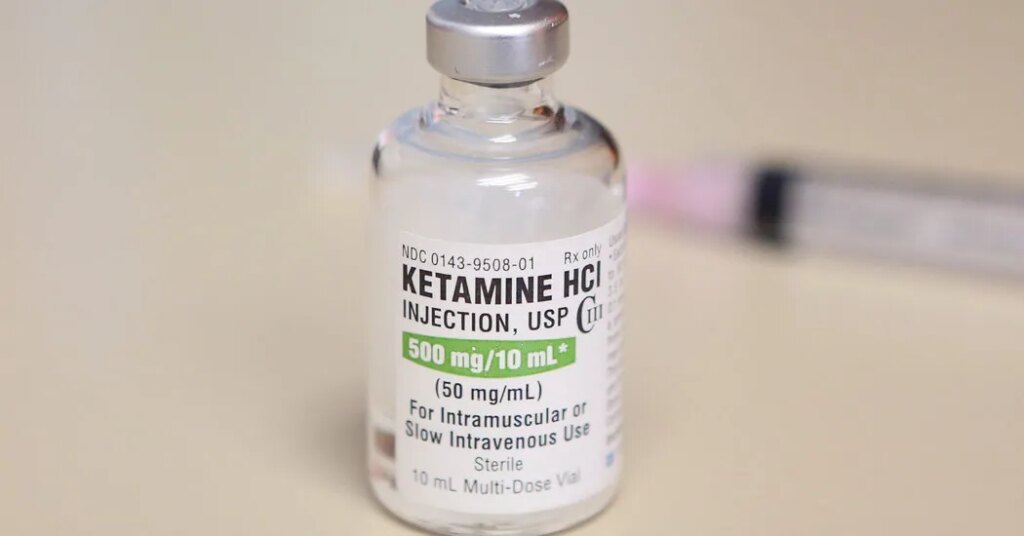
How would you like your ketamine? In tablet form, or a thin film that melts in your mouth? Delivered as a nasal spray, or combined with a cancer drug to extend the antidepressant effects?
In a gold rush accelerated by the Trump administration’s unlikely zeal for experimental psychedelic treatments, over a dozen companies are developing products based on ketamine, the generic anesthetic that in recent years has become a popular treatment for mental health conditions. (And, unfortunately, a ubiquitous recreational drug.)
The companies are chasing the riches enjoyed by Johnson & Johnson, which is expected to earn $2.3 billion this year from its blockbuster drug Spravato, a ketamine-like nasal spray used to treat depression and suicidal ideation.
For now, Spravato is the only psychedelic treatment on the market approved by the Food and Drug Administration.
Because ketamine lost its patent protection decades ago, many of the companies are engaged in what’s known as drug repurposing, the potentially lucrative approach to finding new uses for old medicines.
Repurposing dramatically cuts the time and expense associated with discovering an entirely new therapeutic compound and establishing whether it’s safe and effective. The protections granted by the F.D.A. essentially give an applicant years of exclusivity on their repurposed compound.
Sometimes it’s just a matter of putting an old drug in a new package.
Take Ketafree, developed by the company NRx Pharmaceuticals. Ketafree is essentially ketamine without benzethonium chloride, or BZT, a preservative used in scores of drugs.
The company is pursuing an unusual, two-pronged approach it hopes will give Ketafree an edge over its would-be competitors.
In a petition filed last year, NRx urged the F.D.A. to ban the nation’s supply of ketamine, claiming BZT is a danger to human health. Virtually all ketamine contains the preservative, and the company did not provide evidence for its contention.
But in a separate move, NRx also filed an application seeking F.D.A. approval for Ketafree, which packages generic ketamine in a specialized vial that allows it to remain sterile without a preservative.
At the moment, Ketafree leads the pack in the race to win F.D.A. approval. NRx recently said its application was moving so expeditiously that it had ordered 5 million doses in anticipation of commercialization.
Company executives would not say how much they plan to charge. Generic ketamine costs roughly a dollar a dose.
NRx’s audacious bid to corner the $750 million ketamine market has raised alarms among health care providers who say the gambit, if successful, could upend the fields of anesthesia and psychedelic medicine by dramatically increasing the cost of a pharmaceutical mainstay.
The drug, manufactured mostly in China and India, is already subject to intermittent shortages.
“The whole effort feels very unethical and cash-grabby,” said Dr. Nicolas Grundmann, a board member of the American Society of Ketamine Physicians, Psychotherapists & Practitioners.
The F.D.A. declined to comment, citing a policy of not discussing pending applications.
NRx isn’t the only company trying to jump on the ketamine juggernaut.
Solvonis Therapeutics is seeking approval for ketamine rendered as a thin oral film for the treatment of alcohol-use disorder. Freedom Biosciences is developing an antidepressant that combines ketamine with a 20-year-old kidney cancer drug to extend the durability of ketamine’s benefits.
Tasman Therapeutics is working on an extended release oral ketamine for depression that can be taken at home instead of a doctor’s office. And after years of sitting on the sidelines of the psychedelics boom, Big Pharma has finally entered the fray.
Eli Lilly recently announced a $3.5 billion bid to acquire the psychedelic company AtaiBeckley and its treatment for depression, a hallucinogen called DMT.
Earlier this year, AbbVie said it would spend $1.2 billion on a novel psychedelic that Gilgamesh Pharmaceuticals developed for depression.
Jonathan Sporn, the chief executive of Gilgamesh, said a new wave of ketamine-adjacent drugs would benefit patients by offering more efficacious and accessible versions of existing medications that could be used to treat a broader range of mental health conditions.
He said the company’s drug, blixeprodil, which is still in early clinical trials, had been engineered to reduce the dreamlike detachment brought on by Spravato and ketamine. The goal is for the new drug to be safely taken at home, and for a wider range of depressive disorders. If approved, Dr. Sporn said blixeprodil would be an attractive alternative to Spravato, which is administered via nasal spray at a doctor’s office, sometimes once or twice a week.
Spravato is only approved as a treatment for patients with major depressive disorder who have failed to find relief with at least two oral antidepressants, or are experiencing suicidal thoughts.
Insurers now pay as much as $1,200 per Spravato session. The payment covers the nasal spritz and a mandated two-hour observation period.
“Imagine having to go to a clinic every week, spray stuff in your nose and sit there for two hours?” Dr. Sporn asked. “We think our product will be superior.”
Because ketamine’s off-label use in mental health has not been approved by the F.D.A., most insurers don’t cover ketamine infusions, which can cost thousands of dollars per session at private clinics and often include talk therapy.
Jonathan C. Javitt, chief executive of NRx, said regulatory approval would expand ketamine’s therapeutic reach by opening the door to insurance coverage.
An ophthalmologist by training, he acknowledged the lack of data connecting BZT in ketamine to adverse health effects in humans. But he said there is ample evidence the preservative can be harmful with frequent use.
He noted that the F.D.A. in 2019 banned BZT in over-the-counter hand sanitizers, and that concerns over the preservative in lubricating eye drops had prompted manufacturers to phase out its use in most ophthalmic products.
“There’s no reason to have a toxic preservative in this drug,” Dr. Javitt said. He said the company expected a decision from the F.D.A. in early November.
Critics noted that BZT has been used as a pharmaceutical preservative for more than half a century without reported problems, and that the small amount of BZT in ketamine was unlikely to cause harm.
Christian Yavorsky, a psychotherapist who worked on the clinical trials that led to the approval of Spravato, said patients are not given enough doses for BZT to cause harm. In any event, such chronic use of ketamine itself would be far more dangerous.
Still, claims about BZT’s harms might find a sympathetic ear in Health Secretary Robert F. Kennedy Jr., who has also long claimed, without evidence, that the preservatives added to vaccines cause autism.
Mr. Kennedy, whose portfolio includes the F.D.A., has been the lead champion of efforts to fast-track approvals for psychedelic compounds.
“NRx is certainly seizing the moment,” said Josh Hardman, founder of the trade publication Psychedelic Alpha.
First synthesized in the 1960s and widely used as a battlefield anesthetic during the Vietnam War, ketamine has more recently been used off-label for patients with mental health challenges.
While not a classic psychedelic like LSD or psilocybin, ketamine produces a state of disassociation that can help some patients discover and process unresolved trauma.
Ketamine therapists say counseling to prepare patients for their dosing day and to integrate any lessons gleaned from the session are key to the treatment’s antidepressant benefit.
For this reason, many providers have expressed concern over the new crop of ketamine drugs marketed for mental health, almost all of them designed to be administered without talk therapy — a cost-saving feature that some worry will dampen their therapeutic benefit.
“Psychological change requires psychological work, and ketamine is just the catalyst for what needs to happen in order for patients to get well and stay well,” said Raquel Bennett, a psychotherapist in California who has been working with ketamine for nearly three decades.
Hovering over the ketamine debate is a growing sense of alarm over the rapid corporatization of a field that barely existed a decade ago.
The F.D.A. is currently evaluating dozens of psychedelic compounds, many of them variations on existing drugs that have been tweaked to reduce their mind-altering effects and eliminate the need for expensive talk therapy.
Ms. Bennett, who began as an underground practitioner, recalls the scorn she received from other psychologists in 2015 when she staged an international conference for ketamine providers.
“Back then, if you wrote ‘ketamine’ in an email, it would be filtered out and end up in the junk folder,” she said. “Now everyone and their mother’s brother is a ketamine expert. It’s intellectual whiplash, and I fear in the end it will be terrible for patients.”
The post Why Drug Companies Are Rushing to Market Ketamine Medicines appeared first on New York Times.