This is an edited transcript of “The Ezra Klein Show.” You can listen to the episode wherever you get your podcasts.
No country right now better reveals the transformation in the way the world sees America — the way we’ve turned from ally and partner to bully and predator — than Canada.
In late August, Prime Minister Mark Carney, of Canada, walked away from trade talks with the Trump administration. He did so knowing that the retaliation could be ruinous for the Canadian economy.
But it’s also ruinous and revealing about the shambles of Donald Trump’s foreign policy — how what Trump is doing is not getting America what Trump wanted. I mean, Trump wanted Canada to be the 51st state. Instead, it might become an associate member of the European Union.
Trump wanted to weaken China in the global sphere. Now Carney and Canada are negotiating deals and agreements with all manner of other countries, including China, in an effort to diversify away from America.
America and Canada are hurtling toward a January deadline when massive new tariffs will go into effect. So who is this helping?
And what does it mean, not just for Canada but for America, for our relationship with our neighbors and for our relationship with the rest of the world?
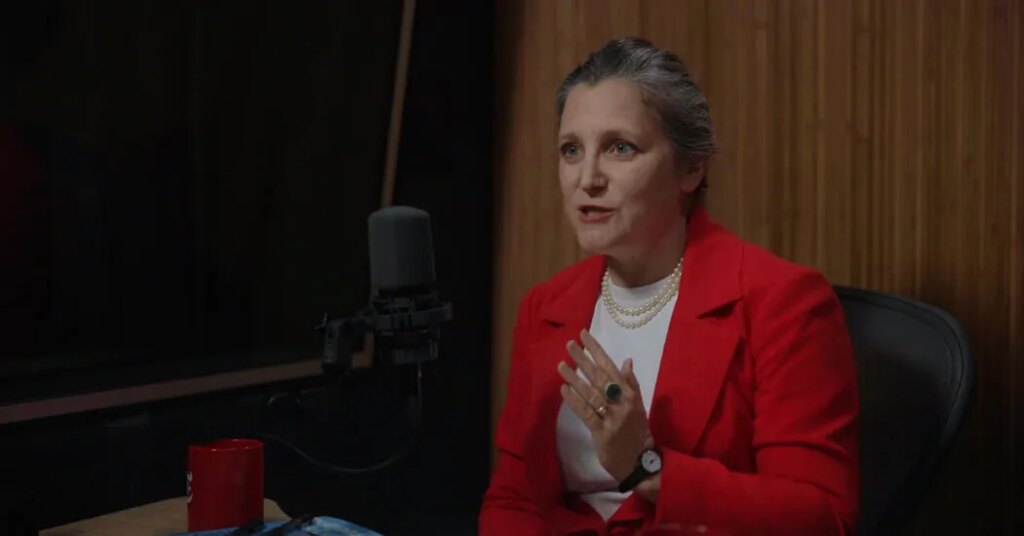
From 2013 until earlier this year, Chrystia Freeland was a member of the Canadian Parliament. She served in a number of senior roles in the Canadian government, including deputy prime minister, minister of finance and minister of foreign affairs, where she was a lead negotiator for Canada in trade talks with the first Trump administration.
Now she’s the author of a new book, “Unreliable Boyfriend: An Insider’s View of Dealing with a Chaotic Superpower, Plutocrats and Other Complicated People.”
Ezra Klein: Chrystia Freeland, welcome to the show.
Chrystia Freeland: It is wonderful to be with you, Ezra.
So a recent Canadian poll found that 41 percent of Canadians consider the United States an enemy country. A poll conducted by the Pew Research Center found that more Canadians have a favorable impression of China than of the U.S.
I guess my question is: How did we get here?
That is a brilliant place to start. It really is. Because I don’t think Americans fully realize what has happened.
I’m familiar with both of those polls. What is really interesting, if you compare where we are today with where we were in 2023 — and in 2023, obviously, Canadians considered the United States to be an ally and considered China to be an adversary — that position has actually flipped.
And what has happened is Donald Trump and the challenges to Canadian sovereignty and tariffs. That’s what’s happened.
There was a Trump administration before this one, I’m reliably informed. I have dim memories. How is that different?
So I actually don’t think President Trump is different, and I think it’s important for people to remember he tried all this stuff in the first administration. And he did a lot of it, right?
He did impose tariffs on Canada and allies — the Section 232 steel and aluminum tariffs. He didn’t threaten our sovereignty, but he said lots of mean things about us and about lots of Europeans.
Remember he famously threw those candies at Angela Merkel at the G7 meeting? Yes! I was there.
He threw candies at Angela Merkel?
Yes, yes!
I don’t remember this at all.
He did. It was at a G7 meeting that Canada was hosting, and the G7 leaders were trying to convince the United States to sign on to what was, like, a totally, historically milk-toast, everyone-agreed-with-it clause about the rules-based international order.
They could not get Trump to agree. He really didn’t like the fact that he was the only one disagreeing with the group. Angela Merkel, who I think was actually quite magnificent in how she handled Trump, was the one sitting in the middle. And as he left, Trump took some candies out of his pocket and actually threw them at Angela Merkel and said: Here you go.
When you say she was magnificent at how she handled Trump, how did she handle Trump?
So I think she got it right.
Angela Merkel, the former chancellor of Germany, for people who are less up on German politics.
Her view — and I think this was shaped by the many years she spent dealing with Vladimir Putin, who could be insulting and demeaning, and really try to knock her off her game. He knew she was frightened of dogs, and so he would sometimes bring a dog into the meeting. So she was kind of used to ——
Yeah, Putin does a lot of psychological warfare things.
Yeah. So she was kind of used to dealing with bullies. And her approach — I think shaped by that — to President Trump, was to be, what you would say in French, “correct.” Which is to be cool, calm, not be sycophantic, not curry favor, not fight him — but just be very clear and rational in her approach.
And I think there are leaders who have thought: I can win this guy over. I can give him the shiniest prize. I can give him a gold watch that’s encrusted with diamonds. I can flatter him in the most outrageous way.
Who’s had that strategy?
I think most people have tried it, actually. And I think that strategy is in part based, oddly, on underestimating Trump. I think there are a lot of leaders who think Trump is dumber than they are, and so they think: Well, I’ll just sort of butter him up. I will outrageously flatter him, and maybe I’ll agree to some things he wants, but it will just be on paper. It won’t be real, and it will all be fine.
I don’t think that’s the right approach. I think a cool, calm — you know, during the first NAFTA negotiations, our approach — and a line I must have said a million times — maybe not a million but many, many in public — was: We do not escalate, and we do not back down.
And I think that kind of steady: I’m not going to suck up to you, I’m not going to be bullied by you, but also I’m not going to raise the emotional register with you.
I think that’s the way to deal with the president.
What does the world in which this goes to full-on trade war — or continues in full-on trade war — look like?
Can Canada’s economy withstand what America is doing? And what is Canada’s response to America, given the size differential?
The first thing I would say is that I think Canadians are very realistic about the fact that this is an asymmetric standoff, shall we say. This is an asymmetric confrontation. And it means it will be more painful for Canada. Canadians recognize that.
But Canadians also really recognize the stakes. It matters more for us, and I am really confident that Canadians will hold the line. So we have been in a version of here before — and the last time the United States imposed tariffs on Canada, we retaliated dollar for dollar. I was the minister responsible for that, and, ultimately, America dropped its tariffs.
The reason America dropped its tariffs was twofold: One, imposing tariffs on our exports to you actually hurt you. That’s what is perverse about all of this — the notion that somehow America is better off when it imposes tariffs on Canadian aluminum is just perverse.
We’re actually doing you a favor by getting you to drop those tariffs. Because tariffs on Canadian aluminum are a tax on electricity. You, yourselves, are choosing to make electricity more expensive, and you’re also ——
Explain the mechanism there.
Well, aluminum is basically electricity in solid form. That’s all it is. That’s why Quebec produces a lot of aluminum, because it has cheap hydroelectricity. And when you put a 50 percent tariff on aluminum, you’re putting a 50 percent tariff on electricity.
The aluminum that Canada normally exports to the United States contains the amount of electricity equivalent to more than 450 data centers — equivalent to the output of about a half a dozen Hoover Dams. It’s a lot of power, and you are choosing, voluntarily, to say: We’re going to make that 50 percent more expensive. That’s the whole absurdity of these tariff wars.
When Trump says that the things we buy from Canada become more expensive, he’s taxing things Americans buy. That’s the literal ——
Right. Exactly. The absurdity here is that the initial thing that you want to do, and you are seeking to do unopposed, is actually bad for you.
But it’s also bad for you.
Right. For sure. For sure it is. But you are getting that pain. And one reason — and this is kind of a technical reason, Ezra, but I know that you’re a wonky person. One reason, one advantage Canada has in a trade fight with the United States — and one reason imposing tariffs on Canada is just so dumb — is that we mostly export intermediate goods to you.
So the stuff that we sell you is mostly stuff you use to make stuff yourselves. And so, by imposing tariffs on the stuff we sell you ——
Give some examples of intermediate goods.
So aluminum is an intermediate good. Very few people go to the store and say: I’d like to buy a ton of aluminum.
Aluminum is used by companies to build stuff. Another really good example is the softwood lumber that we export to you. Very few people just buy the wood, but people maybe buy a house or buy a table.
Potash is another great example. Farmers buy potash. I grew up on a farm. But, actually, farmers don’t even buy raw potash, but farmers buy potash turned into fertilizer. But everyone uses potash because we like to eat.
So tariffs on Canadian goods make stuff in the United States more expensive, and then Canada’s retaliation actually has an impact. It’s true that the Canadian economy is smaller than the American one, obviously. It’s true that Canada is more exposed to trade in general than the United States, obviously.
But we actually are your biggest market. Canada is the largest export market for the United States — larger than China, Japan and the U.K. combined.
I think it’s more for Americans thinking about what it might mean for our economy, much like China’s targeting essential parts of the American manufacturing process with rare earth magnets and things of that nature.
There seems to be a view on Canada’s part that it can cause outsize pain by focusing on things like auto manufacturing.
Look, this is Trade Policy 101. It’s not something that Canada invented. It’s what we did in 2018.
And by the way, in 2018, we were joined by Mexico and the E.U., which was really important. And I would love it if the E.U. came on board this time.
The way to retaliate is you try to do two things: inflict maximum pain on your adversary — and I hate even using those terms when it comes to the United States, because Canadians really do not wish Americans ill. They just don’t want to be the target of unjustified and illegal tariffs. But once you’re in that situation, you want to inflict, let’s say, maximum pressure on the other side and minimum pain on yourself.
So the minimum pain on yourself is to try to avoid imposing tariffs on the intermediate goods. You don’t want your own economy to suffer. You don’t want your own manufacturers to suffer.
You try to impose counter-tariffs on things that are easily substitutable. And then you try to target your retaliation so that it hits politically sensitive constituencies. You look at who are the influential senators, who are the influential members of Congress, which are the swing states that the White House depends on, and you try to be sure that your retaliation is hitting there, so that people recognize the tariffs are hurting them.
So Smucker’s jam — this was in 2018 — turned out to be a really great thing that we targeted. Made in Ohio. And I had a conversation with Sherrod Brown, whom you wouldn’t have expected to be a defender of Trumpian trade policy — and I want to be clear, he was not. He is a great guy, was a great partner and, ultimately, supported our renegotiated deal. But at one point he said to me: Could you guys ease off on Smucker’s jam, please? It’s really hurting my constituents.
And I said: Sherrod, with all due respect, that’s the point. We want your constituents to be complaining to you, and we want you to go out and say: You guys might lose your job because of Trump’s stupid trade war with Canada.
And I’ll give you one example of how this is starting to work. So as you may have heard, there’s a pretty important Senate race in Michigan.
I have heard that.
The Republican candidate has done an ad where he is drinking Labatt Canadian beer, and he says how bad the tariffs are.
Archival Clip of Mike Rogers’s ad “We Need to End the Tariff War”:
Rogers: Drinking a Labatt and watching the Red Wings — man, it just doesn’t get more Michigan than that. And here in Michigan, we know that Canada is not our enemy. We need to end this tariff war now.
So the Republican guy, who is part of a party that is imposing these tariffs, is doing everything he can, including visual cues, to say: I’m on Team Canada’s side.
So you were central in the trade negotiations between Canada and America in the first Trump term.
How did that resolve? Why did that not escalate into what we’re seeing now?
Well, it did escalate, actually.
But not to where we are now.
Not far off, actually. The night before that trade retaliation went into force, President Trump called then Prime Minister Justin Trudeau, and threatened him with the destruction of the Canadian economy if Canada went ahead. He told him he should fire me and called me a nasty woman. And I really give Justin Trudeau a lot of credit for holding his nerve.
And you saw then what you’re seeing now, which is that Canadians understood the stakes, and Canadians supported that action. We did have an intense trade conflict, and we got to a deal. We got to a deal that Donald Trump said was the best trade deal ever, that Nancy Pelosi supported, too, that Sherrod Brown voted for. So we had the fight, and we had a positive conclusion.
One thing that really helped was that we had Republican allies, people like John McCain, people like Chuck Grassley. Even, at the end of the day, Bob Lighthizer, who was the U.S. trade representative and was someone with whom I had many tense moments. But at the end of the day, he is a very, very smart, very, very sophisticated trade negotiator, and he understood that it is in the interests of the United States to have a trade agreement with Canada. And so I think for those reasons, and with those voices on our side, we were able to get a deal.
So is this what you mean when you say that Trump was not that different between the two terms. But in the first term, he had, from your description of this, less control over the Republican Party?
There were more independent voices who had their own power bases, much more so than there are today. Think of John McCain. You think of Paul Ryan for part of that.
And then Trump’s staff did not treat him in the way they do now — as this great man of history who cannot be questioned and, in fact, should have his impulses accelerated. There were people there who were also trying to guide and restrain Trump, even if they agreed with him on some dimensions of what he wanted to do.
Yeah, I think that’s right. When you are the leader of a country, or even a minister, the job of the people around you is, yes, to help you accomplish the things you want to accomplish, but also to stop you from doing dumb stuff. And sometimes, the way to help you accomplish what you want to accomplish is to say no to you.
I would say the war in Iran is a great example. President Trump would be much more effective had America not started that war of choice. So people in his entourage, had they managed to convince him not to wage that war, they would have been doing him a favor.
And I think, for sure, there’s less of that. But the other thing I would say, Ezra: That is a big difference. You’re American, I’m not, so maybe you can explain this difference to me.
A big, big difference is that the capitulation to the president seems, across all of America, much more widespread than it was in the first Trump administration. And, inevitably, that does seem to embolden the president. And for America’s friends and allies, it makes people ask: Is this just about the president, or is this about the whole country?
I think that was truer in the first eight months, 10 months, broadly, than it is now. I do think it happened.
But you think the tide is starting to turn?
I don’t think that civil society — I don’t think the Democratic Party — I don’t think the country writ large has been laying down before Trump. Much of it was what you saw with law firms and universities in the first months.
I do think the biggest problem is the Republican Party. When President Trump has a Republican majority in Congress, and you have a political system where the check on the president is first and foremost a Congress jealous of its own prerogatives while ostensibly committed to the national interest, if Congress is captured, if it is intimidated, there’s no real check. And so, it’s not like American society, as you know perfectly well.
I think an amazing poll is that Prime Minister Mark Carney’s tariff reprisals against Donald Trump are more popular with Americans than Donald Trump’s tariffs on Canada. I mean, literally, in a trade war, in polls, Americans are taking the Canadian side.
The other thing, though — this is where I think you’re underselling a little bit how different Trump 2.0 is from Trump 1.0. Because even in the story you tell in the book, the trade negotiations in Trump 1.0 feel like they are about trade, and they’re ultimately resolved through questions of trade.
That may be true here. But the trade negotiations in Trump 2.0 seem like they are about dominance, tribute — how affronted Trump is that Canada does not want to become the 51st state — in a way that has not been easily solvable through, say, higher labor standards on auto manufacturing.
Where that came from in Trump, I think, is an interesting question. But that has been much more present in Trump 2.0 than I think it was in Trump 1.0.
You’re totally right. And I think that it was always there. I’m not even going to call it latent, but it was more than that. There was always that drive to domination. But you’re absolutely right that, in this iteration, it has become absolutely explicit.
I do think that Trump’s Washington, its offer to the rest of the world is: You choose either to be a vassal or fight your way to being an equal. And for a country, you have to decide which lane you are going to pick. If you pick the vassal lane, then I think be Delcy Rodríguez and negotiate the best possible terms of submission.
Obviously, that is never the lane that Canada would choose. And so, you said, Ezra: It’s harder to know what to do.
In some ways, it’s easier because — although the situation Canada finds itself in is dreadful — there is a very deep national consensus that, given that our sovereignty is actually being questioned, the only thing for us to do is to stand up for ourselves. And that’s the view of the current Liberal government.
But Stephen Harper, who was a very long-serving Conservative prime minister, in early 2025, when the issue of sovereignty was first really being raised, said that Canada should be prepared to pay whatever the economic price is if it is about defending our sovereignty. And I think, I hope, Americans would agree that if they were in that position, that’s the view they would take, too. And maybe that poll you cited about the tariffs speaks to that.
Well, this feels to me like a place where Donald Trump has, in profound ways, underestimated or misapprehended the psychology of other people and other places.
The core of the Trump administration’s case is transactional. America is bigger, we should get more. Bob Lighthizer, the former trade representative, said to you, in a trade negotiation at some point — you say this in the book: America is 10 times the Canadian economy, he should get his way 10 times as often as you do.
The thing is that people aren’t governed, in their souls, as transactionally as Trump is. It would, I think, be easy to imagine a world in which Prime Minister Mark Carney’s walking away from the trade table with Trump threatening pretty ruinous levels of tariffs on the Canadian economy would be an unpopular move.
By some polls, he’s now the most popular prime minister in Canadian history. Trump very arguably elected Carney in the first place, with his threat to Canadian sovereignty, because the more conservative party in Canada had been surging before Trump nationalized and united Canada against him.
I think this is really important, because it gets to this question of whether Trumpian foreign policy will work, right? Whether it does what it says on the tin and gets America more power and more wealth.
If you misunderstand the way people will react to you, if you think you’re going to get them to accept a better deal, and, actually, what you’re going to do is turn them against you in a nontransactional way — like you’re going to unite them spiritually against you — well, then your foreign policy is going to fail.
Look, I think you are 100 percent right. And I would even go further.
I think there is a huge miscalculation when it comes to what the impact on other countries will be. I would say the world’s capitulation contributed to this Trump administration thinking it would work. Because at the beginning, it wasn’t only Americans who were trying out appeasement — so did most of the rest of the world. So I’m not going to say it’s understandable, but it is easier to understand why, when “Liberation Day” was met with appeasement, the Trump team said: Hey, this is working. Let’s keep going.
Describe what you mean by “appeasement.”
Well, countries accepting the imposition of unilateral tariffs. Shocking, really.
And Trump administration officials themselves said, as these tariffs were being proposed, that they expected that other countries would retaliate, and most of the world didn’t. The major exceptions were China and Canada.
That was a mistake. So I agree with your point that beating up on your friends is actually not going to make them give in and do what you want.
But I would add another twist to this, Ezra. Which is that even if this approach to trade were to work, and you were to have your partners really give in and accept the approach that is being pushed on them by the United States, it would actually be a bad outcome for the United States.
So going back to that Lighthizer quote to you — which I find very telling: America is 10 times your economy, we should get our way 10 times as often. The corollary, the obvious international relations realist way of thinking about that relationship, is a world in which America acts that way.
If we are 10 times your economy, and we are much more than 10 times your military, we are a tremendous threat to you at all times. And a world in which the Western superpower is a threat to everybody in its reach — which is everybody — is a world in which all the other countries may cut deals with us in the short term but in the background are banding together to contain our threat in the long term.
So in the last two years, Canada has signed a trade deal with China.
Not quite. It’s not ——
How would you describe it?
A trade deal is a big thing, but Canada did a deal with China. How’s that? It’s not ——
China has begun forging closer trade ties and being very public about that.
Yeah, yeah.
Canada, instead of becoming the 51st state, has begun talking about becoming an associate member of the European Union, which I didn’t quite expect to happen.
Really?
Yes.
Canadians very much expected that to happen.
Wait, so then tell me more about that. Why have Canadians wanted to be an associate member of the E.U., rather than our proud 51st state?
Oh, my God, Ezra, don’t say that.
We can’t — Canada will not be the 51st state. Let me just be really clear.
I know you didn’t mean it this way, but we do not treat it as a joke. On the E.U., this is something that, in a joking-not-joking way, we started to talk about in the first Trump administration.
Just a couple of weeks before President Trump was elected for the first time, Canada concluded our free trade agreement with the E.U. I was the lead negotiator. And what is not widely appreciated is that the deal is actually, on paper, a much deeper trade agreement than the U.S.M.C.A., because it includes government procurement. So Canada and the E.U. open up government procurement significantly more to each other.
So we had that foundation. And then, when Trump was elected for the first time, and for the first time started beating us up with tariffs, we had become friends with the negotiation of the E.U.-Canada Comprehensive Economic and Trade Agreement, our trade deal with Europe. And we talked, in a kind of joking-not-joking way, pretty regularly with the E.U. about how, if NAFTA fell apart, if our trade deal with the United States didn’t work, would the Europeans let us be members?
And it even got to a point where Cecilia Malmström, a wonderful Swedish liberal, was the E.U. trade commissioner. She was dealing with the U.S. I was, too. We would text each other and talk to each other, and we developed this shorthand where, if you said: I am in Mordor — that meant: I’m in Washington. Cecilia once sent me a text saying: Gandalf is going to Mordor next week.
Obviously, to me, what that meant was that Angela Merkel was going to Washington. In the shorthand, the elves were Europeans. Hobbits were Canadian.
I didn’t mind that. I’m very small. I don’t have huge feet, but in other respects, I’m not dissimilar to a hobbit. Grew up on a farm and stuff. And of course, I think you know who Sauron was.
And so, were you constantly going back and forth from the shire then?
Yes. Oh, definitely. I would say, like, safely back in the shire, for sure. And by the way, I felt that way. I felt that relief.
That’s the other side of that deal-making strategy, that you force people to begin treating you as a threat, which means figuring out how to create defenses against you. And in the long run, this is classic international relations theory — figuring out how to weaken and undermine you.
One-hundred percent correct. I think that the Trump administration is unintentionally revealing the genius of the postwar American establishment. And it’s actually remarkable what they did.
They created an alliance based on the idea that they would be better off if their allies were stronger and more prosperous. They actually invested in the postwar reconstruction of Germany and Japan. America was in this position of unmatched dominance after World War II, and it decided to build an alliance.
From the position of a country that was not America, very easy to [expletive] about that alliance. And by the way, when you guys are not in the room, we always have been, right?
These were never truly equal partnerships. America was always first among equals.
But America did actually listen to its allies. America was governed by this general idea that this is a win-win partnership, that we will get rich together, that the prosperity of one country within the group of allies, far from being a threat, is actually going to help us, and that we have an interest in each other’s security.
And like, wow, such a great idea, and a great idea for America. Like, that is what made America different from the Soviet Union. The Soviet Union certainly did not have partners — it only had vassals. Same with China.
That’s how America was a distinctive superpower. And when Timothy Snyder talks about “superpower suicide,” what he means is that America is voluntarily wrecking that.
I think you’re totally right: Part of why this incredibly ill-conceived approach seems to have been pursued is that no one thought about the next step. No one thought: OK, if we do that, what are our counterparties going to do?
And the counterparties are doing two things: One is to try to become as not dependent on America as possible, to disentangle those ties as much as they can, particularly in the military space but also economically — and that’s bad for America materially.
Countries are going to think really hard before they buy another F-35 controlled by the Pentagon. Why would you want a jet that Americans control?
Europe and Canada are obsessed with having an alternative to Starlink.
And so is Ukraine. And, like, rightly so. Become less dependent, so American companies get less money. They have fewer clients. But then, also, America has less leverage.
The part about all of this that I find not just depressing but horrifying is that the biggest winner is China. Because — as with that poll that you cited at the beginning of our conversation, Ezra — we are now in a world where citizens of democracies, of countries that have been U.S. allies for generations, now believe the United States is a greater threat than China.
And this is Xi’s China. This is a China that is more authoritarian than it has been in decades. So I find a world where every country — that is not the United States or China — is engaged in a balancing act between these two predatory hegemons to be a really bad world.
And just to add some data to that, the Democracy Perception Index put out a survey of 98 countries. The U.S. was the fifth worst-perceived country. We were just ahead of Iran, two spots behind Russia. China, among these countries, was net favorable.
Again, going back to the question of, even, instrumentally — even from the Trump administration’s promises and perspective: Is this working?
To the extent that the Trump administration had a coherent theory of the case, it has always been about American competition with China — American competition for power, American competition for manufacturing capacity, American competition for geopolitical influence, American competition at some level for hearts and minds.
Even now for technology and A.I.
For technology and A.I.
Trump has acted like a Manchurian agent. I mean, he has put China in an incredibly strong position, compared with where it was even a couple of years ago. And one way in which he has done that is, what countries want above all from counterparties is predictability and reliability. China has a lot of problems. They ——
Unreliable boyfriend.
Unreliable boyfriend. What they are is fairly predictable and reliable. You wouldn’t say that’s true in deals people make with them?
So look, I totally agree with your observation that there has not been a president who has been more beneficial for China than Donald Trump. Astonishing how this has helped China. The Economist had a great cover. It said, “Never interrupt your enemy when he’s making a mistake.” And I think that’s the Chinese official statement.
Wasn’t it Xi looking at Trump?
Yeah, yeah. And kind of: Shh.
And I think that is 100 percent correct. The only thing that I would take issue with a little bit is, I would say: Let’s not fall for the Chinese propaganda, right? The Chinese line is: OK, you might not like us. You might think it’s bad that we oppress Uyghurs and Tibetans, and that we crushed liberties in Hong Kong. But don’t pay attention to that. Like, don’t be a namby-pamby liberal. You can trust us as an international player because we play by the rules. We are not a power that seeks to expand. We’re not a power that seeks to dominate. We actually believe in the rules-based international order. So I might be beating up my wife and kids at home, but when I’m outside in the world, I’m a trustworthy partner.
And this is critical in what China is saying right now — a partner who is supportive of the rules-based international order and multilateralism. And I don’t think that’s quite true.
Where I think it’s not true is, first of all, in trade. China broke the global trading system through intentional overcapacity and through intentional and pretty vicious building of supply chain dominance.
That’s one of the things that got Trump elected. Not the only thing, but one of the things. And that’s an area where I think he has a point.
And then the second thing is, I think we should be careful about believing the Chinese assertions that they don’t want to change us, that they want the world just to have rules-based multilateralism. China definitely wants to change Taiwan. And China passed a law that gives it extraterritorial authority, as deemed by itself, over political forces outside China that China deems to be acting against China’s ethnic unity.
And the final thing I would say is that China has been pretty Stephen Miller-esque: The strong do what they will, and the weak suffer what they must in its foreign policy.
The iron law of power.
Right. Exactly. The only difference is that China has done it effectively. So when Norway granted a Nobel Prize to a Chinese writer — and, like, that’s not something the Norwegian government is the boss of — but China punished Norway. China punished Norway by banning salmon exports, and Norway had to grovel and kowtow to get them reinstated.
When Lithuania wanted to have a relationship with Taiwan, China imposed economic punishment on Lithuania. When Canada honored our extradition treaty with the United States and arrested — but, like, under pretty nice house arrest in a $5 million Vancouver mansion — the C.F.O. of Huawei, two Canadians were illegally arrested and detained in conditions that experts said amounted to torture. So China is very good at imposing dominance and vassalage on countries that it thinks ought to obey.
It’s funny, I agree with you. I don’t think we’re saying something different, but I realized where the difference is when you were saying that.
I don’t think the rules-based international order is a concept that still has meaning. And so when ——
Maybe it has meaning, but it doesn’t exist.
Yes. I understand linguistically what you are gesturing toward.
Like it could exist, you know what I mean?
But the point I’m making about this is, I think that a lot of the conversation is caught on this nostalgia for a thing that arguably has not existed for a while — and definitely does not exist now.
When I say China is reliable, I don’t mean they’re reliable as a multilateral partner who upholds a fair and neutral rules-based order. They’re obviously not reliable at that.
But that’s how they pitch themselves.
I agree that’s how they pitch themselves. I think that they are, broadly speaking, a predictable counterparty in quite often very unequal relationships. Whereas, Trump is an erratic counterparty.
A predictable predatory hegemon.
Yes. So if you’re Taiwan, you know what China wants from you. And to some degree, if you’re Norway, you know what China wants from you. You know what their red lines are going to be, right?
This is a bad system to move toward, right? This system is a regression toward older forms of geopolitics that we moved past through a lot of blood.
But this is the tragedy.
Yeah, I fully agree. And I think another way of putting it might be that China is what an effective Trump administration would seek to become.
That’s interesting.
Right? Yeah. Like a predatory hegemon, but that’s good at it. And I would include that’s also good at mercantilism. And that is good at running a rent-seeking, kleptocratic state.
I agree with you. China is good at being a 19th-century-style, totally immoral, self-dealing, self-interested, elite-at-the-top superpower. And if a totally dystopian ——
Just power interested. I don’t even think you have to say totally immoral.
Some things they do are immoral, some things are amoral, but they are extremely transactional in pursuit of their own power. It’s why I think you are right when you say that in some ways, they are what Trump only promises to be.
But I think there is some actual immorality there. too. Like, it’s the difference between abusing your workers just to make money and wiping out the Uyghurs and the Tibetans because you believe there should be one Han people. Do you see what I mean?
Yeah. Though I don’t want to be here defending Chinese treatment of the Uyghurs.
I guess what I’m trying to say here, which I think is an important distinction, is that it’s not just like a ruthless pursuit of economic efficiency. There are some political and social ——
Oh, yeah. That’s why I say it’s a pursuit of power. And I think this is not a new thing. A longstanding view of particularly large regimes is that power comes from enforced social solidarity, which can often mean the extinguishing of difference.
Yes, correct.
That is a scary thing, right? I do not want to live in a world ruled by China. I don’t want to live under Chinese rule.
This world, where you’re caught between China and America, is a tough world for everybody who’s not China and America. And possibly a tough world for America, too.
I 100 percent agree. The only stipulation I would add is this world where you’re caught between China and a predatory America, a Trump America: It’s a terrible world. I think that in that world, America is less rich. It does less well economically, and I think America is less free.
The danger for America is that it shifts from being — broadly, I don’t want to romanticize pre-Trump America — a rules-based market economy to a kleptocracy where rent seeking is the way that businesses prosper. History is replete with examples of how, when you flip to rent seeking, it can be good for the individual rent seekers, but it is always terrible for the country as a whole.
So I think it’s a bad option for America. And it’s a really bad option for the world’s democracies.
I’ll give you an example of the benefits of a benign America that I came across just this week. I was talking with a Brazilian about the Brazilian elections. This is a progressive. This is someone who is very much anti-Bolsonaro. And this person said that the problem is, even if a miracle happens, and Bolsonaro doesn’t win — and by the way, this person is predicting Bolsonaro will win fair and square. But the person said: Even if a miracle happens, and Bolsonaro doesn’t win, there is a real risk that the vote will not be fairly counted.
And then what this person said is that it would be different with a different U.S. administration, because in the past, something that helped guarantee fair election counting was a U.S. administration — and we don’t have that now. I think that impact at the margins is something that the world’s democracies will really lose.
And again, this is one of the reasons I wrote my book — and one of my big conclusions — is that the battleground for liberal democracy in the world is America. If liberal democracy loses here, it’s going to be in tough shape in the rest of the world.
In the first term, if you looked at people like Jeff Bezos or Mark Zuckerberg — a lot of the people at the top of the economy — they were very opposed to what Trump seemed to mean for how to do business in America.
They didn’t like what he meant for democracy. They didn’t like what he meant for our openness to immigrants. They didn’t like what he meant for our values. But they also didn’t like this idea that you would have this transactional pay-to-play system and to, you know, they ——
They were not in his coalition. In the second term, to varying degrees, many of them have been going all the way up to Elon Musk, who just dumped $250 million or something to try to save Republicans in the midterms. And it has that antecedent in your book from your time in Moscow, post-Soviet Union’s crackup, watching the oligarchs take over.
So I’d be curious how this has looked to you, played out to you. Because in some other world, it’s American business executives who are very, very strong in talking Trump down from the tariffs. But I don’t think they’ve been as strong as they would have been in the first term.
I totally agree with you, Ezra. And it’s really frightening to me, actually, because of what I saw in Russia.
I don’t want to stretch it too far, right? Russia tried to become a democracy in the ’90s but never fully got there.
America is arguably the world’s strongest democracy.
Arguably.
Arguably. And Russia never fully built a really freely functioning market economy. So many, many differences — but parallels, too.
What I saw in Russia in the ’90s was, the men who became oligarchs were broadly really smart guys — innovative, entrepreneurial, Ph.D.s in math and physics. In a different environment, they might have become Silicon Valley founders.
They were smart enough to figure out that the best way to get superrich is to get the government to give you an oil company. It is a way to get very rich, very fast.
But then, as they realized this, they decided that they could control the state, and it started with Boris Yeltsin. But then, as Yeltsin was fading, they needed to put someone else in his place.
And it was actually the oligarchs, or at least one of the oligarchs, who put Putin in place. And the thinking was: He will be our guy, and, ultimately, we will manipulate him. We’re so much smarter than this guy. He’s like a primitive K.G.B. agent. We’re like brilliant business entrepreneur guys.
But of course, he got the last laugh. And once Putin was firmly installed in power, he showed them who was boss — and that was him. That should be a cautionary tale for America’s plutocrats, and I think they should be very careful about thinking that they can control President Trump.
Do you think they think they can control him? I don’t actually think that’s what they believe.
Elon Musk?
I don’t think he thinks he can control him.
Really?
Yeah.
Do you think he ever did?
I don’t know. Trump didn’t come from where Putin did, right? Trump was already president when they began — had already been president once — when they began moving toward him. Trump had developed, particularly around the assassination attempt, which is when Musk endorses him, this somewhat force of history, great man of history.
These same people were very angry at the Joe Biden administration. It had snubbed them, it had taxed them, it had regulated them, it had investigated them, it had spoken unkindly of them, it had moderated them. It had done all these things that they’re ——
Trust busted them.
Trust busted them. So in some cases — actually, for a lot of them, it hadn’t, but we can put that to the side. Their level of fury often seemed to me quite outsize to whatever regulatory tax they were willing to pay. It’s not like Biden actually did break up Facebook or something.
Anyway, what I think they saw in Trump, though, wasn’t somebody they could control so much as somebody they could do business with. I think they know they’re not in control of him. But particularly now that he won, they take the system as it is.
This is the real danger of a system mutating into what our political system is mutating into, and the tariffs are part of this. Tariffs are, among other things, a tool of corruption — this is actually the way to prosper and attain power in the system.
In a world where the Trump administration will go after its enemies and give favorable decisions on mergers and other things to its friends, I think many of them convince themselves that this is just how you do business. You’re not doing anything wrong. It is what it is.
Some of them are true believers. Musk has a very extreme form of politics.
I don’t think they’re all true believers. But the thing that is very frightening about capitulation, at the level we’ve seen, and the kleptocratic structure I think Trump is trying to build, both explicitly and intuitively, is that there becomes a competitive logic to further capitulation, right?
It’s the opposite of the virtuous cycle of collective action.
Exactly, right.
You’re Anthropic and Dario Amodei. You try to put limits on what your system will do through the Pentagon, and all of a sudden, you’re being potentially declared a supply-chain risk and frozen out of all government contracts, right?
Conversely, you’re one of the other companies, and you say: We’ll do what you want, Mr. President — and you get all the contracts. It changes the entire incentive structure in a way that creates this feedback loop between power and capitulation.
But what I also believe has happened, and this maybe came first, is the reason that you saw some big business interests get behind Trump before he was re-elected, is a sense — or maybe “sense” is too weak a word — an observation that populist rage was rising in America, that there were a lot of people who felt left out.
And an anxiety that this rage could be pretty bad for the 0.1 percent. And from that comes the view: OK, here’s a guy who can harness that rage. Here’s a guy who can be the hero of people who are really unhappy with how things are going right now.
And the good news is, he is not going to be a trust buster. He’s not going to break up our companies. He is not going to raise our taxes. He’s going to find a different direction in which to channel that anger.
Here’s the only amendment I would make to this: I don’t think that what the business titans we’re describing here feared was populism in the country. I don’t think they were worried about laid-off steelworkers in Ohio. I don’t think that’s the kind of rage or power that they feared.
I’ve talked to many of these people. I’ve heard many of them talk to each other. One of the wonderful things about the podcasting economy is that you can listen to billionaires talk to each other and see them talk to each other on Twitter and elsewhere — X.
And what they hated, like, say, in Silicon Valley, was the way The New York Times covered tech. What they hated was their employees organizing on Slack, demanding they put out Black Lives Matter statements. To say nothing of unionizing or other more threatening things to the business.
When I think of what they were trying to bring to heel — and many of them have talked about this very explicitly. Marc Andreessen talked about this when he did an interview with my former colleague Ross Douthat.
What they were trying to bring to heel, what they were trying to stop, was this effort by another part of society with actual power centers to not just regulate them, not just tax them, but to diminish their social status. To say that what they did was bad, and it should change, and they should not have the pull or the power that they currently have.
But I don’t think they were worried about populism as normally understood. I think they were worried about the progressivism that was coming from other kinds of power centers in society.
I sort of agree, but with a plus, plus, plus. So I think that there are two parts to the hurt feelings of the superrich. I think one part is exactly what you talk about. It’s not quite status anxiety as it is: What is your social position? Do you have main-character energy in society?
Should you be lauded and praised?
Right. Right.
Should the garlands of flowers be thrown at your feet for what you’ve done?
Exactly. Like, are you the heroes? Because, certainly in Reagan, then Clinton, then dot-com techno-optimism, there was this moment of like: Yay, entrepreneurs, inventors, the heroes.
And I think there is, kind of understandably — everyone wants to be considered good by their society — a resentment at not being considered good.
But I would not overlook, Ezra, the power of material self-interest and the anxiety being: Sure, like a New York Times columnist might write something mean about me. But where that becomes really offensive, sufficient to politically organize, is all of those mean columns end up electing a Bernie Sanders or an Elizabeth Warren, who is going to tax us, regulate us and break up our companies.
Or they potentiate into a Biden administration, that has Lina Khan, who is actually trying to tax them.
Right. Like, it’s not just hurt feelings. It’s partly hurt feelings, but it is also: My economic interest is going to be hit.
Yes.
And I’m going to put to you a thesis or a possibility, which is that the tide may be turning. I’ve actually just written a piece for the Financial Times making this argument, that I think we’re reaching a tipping point, and that you’re going to see a lot less capitulation.
Because I think there are a lot of people who decided appeasement was the right thing to do — and I think a lot of them are deciding — first of all, it actually has just encouraged the president to be even more unhinged. But second of all, I think they think maybe he’s going to lose.
And if the tide does end up turning — I’m going to say the moment that it started to turn was The Wall Street Journal piece that Jamie Dimon published on the Sept. 28 — so just a few weeks ago — I don’t know if you saw this — where he called for a massive U.S.-E.U. trade and economic deal. And he even described it as a “big, beautiful” agreement and said that this is what America should be doing.
I see that as really significant. Because the piece that Jamie wrote contains no direct criticism of the Trump administration. But its actual content is 180 degrees different from the policies the Trump administration is pursuing.
And there is also, I think, a really big group of C.E.O.s who actually think global trade, particularly with value-sharing partners, is a good idea — who believe in the trans-Atlantic alliance, who think Ukraine should win the war with Russia, who think it is nuts to be having a trade war with Canada.
I think there are a lot of business leaders like that. Certainly, I talk to a lot of them. Now, I’m Canadian and also support Ukraine, so maybe I know more people like that.
But I talk to a lot of people like that, many of whom actually donated to the Trump election campaign, who are profoundly disappointed right now, and even kind of scared by what they see happening. They’re scared by the war in Iran. They are scared by Trump actually siding with Putin rather than Ukraine. They’re scared by trade wars that seem to be about a fight for dominance that Americans don’t want.
Americans don’t actually want Canada to be the 51st state. They do not want to crush Canada into submission.
Or our enemy.
Or your enemy. So I think it will depend on the midterms, because I think what we’ve seen from American business is they’re going to be on the side of power. But I think that if they see that President Trump and MAGA no longer deliver at the ballot box, you may start seeing some very different behavior.
I think that might be right. So there’s this idea of preference cascades, which are situations where a lot of people hold a preference that they don’t yet feel comfortable voicing, and so something changes, and then everything spills out because there’s been pressure building up behind a wall.
So many people will make the argument that there was a preference cascade toward Trump in 2024, that many in the American business community and in the American cultural elite, and so on, had actually become, at the very least, against the Democrats, right? They hated wokeness. They hated Joe Biden. They hated Lina Khan. They hated the whole kind of situation.
But supporting Trump had been culturally looked down upon. Maybe you wouldn’t get invited back to your galas.
Well, you might get invited, but people would think, like ——
They’d think you’re a jerk. So people were sort of holding back, and it was once Musk did his endorsement, and Andreessen, and then things began. All these people who had actually been quietly pro-Trump, at least somewhat, there was this rush toward it.
Then in the Trump era, because there is a real punishment for getting on Trump’s bad side, lots of people at different levels of society — but particularly in the business community here, who actually can’t stand this — they have the opinions they had in the first term. They think this is grotesque, but they’re mostly quiet because it’s a risk.
Even something like the Jamie Dimon Op-Ed you’re describing. Yes, if you know how to read trade debates, Dimon is disagreeing with Donald Trump, but as you say, it doesn’t come out with a critique of Donald Trump.
But it’s a disagreement at a profound level, right?
Sure. But the thing that will tell me the dam has burst is when people say the thing that is true: This guy is insanely corrupt, and he is harming America’s interests. And this is a grotesque way of using the Oval Office, and it is against what we stand for, both as a country and as citizens.
Right? I agree, I’m glad Jamie Dimon is standing up for decent trade policy, but I see that as a fairly low bar to clear.
Agreed. And I would also, just going back to these preference cascades, I think part of what was kind of pent up was very well expressed in a great piece that the Financial Times ran right after Trump’s re-election, where they quoted an anonymous top banker saying: “We can say ‘retard’ and ‘[expletive]’ without the fear of getting cancelled. It’s a new dawn.”
Yeah. Congratulations, guy. Also that they quoted him anonymously is so — some of these people ——
It’s so revealing that like: Wow, we were so oppressed. We weren’t allowed to call people “[expletive]” or “retards.” Terrible, the oppression that we suffered under Democrats.
But I think there clearly was that, and I guess I do think that there is now pent up, among very privileged people, appreciation that the policies of this administration are bad for America. They are bad for the country as a whole. They are bad for the country economically. They are bad for the country in terms of security.
And business leaders are starting to see that. Even people who describe themselves as very conservative — who are quite sympathetic with some of the stated objectives — I don’t think they ever were supportive of America turning into a kleptocracy that was Putin’s best friend, that was seeking for Ukraine to lose the war and that was breaking up the NATO alliance. And that’s what’s happening.
So I want to bring this back to the U.S. and Canada. If before Jan. 1 there is a deal, what do you think that deal will look like?
What do you think are the core issues that actually could be resolved, such that both sides would say: That’s good enough. Can we step back from this?
So the first thing I would say is that there doesn’t have to be a deal before Jan. 1. There just has to be getting into a negotiation and sort of saying: We’re going to have a cease-fire on further tariffs while the negotiation happens.
I think that would be a good place to begin.
In terms of where negotiation goes, what I think would definitely be the outlines of a plausible deal — and this is not just a deal with Canada, actually, I think this could be a deal with the allies writ large, so including the E.U. and the U.K. — is for America to say: Actually, we want to be your friends. We want to be your trading partners. We actually recognize that trade between us is mutually beneficial. It makes us richer, it makes us safer. But we’re concerned about China. And so, what we would like to do is to have a common policy on China.
And by “common,” I don’t mean exactly matched tariff policy but a common approach that has real teeth.
Look, I think it’s important not to frame it as anything punitive toward China, but to create a space where our economies can flourish, as well, and where we do not have a dangerous dependence on China. That, to me, would be the basic logic of the kind of deal that you could have.
I’d love to see two things happen: The first is that the rest of the democratic world should join Canada in retaliating against U.S. tariffs.
It’s great to have declarations of solidarity and say we’re all friends, but what should really happen right now is a more in-sorrow-than-in anger-united response from the allies who say: This is not acceptable to us, and we’re happy to have negotiations. If there are elements of the trade relationship that you want us to work on, we’re happy to do it, but we are not going to accept unilateral tariffs. And actually, we’re going to match them dollar for dollar.
And if you had Canada, Mexico, the E.U. — I’ll throw in Japan, South Korea, Australia, just for fun — basically, America’s democratic partners all respond together, I think you would see real, meaningful pressure on the United States in the right direction. So I would love to see Canada not standing alone.
The second thing I would love, and this did happen in the first Trump administration, is for Americans to say to the White House: This is nuts. You have to stop doing this.
You need to see American business speaking up a lot more, I would say, starting with the auto industry. That’s where we build things together.
I think the midterm results will be really, really important. I would say Senator Grassley was someone who really had guts last time around, and said to the president: You have to stop this — this is not a good idea.
There needs to be more Republicans who say that. And that poll that you cited — showing that Americans support Canada’s counter-tariffs but don’t support American tariffs against Canada — what that says to me is that this would be a popular position.
I think that is a good place to end. Always a final question: What are three books you’d recommend to the audience?
OK. So my books are two golden oldies, which I reread often, but they’re almost like characters in my life.
One is “The Dispossessed: An Ambiguous Utopia” by Ursula K. Le Guin. Do you know it? So I love this book, and it speaks so much to our time, actually, when you think about both the dystopian universe that it describes — but also the hope for a small, hardy band of people standing for their values. So I love that book.
The second one is “The Player of Games” by Iain M. Banks.
You’re a sci-fi head.
Oh, I totally am. I always have been. I’ve read sci-fi, like, since I started to read. And I think that is darker but also has light and hope.
I recommend both of those books because I do think — we haven’t talked that much about A.I., but the combination of A.I. and a geopolitical order, which is all smashed up, and people having questions, partly because of the economy, partly because the geopolitical order, partly because of A.I. — it’s about what it means to be human. I think that reading sci-fi is a really good way to explore those issues. So anyway, those are two great books I highly recommend.
Then my third pick is “Book of Lives: A Memoir of Sorts” by Margaret Atwood, and it’s really wonderful. She’s obviously a brilliant writer. The book kind of reveals her to be just an amazing person, who doesn’t take herself too seriously, who is able to laugh at her own weaknesses and failings, who is not self-indulgent.
And since, Ezra, we’ve been talking about how suddenly people are kind of interested in Canada, her life is a really Canadian story, and reading her account of parts of her life tells you a lot about Canada.
Chrystia Freeland, thank you very much.
It has been wonderful.
You can listen to this conversation by following “The Ezra Klein Show” on the NYTimes app, Apple, Spotify, Amazon Music, YouTube, iHeartRadio or wherever you get your podcasts. View a list of book recommendations from our guests here.
This episode of “The Ezra Klein Show” was produced by Jack McCordick. Fact-checking by Kelsey Lannin and Kate Sinclair. Our senior engineer is Jeff Geld, with additional mixing by Aman Sahota and Isaac Jones. Our recording engineer is Aman Sahota. Cinematography by Bets Wilkins. Video editing by Kristen Williamson, Julian Hackney and Dani Dillon. Our executive producer is Claire Gordon. The show’s production team also includes Marie Cascione, Annie Galvin, Kristin Lin, Emma Kehlbeck, Rollin Hu, Marina King and Jan Kobal. Original music by Pat McCusker. Audience strategy by Shannon Busta. The director of New York Times Opinion Shows is Annie-Rose Strasser. Transcript editing by Filipa Pajevic and Marlaine Glicksman.
The Times is committed to publishing a diversity of letters to the editor. We’d like to hear what you think about this or any of our articles. Here are some tips. And here’s our email: [email protected].
Follow the New York Times Opinion section on Facebook, Instagram, TikTok, Bluesky, WhatsApp and Threads.
The post Trumpism Is Backfiring appeared first on New York Times.