I was cat-sitting for my mom in San Pedro, California, in 2024 when my phone rang. The screen read “Healthcare.” It was my primary care provider. They asked me to come in immediately to discuss my recent test results.
For about a month before I went in for a checkup, I’d noticed swelling on the left side of my neck. I told myself it was nothing — muscular, probably, maybe from an awkward dive into a river or my partner’s strong hands trying to work out a knot.
My doctor did a physical exam, including pressing on the swollen spot and nearby areas including my head, neck and underarms. She reassured me it was probably nothing, but ordered an ultrasound just to be safe. When she insisted on seeing me in person to tell me what it found, I knew something wasn’t right.
The room shrank. My hearing dulled. It felt like my body stayed there, but my mind left.
Walking back to the car, I knew I wasn’t the same. The version of myself I’d known for 38 years disappeared in the three minutes it took for my doctor to tell me I had cancer.
Processing and looking for a way forward
Within the hour after I got the news, the appointments started stacking up — they scheduled a CT scan, a biopsy and a PET scan, each one requiring its own phone call that I didn’t want to answer. I screened the calls, letting them go to voicemail, and sat in my room trying to make sense of my life, my thoughts, my spiraling anxiety.
I spent the next few weeks researching, trying to find alternative ways to shrink the swelling in my neck, which I had learned was due to a few swollen lymph nodes, small organs that filter infections and abnormal cells — such as cancer — from the body. I alternated between convincing myself I was doing the right thing and knowing deep down that I was taking a risk by not following my doctor’s orders to jump right into more testing.
A few weeks later, I eventually agreed to additional tests. The first biopsy came back inconclusive, and my doctor didn’t know what to make of it. But for one short week, I celebrated, thinking that meant I didn’t have cancer.
A second, deeper biopsy confirmed it: Hodgkin’s lymphoma, a cancer of the lymphatic system. I took the news numbly. I didn’t share this information with anyone except my family and partner. I almost felt embarrassed that I was sick. My mind would go to dark places. Why me? Am I weaker than other people my age? Do I deserve this?
My doctors told me I should start chemotherapy. I thought about my dad who was diagnosed with a blood cancer called multiple myeloma in 2020 and died just a year later. Chemo hadn’t saved him. Did I really want to put myself through the terrible side effects just to end up with the same outcome?
The next few months became a marathon. I explored alternative healing, spoke to doctors in different countries, connected with others with the same diagnosis, and turned inward. I meditated, prayed, even started going to church, trying to ground myself and figure out how I was going to tackle this.
It delayed treatment, but I needed that time. I learned a lot about myself. And over the course of those two months, I also learned that my type of cancer actually responds really well to chemo.
I started the frustrating task of searching and calling around to find a specialist within my insurance network and finally landed an appointment with a young hematologist-oncologist.
His parting words after that first appointment summed up the year ahead: “Let’s hope for the best and plan for the worst.”
Navigating chemo treatments and hair loss
The night before I was scheduled to have a port implanted, which would allow me to get treatment and blood draws without repeated needle sticks, I realized my period was late. A pharmacy’s worth of tests all came back positive. I was pregnant.
Strangely, I wasn’t afraid. For a moment, hope outweighed the fear of death that had consumed me for months.
I was reclassified as high-risk and referred to a top oncologist at a hospital outside my network. Weeks later, I miscarried. But in light of all this, I was starting this journey in the hands of a doctor and clinic I truly trusted, and that gave me a better outlook as I began treatment.
Life started to make a little more sense.
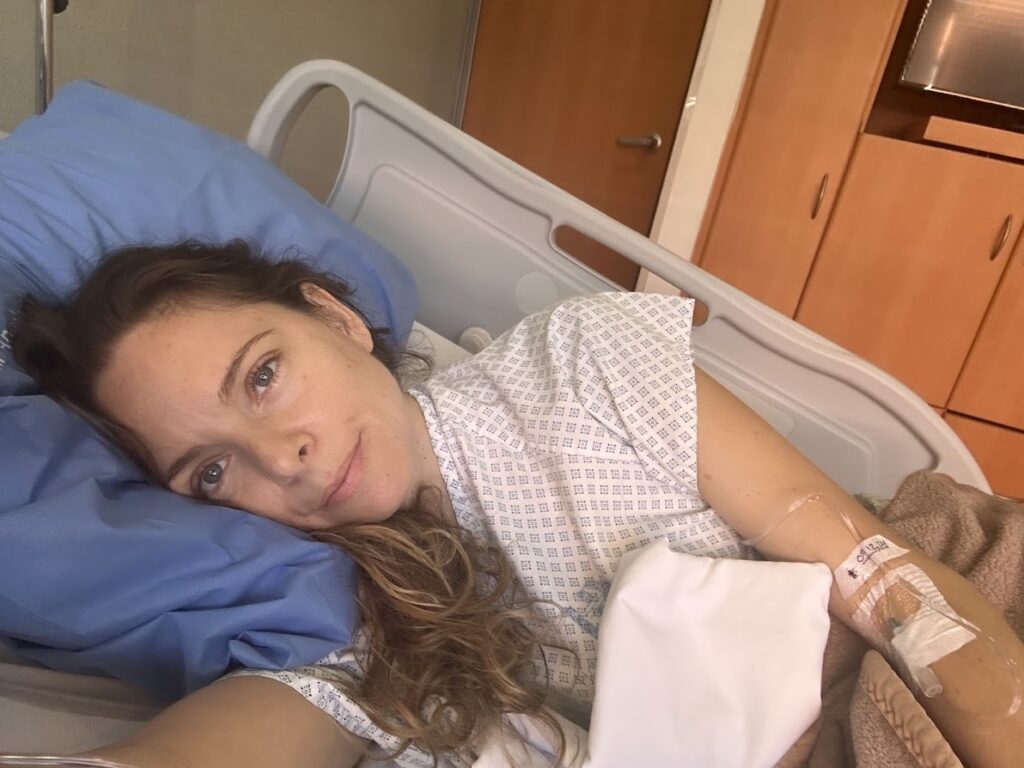
The plan was six months of chemotherapy, twice monthly, four hours at a time. It would be delivered through a PICC line — a long, thin tube that’s threaded into the arm and toward the heart to deliver medication directly — because the drugs were so harsh that they might irritate or even damage the delicate veins in my arms. I told myself it was healing medicine, not poison, and tried to meet it with trust instead of fear.
Losing my hair terrified me. Not out of vanity, but because it felt like a total loss of control. I didn’t want my family or my partner to see me bald because I knew they’d feel worse.
I eventually came across cold-capping, which is a treatment that involves wearing a scalp-cooling device to help slow hair loss during chemo. I looked into the companies offering the services and learned it was going to cost me about $4,000 to $5,000.
I gave up hope of being able to afford it but then a friend of mine told me about a DIY version. All I needed was two different-sized gel packs, clear tape and a pair of scissors. I figured it might not work, but I couldn’t afford the official setups (which aren’t guaranteed to work anyway), so I decided this was better than nothing.
With Patrick’s help, I spent an entire day building 10 helmets. First we taped the sides together and then shaped them to my head with more tape. I needed one helmet for every 30 minutes of infusion, plus one 30 minutes before and one after.
For every infusion, I hauled a cooler of helmets, packed in dry ice, into the clinic. My doctor liked to jokingly ask where the beer was.
To help with the cold, my mom would bring a giant bag packed with heated blankets, gloves, scarves and anything else to keep me warm.
The cold was brutal, but it worked well enough: My hair thinned out, but I never went bald.
To disguise the thinning, I kept cutting it. First I went to salons, then eventually I asked Patrick to chop it. Strangers would compliment me on how “chic” or “French” my short hair was. I often thought, “How much should I trauma dump?” I always just smiled and thanked them.
There were other small indignities and mercies. I had to chew ice to prevent mouth sores; my ruined immune system resulted in occasional infections; I had one bout of vomiting; I also lost weight.
Through it all, there was my cat, Elso, curled on my chest every night after infusions while a projector turned my wall into a movie screen — our usual living room setup relocated to the bedroom so that I could watch movies in bed.
I continued to keep my health struggle to myself. I kept working as much as I could. Not because nothing was wrong, but because it helped me stay myself.
In between appointments and treatments, life still existed. It made me appreciate the little things more than ever. Walking on grass. A hot bath. The people who showed up. The sun on my face.
Life really slowed down. Nothing else mattered but making it to another day.
Gaining a new perspective on life
I finished treatment in September 2025. I was officially cancer-free.
A year out, I still see my doctor for regular checkups and mostly live like before my diagnosis, except for the bursts of anxiety that appear when I have a doctor’s appointment on the calendar.
But sometimes I think about how frightened I was at the start, and I wish I could reach back and comfort that version of myself. I wish I could tell her it would all be okay, that on the other side of all this, I’d come away with a perspective on life I’m not sure I could have gained any other way.
I don’t know exactly what life looks like after this. I’m still getting to know myself again. But in some ways, I feel a little like a newborn — curious, openhearted and seeing the world with fresh eyes.
I recently went camping for the first time in years. As I drove home through the beautiful mountains with the sun setting, I cried. I remembered looking at the sky when I first got sick and feeling terrified that I might never get to experience life again.
Over time, and now that I’m on the other side of treatment, that fear has turned into gratitude.
In the weeks after my diagnosis, I thought about all the times I had complained or gotten upset over things that didn’t really matter. I prayed to God that if I got another chance at this life, I would always be grateful.
What that looks like, in practice, might change day-to-day, and sometimes I need to remind myself to stop and make good on that promise. But ultimately, I’ve learned that appreciating life doesn’t require grand gestures. It often happens in small, ordinary moments, like when I sit outside and feel so blessed to simply be alive. To hear the birds chirping and the leaves rustling in the wind. To feel the heat of the sun on my face.
I think about how, before my diagnosis, I used to take these things for granted. Now, I consider these mundane experiences as gifts; small, frequent reminders of how alive I still am.
About this story
Story and visuals by Jessica Pons. Senior producing by Drea Cornejo. Editing by Amy Marturana Winderl and Theresa Tamkins. Copy editing by Fernando Ortiz Jr.
The post How I got through cancer at 38 — and what it taught me appeared first on Washington Post.