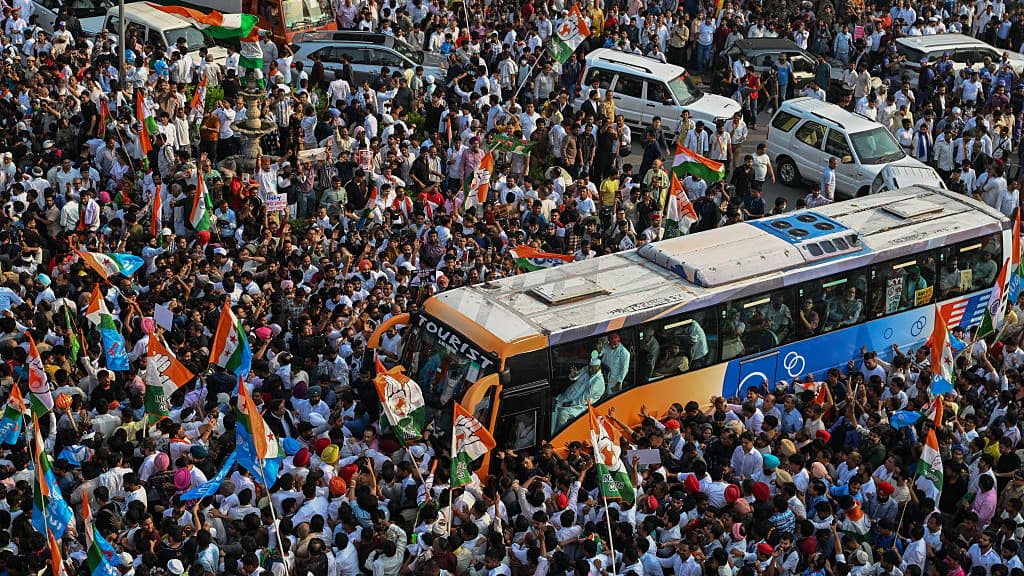
Demonstrations have swept across India in recent weeks, fueled by anger over what protesters say is a politically motivated purge of electoral rolls.
The protests were sparked by the removal of some 130 million names from the rolls by election authorities, who have defended the process, saying the exercise was intended to weed out ineligible voters.
But critics of the process, known as the Special Intensive Revision, said it was designed to bolster Prime Minister Narendra Modi’s Bharatiya Janata Party (BJP). They have demanded the resignation of the chief election commissioner, Gyanesh Kumar.
The demonstrations have been met with a heavy-handed response from Indian authorities, who locked down the capital, New Delhi, and detained leaders of the burgeoning Cockroach Janta Party (CJP), a youth-led movement that emerged earlier this year. An Indian court on Monday extended the detention of two Cockroach movement leaders, Ashutosh Ranka and Saurav Das.
The movement proved itself a powerful force in Indian politics this summer when it successfully campaigned for the removal of Education Minister Dharmendra Pradhan, who resigned on July 25.
To discuss the protests and what they mean, TIME spoke with Mukul Kesavan, a historian, novelist, and one of India’s best-known writers.
This interview has been condensed and edited for clarity.
Q: What are these protests actually about? Are they a natural progression from the Cockroach movement’s earlier protests, or something different?
MK: It’s related to the Cockroach movement (CJP) sit-in at Jantar Mantar [a traditional site of protest in the Indian capital] that led to the resignation of the education minister, in that the sit-in created a space for dissent by making Modi’s government back down. But [the Oct. 12 march] was distinct because it was organized by the Congress Party along with other conventional political parties. The CJP had no hand in organizing it, though one of its progressive/left stars, Neha Bora, participated in the march to the Supreme Court. It was also about a distinct issue: the Election Commission’s fiddling with voter rolls.
Q: Police detained the movement’s leaders before the October 10 rally, then detained two of them again at Jantar Mantar days later. What does that tell you about how the government sees this movement?
MK: There has been a reversal of the government’s attitude towards the CJP. At Jantar Mantar 1.0, the government underestimated the cockroaches, thinking it was a sit-in that would peter out. They were ambushed by the massive turnout of the young on July 20. The lesson the government learned from the police violence that discredited it was that it couldn’t afford to let the cockroaches occupy a space where massed citizens confronted the police for phone cameras to record. We’re seeing a strategy of pre-emptive detention to head off that possibility.
Q: India’s elections have long been a source of national pride. Has this episode damaged that image, at home or abroad?
MK: India’s elections were a bit iffy until a man called T.N. Seshan became chief election commissioner in the early 1990s. He was an awkward egomaniac who took his office seriously enough to clean up the whole election process. The Election Commission became a three-member body that was more or less impartial till the Modi government passed a law that gave the government the majority in the three-member panel that appoints the election commissioners. Gyanesh Kumar has been grotesquely partisan and the Special Intensive Revision has so obviously tried to shape the electoral roll to favor the BJP that the institution has been publicly discredited. India begins to resemble electoral autocracies elsewhere like Turkey.
Q: What do these protests tell you about Modi’s position?
MK: It’s the conventional thing to say, but it’s palpable that Modi’s aura of menace and authority has dissipated. The mockery and rudeness of young cockroaches, especially the young women who crowded into Jantar Mantar, did something that solemn ideological opposition had failed to do: it made him seem ridiculous, old and out of touch. I don’t know if the protests tell us anything about his electoral reach: we’ll have to wait for an election to find out. Opposition parties have to find a way of turning this fizz into votes.
Q: Modi has now been in power for 12 years. What are his real achievements? What will historians credit him with?
MK: Some achievements in infrastructure: road building, airports, etc. The kind of things authoritarians do well. It’s hard to know what the economic growth figures mean in terms of general wellbeing. Geopolitically, his time in office has been a disaster: India is on bad terms with all its neighbors, in denial about China and in the doghouse with Trump. It might be more useful to talk about how he has degraded the republic’s institutions—the press, the courts, the election commission—than his achievements. His greatest “achievement” has been to normalize the rhetoric of Hindu supremacy.
Q: India has one of the largest young populations in the world, yet the quality of its education and the prospects for its young people are grim. How does the situation compare to other places where young people are protesting?
MK: With the possible exception of Sri Lanka, all South Asian countries, including the ones that have seen youthful insurrections in recent times like Nepal, Bangladesh and India, have school and university systems that are generally poor, with a few exceptions: elite institutions. This would be bad in itself, but the success of China in improving its educational system at every level makes our failure demoralizing.
The post Why Young Indians Are Fearful About the Future of the World’s Largest Democracy appeared first on TIME.