Joel Achenbach is a former Washington Post reporter and columnist.
I fly regularly in and out of Washington’s Reagan National Airport and until recently had managed to do so serenely. When told to “sit back and enjoy the flight,” I always tried to comply, even though it is borderline nutty to climb into one of these giant metallic tubes and let strangers hurl you seven miles above Earth.
Some of us lean on prayer as a hedge against misfortune. I put my faith in the professionals, the experts out there, all those air traffic controllers, airplane inspectors, government regulators and, of course, the pilots, who radiate competence and sobriety.
But three things have caused me to start looking out the window nervously. The first and most horrible was the tragedy of Jan. 29, 2025, when a helicopter collided with a jetliner on its approach to Reagan National Airport (DCA), killing all 67 people on board the two aircraft. It’s hard to read the subsequent National Transportation Safety Board report, because it shows that this was a disaster waiting to happen.
Reagan National is a compact airport embedded in an absurdly congested airspace that buzzes with both civilian and military aircraft. It wasn’t built to handle so much traffic. The main runway is the busiest in the nation. Congress kept adding flights to the airport despite warnings from pilots and aviation experts. (It’s convenient for lawmakers in a rush.) Airlines bunched flights together during peak travel times. The approved corridor for helicopters flying along the east bank of the Potomac came within 75 vertical feet of the flight path for jetliners descending to the short Runway 33 — an “intolerable risk to aviation safety,” in the words of NTSB Chair Jennifer Homendy.
On the fatal night, a military helicopter crew conducted a training flight during the airport rush hour. The crew wore night-vision goggles, which limit peripheral vision. An air traffic controller was given double duty controlling helicopter and jetliner traffic. That’s just a partial list of the risk factors that converged in one place and time.
As a journalist I’ve covered a number of disasters, and while they are ghastly events, they’re also teachable moments. One thing we learn is that risk builds like plaque. The technical term is “compounding risk.” It’s a simple idea: Seemingly small risks can layer upon one another to create an intolerably high risk of a calamity.
Which brings me to the second thing causing me unease: President Donald Trump’s proposed 250-foot triumphal arch near the entrance to Arlington National Cemetery and close to the flight path in and out of DCA.
Much of the debate about the arch has properly focused on the architectural optics and the psychological needs of the man who wants it built. The arch would dominate part of the capital’s monumental core. The public didn’t ask for the arch. Neither did Congress. Trump has said it was supposed to be built a long time ago, which is not true. The idea that this is truly honoring America and the sacrifice of those who took up arms to protect it collides with everything else the president has done to put his imprint, and often his name, on the physical landscape of the capital.
But here’s a simple question any frequent flyer should ask: Would the arch pose an aviation hazard?
Sen. Tammy Duckworth (D-Illinois) has objected to the arch on aviation safety grounds, pointing out that its construction would require cranes that would tower 300 to 320 feet, even higher than the arch. Recently Sen. Tim Kaine (D-Virginia) joined the criticism, saying, “Construction of that kind, right in the flight path toward the landing area at DCA, is the last thing the nation needs. It turns my stomach even to think about it.”
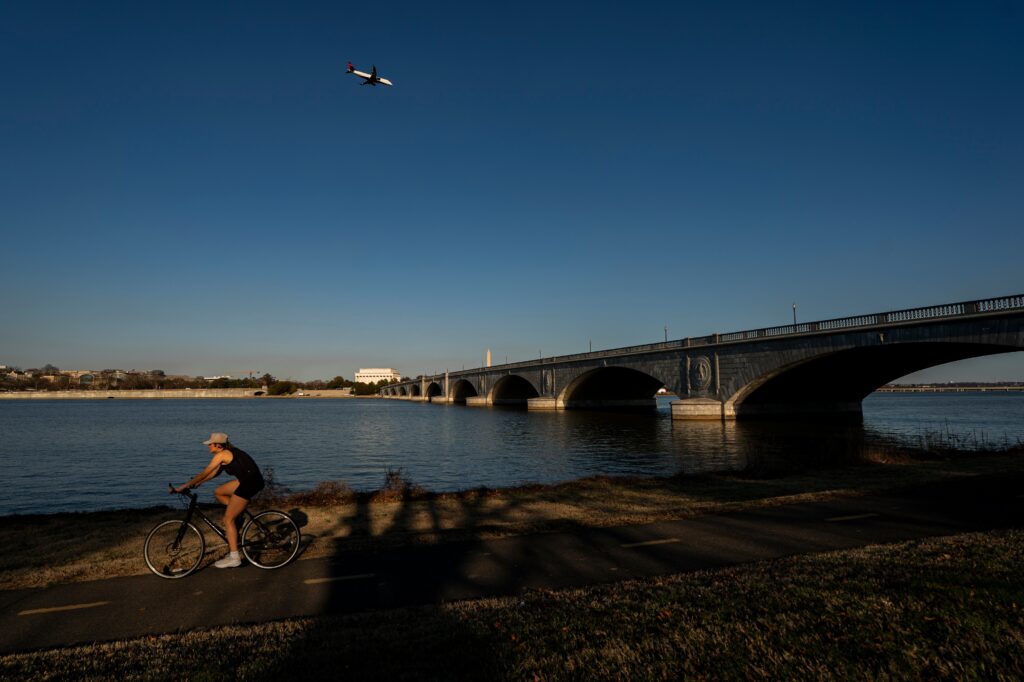
The website AirInsight.com also came out against the arch, saying planes routinely cross Memorial Bridge at altitudes of 400 to 500 feet. The flight path from the north is already notoriously challenging for pilots, who must operate on visual flight rules and follow a serpentine route down the Potomac, avoiding restricted airspace near the White House and the Pentagon.
“Adding a new obstacle at the river’s edge on an already unforgiving approach will complicate maneuvering on final approach, increase cockpit workload during night flights, and create potential glare from lighting on the arch, particularly if the external monument lighting illuminates upward,” the website said.
In a preliminary review, the Federal Aviation Administration in June said the arch wouldn’t be a hazard. It would need, however, a blinking red warning light at the top, much like buildings in Rosslyn and the Washington Monument. Then, in September, the FAA issued a final report approving the arch, with a new caveat: It must have a “non-standard eternal flame” at the peak and be lit by floodlights “to make it more conspicuous to airmen.”
The FAA report doesn’t offer a definition of a “non-standard eternal flame” (a phrase that shouts out for scare quotes), but does give the reader a brief rundown of safety concerns raised by the public, including whether “planned decorative monument lighting will increase pilot night-vision impairment, hinder the ability to identify other aircraft at night, and cause severe glare during arrivals and departures.” One by one, the FAA dismisses the safety concerns.
But the safest move is obvious.
“The best, and the most basic option, is simply not to build it,” aviation safety expert Jeff Guzzetti told NPR. “This is just adding another hazard.”
After the January 2025 collision, I became mildly obsessed with the disaster, to the point where I’d go out on the bluff by the Potomac and use my stopwatch to time the intervals between incoming planes. One minute 53 seconds … Two minutes 11 seconds … . But I’ve never flown anything more sophisticated than a paper airplane. Journalists typically don’t know much about technical, complex systems like aviation safety. We rely on experts.
And that’s the third thing causing me to shift in my airplane seat.
When I look out the airplane window at the Federal Triangle as I’m flying in and out of DCA, I see agencies full of regulators, scientists, lawyers and experts on myriad topics. They are supposed to oversee food safety, drug approval, vaccine guidance, biomedical research, cybersecurity and so on. I want to trust them to do their jobs without political fear or favor. Just hit it down the middle of the fairway. In successful societies with a free press and institutional watchdogs, people generally trust their governments.
When Trump returned to power in January 2025, following the playbook outlined in “Project 2025,” he effectively declared war on his own executive branch, seeking to downsize the bureaucracy and purge agencies of anyone perceived to be part of the alleged “deep state.” Across the government, hundreds of thousands of civil servants were driven from the workforce, either through retirement, buyouts, layoffs or simply because they felt terrorized by the aggressive actions of the U.S. DOGE Service.
For any enterprise, agency, business or government, it’s risky to restructure your operation using dynamite and wrecking balls. It’s risky to get rid of people who, thanks to experience, know that many bold, novel and exciting ideas are actually very bad ideas. You want people who will say to their bosses things like: “Your war proposal smells of quagmire.”
We live in an era of complex, interconnected systems and technologies that are not easily managed or predictable. We need smart people guiding us in the years ahead. We’re all passengers on this wild ride into the future.
Sit back and enjoy the flight? Okay, I’ll try — as I look out the window, fingers crossed.
The post A 250-foot obstacle is the last thing Reagan National Airport needs appeared first on Washington Post.