Dr. Robin Sautter raced the eight minutes down the quiet streets of Moscow, Idaho, to the small brick hospital. Inside, in one of the postpartum recovery rooms, a new mother was bleeding out.
Postpartum hemorrhaging, Sautter knew, is one of the most common causes of severe complications after childbirth. In the most serious cases, a patient can bleed to death in under 10 minutes. Sautter’s colleague, Dr. Emily Barnes, had swept the uterus for blood clots and remaining pieces of placenta with her hand, a first effort to stop the heavy bleeding. She had also initiated the hospital protocol for a major blood transfusion. Both doctors understood that the key to avoiding a catastrophic outcome was to move quickly through a gantlet of medications and escalating clinical interventions.
Barnes had called in Sautter, just an hour back from vacation, for backup. There was no one else to call. Two other partners in their small family-medicine practice were occupied with a difficult vacuum-assisted delivery in another room, placing a suction cup on the baby’s head to help guide it through the birth canal.
Sautter ran into the hospital room, feeling the familiar surge of adrenaline that sharpened her focus when she faced emergencies. If their efforts failed to stanch the bleeding, Sautter knew, the patient would need a surgical procedure to remove her uterus — a hysterectomy. That operation is the second most common surgery for women in the United States, with hundreds of thousands performed each year.
Sautter, a 36-year-old family-medicine doctor with a specialty in high-risk obstetrics, could deliver babies, including by cesarean section; implant IUDs; conduct gynecological examinations; and perform minor operations, including dilation and curettage to remove remaining fetal tissue after a miscarriage to avoid dangerous infection. But she did not have the specialized training required for hysterectomies. Neither did Barnes nor the two partners in the other room. If their patient needed a hysterectomy, the operation would require an obstetrician-gynecologist. And in Idaho, as Sautter and her colleagues were acutely aware, that had become a serious problem.
In the four years since the U.S. Supreme Court overturned Roe v. Wade, triggering a near-total ban on abortion in Idaho, with the potential for criminal prosecution of any doctor who performed the procedure, OB-GYNs have been fleeing the state in extraordinary numbers. More than a third of Idaho’s OB-GYNs have stopped practicing obstetrics, left the state, closed their practices or retired since the ban took effect in August 2022, according to a study published in The Journal of the American Medical Association last year. By December 2025, there were just 170 obstetricians for the state’s roughly one million women — fewer than two doctors per 10,000. About five full-time maternal-fetal-medicine specialists, who serve the riskiest pregnancies, remained, according to a separate report released in 2024. One half of Idaho’s 44 counties no longer have a practicing obstetrician.
The impact of the exodus has rippled across the state. Since 2023, three hospitals in rural parts of Idaho have shuttered their labor and delivery wards because of staffing shortages. In the southeastern corner of the state, one OB-GYN serves a population of more than 120,000 people, according to a recent paper by a researcher at Oregon State University. Even in more populated areas, like Boise, OB-GYNs are so overloaded that the wait for a hysterectomy can be six months. It can take nine months to secure an appointment for an annual exam. Increasingly, hospital administrators say, women facing life-threatening complications are loaded into a helicopter and flown out of state for treatment that OB-GYNs in Idaho are not allowed to administer.
There’s a chance the law could change this year. In November, Idaho voters will decide on a referendum that would restore abortion rights until fetal viability — the standard that had been set in Roe. That effort has set off a pitched political fight that could determine the future of abortion rights as well as women’s health and maternity care in this conservative state. But the impact of what some are calling a generational loss of doctors is already clear: By banning abortion, Idaho has become a more dangerous place to give birth.
Unlike many other parts of Idaho, Moscow, nestled amid the rolling hills and farmland of the state’s northwest border, still had OB-GYNs — sometimes. Sautter’s practice worked with three OB-GYNs who shuttled the 10 miles across the border between Pullman Regional Hospital in Washington, where abortion is legal, and Gritman Medical Center, the small hospital in Moscow, where it is criminalized, to serve patients in both states.
On this winter day, the OB-GYN on call was in Washington. He would not be able to come. The patient, meanwhile, was still bleeding. Sautter thought through the limited options. If the hemorrhaging persisted, she decided, they would ask for the general surgeon who was on call for the hospital that day.
It would be a risky and imperfect safety net. Those surgeons didn’t do hysterectomies as regularly as OB-GYNs; the procedure is “not typically within their wheelhouse,” Sautter explained. But “your other option is the patient dies,” she said. “You can’t just stop and say: ‘Well, why don’t we wait? Why don’t we wait until we have everyone here?’” She continued, “You don’t have that time.”
So Sautter prepared for the possibility of surgery, rolling the woman into the operating room and calling the nurse anesthetist to put the patient under.
Then, the two doctors watched the clock. To Sautter’s relief, the patient’s bleeding slowed and eventually stopped. She would not need a hysterectomy. But Sautter knew another emergency would come. Maybe tomorrow, maybe next week or maybe, if luck held out, a little longer.
“At some point, will there be a case that comes in that we can’t handle and we truly have a terrible outcome?” Sautter wondered. “It’s kind of amazing how much is just hanging on by a moment.”
Dr. Bryn Parker, another family doctor and one of Sautter’s partners in the Moscow practice, had just finished a successful C-section in the operating room of the hospital. The baby was healthy, lying on her mother’s chest. The only job left for Parker was to remove the placenta.
Parker reached into her patient’s abdomen and gently jiggled and wiggled with her hands, trying to separate the spongy red disc from the uterine wall, as she had done many times before in her practice as a family-medicine doctor with a specialization in high-risk obstetrics. The organ didn’t budge. Within minutes, Parker knew what she was facing: a placenta accreta, a dangerous complication in which the placenta grows into the uterine wall.
With her hands still in her patient’s open abdomen, Parker asked her nurse to call the obstetricians. The nurse held the phone to Parker’s ear as she received the news: The OB working that morning was in Washington and would be delayed. Her patient would have to wait, lying on the surgical table with her body cut open.
Parker was calm. Waiting for an OB to arrive was common in Moscow. “You sit there and you wait, and you’re like, Does ‘soon as you can’ mean two hours or 20 minutes?” Parker said. “But, actually, I think we’re so lucky that we have that.” In other parts of the state, where OBs have disappeared, patients with a placenta accreta would be flown to Boise or Coeur d’Alene for the operation. After nearly an hour, the OB arrived, removed the placenta and closed the patient’s abdomen.
Parker, an energetic 42-year-old, was recently honored as the state’s family physician of the year by the Idaho Academy of Family Physicians. She has followed many of her patients through multiple pregnancies and served as a pediatrician for their children and a general practitioner for their parents. Her daughters joke about the number of times she gets stopped — for greetings, on-the-fly medical consults and hugs — as she buys produce at Moscow’s sprawling farmers’ market on Saturday mornings. “We love the ongoing relationship,” she said. “There are some people who just see their OB-GYN for a hysterectomy, or for when they have babies, and then bump back to primary care. We’re so lucky in the sense we get to take care of the babies.”
Parker, Sautter and three more partners all have specialties in high-risk obstetrics, and about a quarter of their patient load is maternal care. But there is only so much that can be done at Gritman, a well-respected rural community hospital that has become a regional hub.
For high-risk pregnancies, which require a maternal-fetal-medicine specialist, patients have to drive 90 minutes for appointments in Coeur d’Alene or across the state border in Spokane. The closest fertility clinics are in Spokane; Seattle, a five-hour drive; Boise, a six-hour drive; or Idaho Falls, nine hours away. In emergency situations, patients are taken by helicopter to Coeur d’Alene or Spokane — a flight Sautter took after developing a life-threatening condition during her own pregnancy.
When those journeys can’t be made, the doctors “MacGyver” their way through, Parker said, finding ways to triage care until they can get the resources they need. If a doctor needs backup, the others speed to the hospital. In a way, they are like pioneer doctors, working at the frontier of a new America where abortion laws limit the care they can offer. “We are so ingrained in each other’s lives,” Sautter said. “It’s minds and hands trying to all work together to figure it out.”
Parker, who was raised in a cabin on 14 acres in central Idaho, became fascinated by biology as a child after seeing the organs of the deer her father hunted in rural Elk City. She always planned to practice in a rural environment. Like most physicians in the state before the abortion ban, Parker and her colleagues did not perform elective abortions. It was understood that women who wanted such an abortion would travel across the border to Washington.
Now the doctors found themselves, and their patients, forced into difficult choices when a pregnant woman’s health was at risk and an abortion was recommended. The law includes a narrow exception to save the life of a pregnant woman. But in practice, the line was not always clear, and physicians were uncertain how close a woman had to come to dying for an abortion to be deemed legal. Even treating miscarriages could put doctors and patients at risk.
And the stakes were high: Idaho law mandated that anyone who performed an abortion could be charged with a felony and punished with at least two years in prison. Extended family members of what the law called a “preborn child” could also sue the abortion provider and anyone who assisted for up to four years after a procedure, with a potential bounty of at least $20,000 and legal fees.
Parker and her partners now worry about the peril involved in even routine care involving miscarriages. The doctors began doing more extensive documentation of their ultrasounds, building records of their decision-making to show that it was legal. They started loudly announcing “there is no fetal heart beat” in the operating room before starting surgery to remove fetal tissue after a miscarriage. Treating miscarriages became more complicated as pharmacies stopped stocking mifepristone, long part of a two-drug regimen for miscarriage management, because it is also used for medical abortions.
A few times since the ban, pharmacies have refused to dispense the second medication — misoprostol, which remains legal in the state — without additional clarification over what it was being used to treat. “It’s these little things,” Sautter said, “that continually chip away at your confidence that you can safely practice here.”
The Moscow hospital, the only one in Latah County, has seen a more than 15 percent drop in babies delivered since the ban. Hospital administrators think many patients are going to Pullman, given that the number of women who live in the county and gave birth in Washington State over the same period increased by around 50 percent, according to data collected by the Idaho Department of Health and Welfare.
Those departures sadden Parker, who prides herself on her relationships with her patients. “I have women who are my patients who are saying, ‘I love you, Dr. Parker, but I can’t have my baby with you,’” she said, adding that they explain that “‘it just doesn’t feel safe, because you only deliver in Idaho.’” She understands their concerns. “They’re apologetic,” she said. “They’re like, ‘I’m so sorry that you’re in a place where you have to run the risk of criminal charges for doing the right medical thing.’”
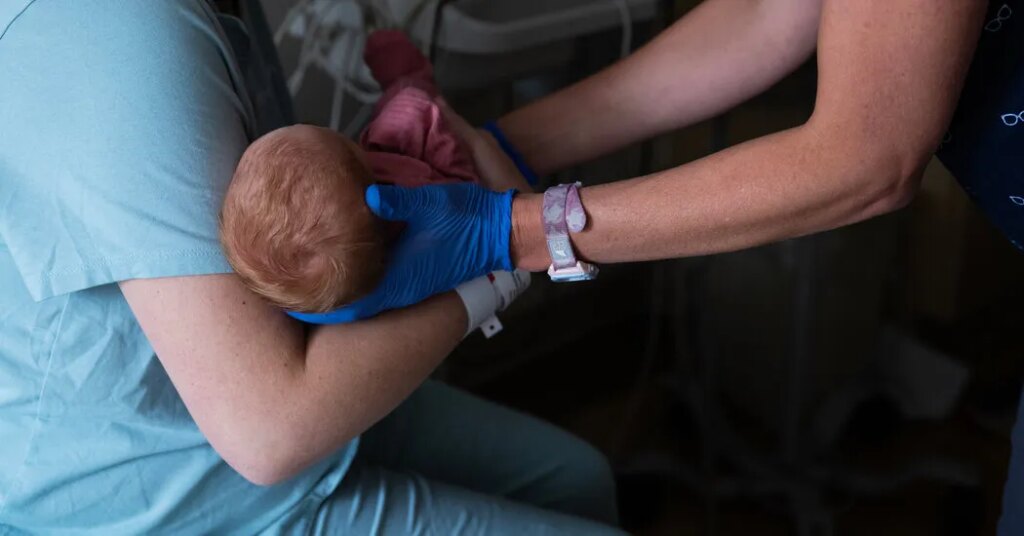
One morning in July, Parker entered the hospital room of Ashlie Heywood, who had delivered her baby the night before. Heywood and her husband, Dakotah, had traveled two hours from Weippe, a logging town of 400 people in northern Idaho, to have their child at Gritman. The plan was for Heywood to be discharged that afternoon, Parker explained as she lifted the baby for the routine one-day checkup.
But after giving birth, Heywood’s leg had swollen into what she described as a painful, tight “sausage.” Parker wanted to rule out a dangerous blood clot that could be worsened by sitting for hours in the car. “I would be 100 percent happy to just do a quick ultrasound,” she said as she gently squeezed Heywood’s leg. “I appreciate you driving two hours away, since you certainly don’t want to go back if it gets worse.”
Propped up in her hospital bed, Heywood marveled that she could receive an ultrasound so quickly. She had an excellent doctor closer to home, said her husband, who works in a mill. But their hospital, like so many across the state, had no OB-GYNs, so she chose to deliver at Gritman because they had heard good things about the hospital. “For her sake,” he said, “it was better to come here.”
A decade ago, it never occurred to Parker that obstetricians could disappear from Idaho. Now, even as their three OBs promised to keep working at Gritman, she is “internally panicking” at the prospect that the situation could change.
If they lost their OBs, or their number was further reduced in Moscow, the results could be catastrophic for the whole region, Parker knows. Patients could die, become infertile or suffer other severe complications that wouldn’t have happened with an OB present. Would the colleagues in her practice stay in Idaho if they face those kinds of risks? “I guarantee you half of them will leave if we don’t have OB-GYN backup,” she said.
Six hours away from Moscow, outside Boise, Dr. Becky Uranga emerged, bleary-eyed, in the early hours of the morning after an overnight shift in February. An OB-GYN at St. Luke’s Meridian hospital, she had handled six cases that night, including a ruptured ectopic pregnancy and a complicated delivery in which the baby’s heart rate suddenly dropped.
The shift had been draining. But Uranga was more shaken by the news she received. That night, administrators at the hospital told her they would no longer bring in a second doctor to assist during overnight shifts.
Uranga didn’t blame the hospital: Just like her own practice of nine doctors, OB/GYN Associates, known as OGA Women’s Health, St. Luke’s was trying to ration shrinking resources to cover an expanding pool of patients. Hospital closures and population growth in the surrounding metro area meant more women driving to Boise. But now there were fewer doctors to deliver their babies.
Since the ban, four doctors in her practice have left. The hospital has since brought back a second doctor as backup for her overnight shifts. Still, the unrelenting workload had almost broken Uranga, an ordinarily upbeat 48-year-old from Montana. “I would feel like a fool if I were the one to leave,” she told me, her voice shaking. “But it’s just exhausting. I need there to be a light at the end of this.”
Many of her patients wait nine months for their appointments. To fit them in, Uranga frequently sees 30 patients a day and skips lunch. Things were so relentless after a nearby hospital closed and as OBs started leaving the state, said Nicole Bradshaw, OGA’s executive director, that “it was like a MASH unit almost. There were all of these patients that were being just funneled into one place.”
Uranga, who has been practicing for nearly two decades and is the most senior member of her practice, worries about her colleagues. She and other Idaho physicians used the phrase “moral distress” — a psychological term used to describe the harm of being barred from taking the right action — when they told me about the personal toll of the law.
And fewer doctors want to take that on. Since the ban passed, OGA has interviewed 15 physicians. Only two accepted their offer. That’s a drastic shift from 2020 and 2021, when every doctor they interviewed took the job. “We can’t hire people,” Uranga said, and tell them, “‘Welcome to your new career — oh, and there’s this criminalization, and the legislature here doesn’t really trust us.’”
Recruiting new doctors has grown exponentially more difficult across the state since the ban, said Susie Keller, the chief executive of the Idaho Medical Association. Idaho does not have an OB-GYN residency program, so there is no pipeline of talent. “Are we putting ourselves in a really good position to be in an attractive place to practice obstetrics and gynecology?” Keller asked. “I think some recruits would say no, that they’re safer in Utah, which also has an abortion ban, but they don’t criminalize the evidence-based care for pregnancy complications.”
Patients, physicians, public-health officials and activists in Idaho have fought back, filing a series of lawsuits pushing for medical exceptions. So far, no doctor has been prosecuted, and this summer, an Idaho district court found that the state can’t prosecute doctors who perform abortions to protect a patient’s health or prevent self-harm. But Raul Labrador, the state’s attorney general, immediately announced plans to appeal the ruling, saying he was “confident” that it would be overturned.
Even the ballot measure may not change the situation. Idaho law allows the legislature to alter or repeal a passed ballot measure through a standard simple-majority vote in the very next session — a definite possibility because both chambers are controlled by Republican supermajorities. The doctors who left are unlikely to return, and new doctors may be unwilling to stake their careers on the uncertainties of ping-ponging lawsuits, legislation and politics.
Uranga was raised Catholic, and early in her residency, she herself had misgivings about terminating pregnancies. But after much thought and prayer, that part of her job began to feel like a solemn duty. “I felt as close as I could be to being a priest or a nun when I was doing that,” she said, “when I am with that person who is so vulnerable and having to make a really hard decision. I hate that I can’t do that anymore.”
Still, at OGA, she performed abortions only if medically necessary. If a patient wanted to terminate her pregnancy for another reason, Uranga referred her to Planned Parenthood in Boise, one of the few places in Idaho that was performing elective abortions before the ban.
Like many of the doctors in her practice, Uranga had rarely even used the word “abortion” to describe the treatment her patients might have needed. Her choice of language, she said, was rooted in a sense of respect for the patients, given the conservative culture of the state. In fact, Uranga said, many doctors initially didn’t understand the implications of the ban. “Someone in our group said, ‘Well, we’ve never done abortions,’ and we even wrote this letter we were going to send to legislators,” Uranga told me. Then they began to comprehend that the medically necessary terminations they did perform fell under the law as well.
In the spring of 2024, Uranga’s friend Dr. Harmony Schroeder, who had recruited her to OGA, decided to move to Washington after other doctors they knew left the state. The two women had been close for years, ever since Uranga’s husband, Mark, who was working as a river guide during medical school, steered Schroeder down the Middle Fork of the Salmon River. Schroeder’s decision to leave was devastating to Uranga, who saw her as a mentor and a confidante.
Uranga has not seriously considered leaving herself. Her children attend the same elementary school her husband once did. They keep horses and mules at a ranch outside the city, ski the backcountry and go on camping trips in the mountains. Mark is now a pediatrician. The couple estimated that if they left the state, they could easily leave around 4,500 people to seek new doctors.
Uranga never thought of herself as particularly political. But after Schroeder left, she felt compelled to push for the reversal of the ban. In July, she stood in the rotunda of the Idaho State Capitol and addressed a crowd that had gathered to celebrate turning in the nearly 110,000 signatures needed to qualify the referendum for the November ballot.
“I absolutely love my job. It is a sacred honor to be your doctor,” she told the crowd, her voice shaking as she held back tears. “I am hopeful that we will never again have to delay helping, waiting for you to get sicker despite every bit of training that tells us to rush in now and do something.”
Since Uranga’s speech, she has taped ads in support of the ballot initiative that are running on social media. In September, she published an opinion essay in The Idaho Statesman with a headline that described her as a “pro-life doctor.” “As a practicing Catholic,” she wrote, “I am wholeheartedly pro-life. I strive to fulfill my vocation in a way that respects both my faith and medical training. This current ban, with its disregard for the health of the mother and the sanctity of the patient-doctor relationship, does neither.”
Bishop Peter Christensen of Boise, the highest-ranking Roman Catholic leader in Idaho, responded in The Idaho Catholic Register, implying that Uranga ignored a core tenet of her own faith. For weeks, she was too nervous to attend Mass. But as the weeks passed, Uranga told me, she came to realize that just as the bishop had to defend his principles, she had to stand up for hers in a changing Idaho. “My job is to keep a woman safe,” she said. “But right now, there’s a limit to how well I can do that.” She paused for a moment. “I just don’t think that’s pro-life in the way I define pro-life.”
At the end of September, as tensions grew over the ballot measure, Parker biked through Moscow to the hospital. The town’s small main street was now blanketed with anti-abortion signs. She was on her way to check on a particularly devastating case. The woman, a longtime patient, had arrived with a second-trimester fetal demise — her baby had died in the womb. Parker saw such cases only every few years. But she knew the stakes. To avoid an infection that could leave her patient infertile or spiral into life-threatening sepsis, she had to safely empty the uterus.
Two different treatments are considered the medical standard: a surgical procedure known as a dilation and evacuation or an induction of birth using a course of two medications — mifepristone and misoprostol.
Medically, the D.&E. was often the better option, Parker knew, because it lessened the risk of postpartum hemorrhage and saved the woman the emotional anguish of birthing a dead child. But no doctor near Moscow performed the procedure. “It’s the surefire way,” Parker said, “but it’s just not very accessible where we are.”
Mifepristone blocks progesterone, the hormone that supports pregnancy. Misoprostol causes uterine contractions, inducing labor and delivery. Using the two medications together would induce labor far faster than using just misoprostol, which was generally easy to obtain.
Parker knew that pharmacists were skittish about dispensing mifepristone, which is largely banned in the state. But despite all the restrictions, it remained legal for medical care unrelated to abortion, including these kinds of miscarriages. She decided to try to find it.
The medication wasn’t stocked in Idaho. Could her patient’s husband drive over the border and get it from Washington? But it was nowhere to be found, even in the border pharmacies.
So with a sense of resignation, Parker dispensed the misoprostol. The wait was agonizing. For the next two days, the woman stayed in her hospital room, crying on and off. Parker stopped by every few hours, bringing flowers and distracting chatter about her family. But medically, she could only repeat a simple promise: This will end, eventually.
Finally, her patient delivered. “It’s an awful process,” Parker said. “You have to go through the same labor and all the pain and all the trauma, and then you birth the dead baby. So then it’s awful afterward, too.”
As she left the hospital after the long ordeal, Parker biked past the anti-abortion signs once more. She saw the one with the cute infant wrapped in a blanket above stark red block letters reading “Save the Babies.” Another showed a silhouette of a mother embracing a baby and the phrase “Idaho Values Life.”
Parker thought about her work, the politics of her state and the women and babies she cared for. Whose life had been helped, or saved, by the cruelty she had seen in that hospital room? The dissonance between the signs and their slogans and the pain she had just witnessed felt almost too much to bear.
The post When Idaho Banned Abortion, OB-GYNs Fled. The Doctors Who Stayed Are Cracking. appeared first on New York Times.