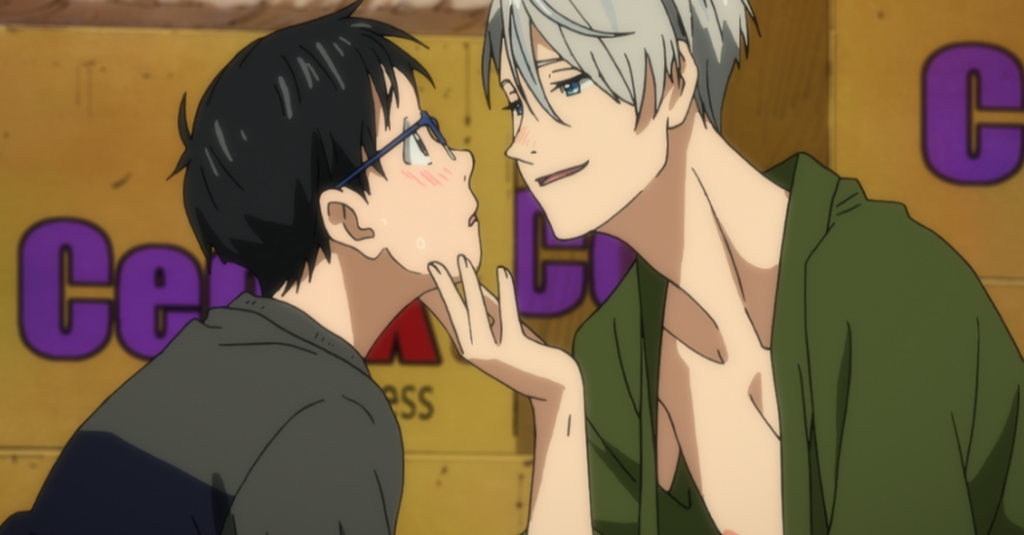
Before Shane Hollander and Ilya Rozanov there was Yuri Katsuki and Victor Nikiforov.
The anime figure-skating duo, who, like the hockey players at the heart of “Heated Rivalry,” also found love on a frozen rink, created a sensation in Japan with their same-sex relationship in the series “Yuri!!! On Ice.” The show represented a monumental moment in Japanese pop culture and for L.G.B.T.Q. representation in media, and was that rare genre combination of sports drama and queer romance. The show’s cultural impact is big enough, even in America, that movie theaters across the country will screen the first five episodes of the show Monday in honor of its 10th anniversary. While it made waves for its taboo-breaking relationship, the show’s elaborate athletic routines and tender love affair stand on their own.
“Yuri!!! On Ice” is the story of Yuri Katsuki, a 23-year-old competitive figure skater who is in a slump. He’s a strong technical skater with a pattern of buckling under the pressure of competition and has all but given up on his chances for greatness. When his idol, the Russian figure skater Victor Nikiforov, decides to coach Yuri, the two develop a unique relationship as partners and lovers on and off the ice.
This type of story isn’t entirely uncommon in Japan, part of a genre called yaoi, or boys’ love. But “Yuri” is a departure from the some of the more problematic tropes of the genre, like the cliché pairing of a tough masculine male with a submissive feminine one, the hierarchical imbalance between partners, pornographic eroticism and sometimes even normalized sexual violence. Also, the story doesn’t begin and end with the romance; the show is as invested in the figure skating itself as it is in the central relationship. It’s all a little razzle-dazzle, of course — and “Yuri” playfully embraces its own silliness — but at the heart of the show is a true appreciation of the sport as a form of storytelling and not just a feat of athleticism.
The show’s visual storytelling — not just the complicated work of animating such balletic choreography, but the emotional depth conveyed in each of the characters’ expressions — is its own kind of seduction. Though when it comes down to the actual seduction between Victor and Yuri, it’s all pretty tame (with some salacious implications). There’s a famous showstopping kiss and an exchange of rings, but Victor and Yuri’s romance builds like a slow dance. Yuri’s journey opening up romantically is mirrored by his journey learning how to tell his story on the ice. The theme of Yuri’s programs is love, and so Yuri must discover his own charms and means of seduction, his own way to embody love as he experiences a new relationship with Victor.
“Yuri!!! On Ice” is about romantic love but also about love for a sport, for competition, and the kinship that forms among competitors. We get to know side characters through their choices of programs. The performances are slick, inventive and androgynous, with a constant tension between masculine or feminine, between bold and demure, that makes them endlessly captivating, even for those who know nothing about the sport. (The dozens of routines in the series were personally choreographed and performed by Japanese figure skater Kenji Miyamoto.)
Watching the final episodes of the series feels just as riveting as watching a real-life competition. By the end of the 12-episode series, Yuri’s been changed significantly and so has Victor; their love for competition is reignited by their love for each other and their collaboration on the ice.
But the particulars of this love, and the series’s portrayal of it, is what divided viewers upon its release. Fans fell into two factions, either celebrating the series for its depiction of a wholesome, unfettered queer relationship or criticizing it for queerbaiting because of the ambiguity of the love. After all, that big kiss between Victor and Yuri is partially obscured by Victor’s arm, and for all the flirting and talk of love, the dialogue skates around an explicit, concrete declaration of their romantic partnership.
But the context is important: The fact that Yuri and Victor wear matching engagement rings is in itself subversive in a country that, in real life, doesn’t recognize same-sex marriage. And the fact that Yuri and Victor can express their affections openly, without any hints of homophobia in this world, is also a subversive fantasy where two men in love can have the same unquestionable relationship as might a heterosexual pair of leads. The show’s politics are subtle but apparent: Here is a world where queer love is on equal footing with heteronormative romance.
Therein lies the true appeal to “Yuri!!! On Ice,” which, despite its rosiness, never feels like just a boys’ love fantasy: Yuri feels real. His anxiety and shame feel real. Even the mechanics of his skating are real. He’s a lover and an athlete, and you can’t help but root for him in both arenas.
The post Before ‘Heated Rivalry,’ This Queer Sports Romance on Ice Shocked Japan appeared first on New York Times.