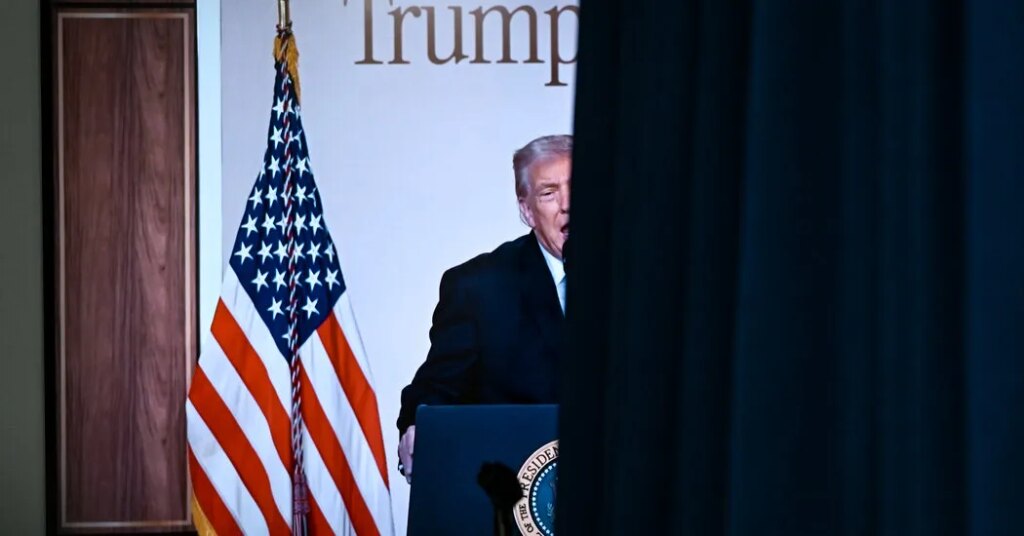
At rallies across the country, President Trump has implored voters to “pretend I’m on the ballot” in the midterm elections.
But on the airwaves, his party is sending the opposite message.
Less than $1 of every $100 in Republican television ad spending on House and Senate races from Sept. 9 through Oct. 17 has gone toward commercials that mention the word “Trump,” according to a New York Times analysis of broadcast and streaming ad data and transcripts from the media tracking firm AdImpact.
Mr. Trump’s approval rating is well under water, putting Republicans in a difficult spot in battleground contests that could decide control of Congress.
Democrats, in contrast, have spent $20 out of every $100 on spots mentioning Mr. Trump during that period, which covers much of the final sprint before Election Day. They have run heavily against the president, opposing the war with Iran, tariffs, cuts to health-care spending and the handling of the Epstein files. Many other Democratic ads do not mention Mr. Trump by name, but are critical of his policies.
The starkly divergent strategies reflect one of the defining dynamics of the final weeks of the campaign season. Republicans are increasingly trying to distance themselves from the president’s unpopular agenda, while Democrats are hoping to tie them to it.
“When the president’s approval rating is in the 30s, that’s not generally something that’s helpful for a campaign that needs to get to 50 percent of the vote,” said Whit Ayres, a Republican pollster and strategist.
The current dynamic differs sharply from the primaries, when Republican candidates, eager to appeal to the base and demonstrate their fealty to Mr. Trump, spent a much larger share of their ad dollars on commercials mentioning the president— $55 of every $100, according to the Times analysis. (AdImpact uses artificial intelligence to transcribe TV ads.)
“Voters blame what they’ve done for the pain that they’re feeling, so Republicans don’t want to own that,” said Jesse Ferguson, a Democratic strategist. “But you don’t get to start the fire and then get credit for calling 911.”
He added that Republicans “need a time machine, not an ad buy.”
Battleground Republican Senate candidates and their allies have largely steered clear of mentioning Mr. Trump in recent ads. And when they do talk about him, it frequently comes with a catch.
Senator Dan Sullivan, the Alaska Republican running for re-election in a tight race, said in an ad released on Oct. 7 that he “voted to force Trump’s D.O.J. to release the Epstein files.”
Other Republicans have tried a more indirect strategy. Former Representative Mike Rogers, the Republican Senate nominee in Michigan, sought to distance himself from Mr. Trump’s trade war with Canada in an ad first aired on Oct. 10.
“Canada is not our enemy,” Mr. Rogers said in the ad. “We need to end this tariff war now. As Michigan’s senator, I’ll bring both parties together to lower your prices.”
Democrats, meanwhile, have spent most heavily on anti-Trump attack ads in states the president lost or that he won narrowly in 2024, including Maine, Georgia, Michigan and New Hampshire, according to the Times analysis of AdImpact data.
In an ad run by allies of Senator Jon Ossoff, Democrat of Georgia, a woman stands at a gas pump and blames Mr. Ossoff’s Republican challenger for the spike in prices caused by the Iran war.
“Mike Collins sides with Trump and we pay,” the woman says in the ad. “We can’t afford him in the Senate.” (Mr. Collins has blamed the Biden administration’s environmental policies for higher energy prices.)
In Republican primaries, where loyalty to Mr. Trump was a major factor and candidates competed to be seen as most supportive of the president, Mr. Trump’s name showed up in more than half of all Republican broadcast and streaming ad airings. His name has appeared in just three out of every 100 ad airings for the general election, according to the analysis of AdImpact data.
Democrats also spent heavily on Trump-related ads in their primaries, which were often contests over which candidate would oppose the president most fiercely: Roughly $50 of every $100 in ad dollars in House and Senate races went to TV spots mentioning the president.
Now, both parties have modulated their approach.
In August, Josh Turek, the Democratic Senate nominee in Iowa, started airing an ad in which he vowed to work with anyone, “including President Trump,” to fix the country’s “broken immigration system” and “secure the border.” Mr. Trump won Iowa three consecutive times.
In her own pivot, his Republican opponent, Representative Ashley Hinson, announced she was running to be Mr. Trump’s “top ally in the United States Senate” last year; now, she argues she can pass legislation regardless of who is in office.
“Working across the aisle isn’t always easy,” she says in an ad mentioning Mr. Trump and Democrats, “but it’s how you get results.”
While Republican candidates have not centered Mr. Trump in their midterm ads, his administration has recently promoted him in taxpayer-funded television spots. A judge ordered last week that the ads be taken down.
The post Trump Urges Voters to Focus on Him. Republican Ads Tell a Different Story. appeared first on New York Times.