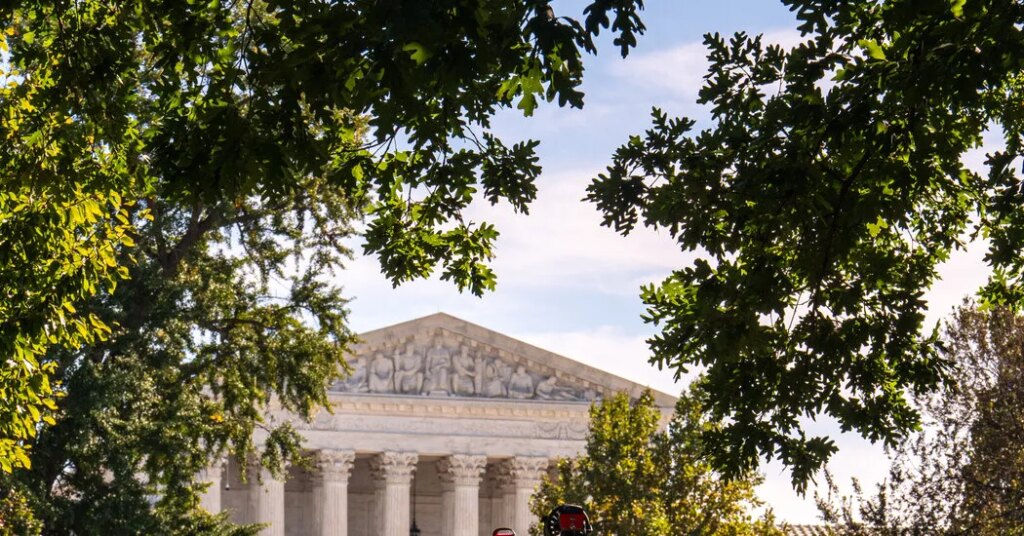
The Supreme Court announced on Monday that it would revisit the issue of race and school admissions, three years after it sharply restricted affirmative action in higher education.
The case involves four selective public middle schools in Montgomery County, Md., just outside the nation’s capital. A group of mostly Asian American parents sued the school system after it changed its admissions criteria, saying that the new rules unconstitutionally discriminated against Asian American students.
In 2023, the Supreme Court struck down race-conscious admissions programs at Harvard and the University of North Carolina. The justices did not address other school policies intended to diversify student bodies that do not explicitly address race.
Since then the court has declined to hear several other challenges to admissions criteria at elite public schools, including one from Virginia and another from the military academy at West Point.
It takes the votes of four justices to grant review, however, and several justices had previously signaled their interest in continuing to explore the implications of the court’s decision affecting higher education. In the Virginia case, Justice Samuel A. Alito Jr. dissented, joined by Justice Clarence Thomas, saying the court should have taken the case.
The justices also agreed on Monday to hear a challenge to federal bans on home distillation of whiskey and other spirits. An Ohio engineer had brought a lawsuit against a nearly 160-year-old federal ban on home distilling, in a case that will test 1860s-era prohibitions. The two cases will be added to the justices’ calendar for oral argument next year and decided before the Supreme Court’s term ends in late June or early July.
In the admissions case, the Maryland school district adopted a new lottery system for selecting eligible fifth graders for four highly competitive magnet middle schools after the coronavirus pandemic.
To be placed in a pool of eligible students, a candidate must have received an A grade in certain subjects, performed above a fourth-grade level in reading or math and scored in the 85th percentile on a standardized test adjusted for “local norms” such as the socioeconomic status of a specific elementary school population.
Students from schools with high poverty rates, for instance, are compared to other students from high-poverty schools.
In court filings, school officials described the process as “a race-neutral, race-blind lottery” adopted after abandoning an in-person exam because of pandemic constraints.
A group of families known as the Association for Education Fairness sued, arguing the lottery unconstitutionally discriminated against Asian American students. The families told the court that Asian American students who attended a high-performing elementary school “disproportionately must obtain substantially higher” standardized test scores to be eligible for the lottery than students of other races who attend lower-performing schools.
In response, school officials noted that at two of the county’s four magnet middle schools, the proportion of Asian Americans among admitted students increased in the first year of the new admissions policy.
A district court judge in Maryland dismissed the challenge, finding no evidence that the policy was enacted with a discriminatory intent. The judge said the policy was meant to account for economic disparities across different schools — a consideration the judge said was “wholly permissible.”
“Alleged disparity in treatment based on socioeconomic status alone does not make plausible discrimination on account of race,” wrote the judge, Paula Xinis.
The post Supreme Court to Hear New Case on Race and School Admissions appeared first on New York Times.