In the days after Russia invaded Ukraine, in February 2022, many orchestras and opera houses responded with a musical offering of solidarity: a performance of the Ukrainian national anthem.
But as the invasion became a drawn-out war, and as new catastrophes surfaced around the world, musicians largely moved on. The Metropolitan Opera didn’t.
Just last week, Peter Gelb, the company’s general manager, spoke from the stage before the start of “Macbeth,” saying: “Ever since Russia’s brutal and illegal invasion of Ukraine, the Met has stood in staunch defense of the nation’s fight for its liberty and for justice. Today, with the nation under nonstop and relentless attack, Ukraine needs our support. It needs the world’s support more than ever.” He then asked the audience to rise for the Ukrainian national anthem.
The Met’s devotion to Ukraine has gone far beyond lip service. It helped create the Ukrainian Freedom Orchestra, which is conducted by Keri-Lynn Wilson, Gelb’s wife, who has Ukrainian heritage through her maternal great-grandparents. The ensemble typically ends its concerts with the national anthem and moving cries of “Slava Ukraini!”
Gelb also dropped the star soprano Anna Netrebko because of her ties to President Vladimir V. Putin of Russia. Many other companies did the same, and then began to welcome her back when she condemned the war. Gelb has said that he considers her statements dishonest, and he doesn’t seem to have any plans to hire her again. (Miguel Esteban, Netrebko’s general manager, said that Gelb is “completely wrong in my view,” adding that she has been consistent and honest in her words and actions, which “speak more than someone baselessly claiming that she is dishonest.”)
The Met’s most extravagant and extraordinary support for Ukraine has been its decision to commission an opera about the war. It’s one thing to perform a national anthem; it’s quite another to pour immense resources into putting a nation’s struggle on one of the world’s biggest stages.
That opera, “The Mothers of Kherson,” with an emotionally urgent score by the Ukrainian composer Maxim Kolomiiets and a brisk libretto by the American playwright George Brant, was developed with remarkable speed for opera. Ordered up three years ago, it premiered on Friday at the Polish National Opera in Warsaw, and is scheduled to open at the Met in April 2028.
Because operas take years to develop, they almost never depict current events. Yet “The Mothers of Kherson” is based on news that is still unfolding. In late 2022, Russian forces separated Ukrainian children from their families under the pretense of keeping them safe at summer camps in Crimea, away from conflict in Kherson. After the city was liberated by the Ukrainian military, however, Russia refused to return the children, many of whom were put in orphanages or adopted.
The International Criminal Court has issued an arrest warrant for Putin and Maria Lvova-Belova, Russia’s commissioner for children’s rights, saying they unlawfully deported thousands of Ukrainian children. Lvova-Belova has said that parents were free to pick up their children whenever they wanted. They just had to come in person.
From this material, Brant and Kolomiiets developed the kind of story that has inspired opera since its earliest days: a hero’s journey into the underworld. They synthesized articles, interviews, documents and more to create something like a modern myth about mothers taking a perilous, 3,000-mile journey to rescue their children. It’s a premise that transcends borders and time; recognizably of the present, it is also made to last.
Some distance may make it easier to assess “The Mothers of Kherson.” The premiere in Warsaw, just a few hours’ drive from the Ukrainian border, and where many Ukrainians sought refuge at the start of the war, is loaded with meaning. As a project, it is almost beyond criticism while being an astonishing feat of artistic activism.
To a degree, it is inseparable from that context. Watching it with a critic’s blinders, though, reveals substantial flaws alongside this opera’s good intentions.
Problems start with how the libretto is presented. Brant wrote it in English, but when excerpts from the opera were performed in Kyiv earlier this year, the text was translated into Ukrainian by the writer Myroslav Laiuk. The English was restored for Warsaw and will remain the standard because, as Gelb told The Guardian, “We want this opera to have the broadest popular international appeal.” It’s a missed opportunity, even a misstep, to deny “The Mothers of Kherson” a Ukrainian libretto. Putin has argued that Ukraine lacks a culture distinct from Russia’s; hoping for global attention but insisting on English as a lingua franca only makes the opera’s diplomatic message less powerful.
Mostly, the libretto is structurally sound. The list of named characters is deep, but you get a clear sense of who they are. While there is a lot of plot, it is well paced; the second act’s journey through Ukraine, Poland, Belarus and Russia unfolds as a series of set pieces, like the trials in “The Magic Flute.” And despite the subject matter, there is plenty of levity and poetry, never more than when the puckish grandmother Olha describes throwing sunflower seeds into the hair and pockets of a Russian soldier so that when he is killed and buried, “something good will grow from him.”
Sometimes Brant traffics in blunt rhetoric. As if the mothers’ encounter with hostile border agents in Belarus wasn’t enough to convey the danger there, he refers to the country with epithets like “wicked” and “vicious.” Poland, the safest portion of their journey, gets an almost propagandistic tribute: “Here kind saints greet us with open arms. Just as they’ve welcomed millions of our countrymen. Bless their generous hearts.”
Kolomiiets’s score is easy to follow, too. (There is a taste of it in the Ukrainian Freedom Orchestra’s latest recording under Wilson, who conducted in Warsaw.) A composer with avant-garde bona fides, here he has consciously created a work of emotional transparency, like a film soundtrack. It doesn’t ask much of its audience and doesn’t break any new ground for opera. But Kolomiiets has said that he wanted his music to be comprehensible to the real mothers of Kherson, who attended the Ukrainian-language preview in Kyiv. On that level, of effective and lucid storytelling, he has succeeded.
The through line of his score is a Ukrainian lullaby, which first emerges from an introduction of bass-drum rumbles and apocalyptic alarm. Kateryna (a dramatic soprano role heroically performed by Izabela Matula) sings it to her daughter Lilia (a bright-voiced Hanna Sosnowska-Bill). Later, at Camp Friendship in Crimea, Lilia and her friend Olena (Weronika Wojtkowska) sing it to a 6-year-old from Kherson, but can’t remember all the words; the full tune isn’t heard again until the end, when Kateryna and Lilia are reunited.
Kateryna’s sound world is fervent and reflective. Her friend Dasha (the soprano Kamila Dutkowska), the mother of Olena, is introduced with comparatively lighter music and an aria about the importance of maintaining faith. That outlook is crucial to the final scene, in which Russian forces refuse to return Olena to her. In the score’s most wrenching moment, the lullaby pauses, and from sustained silence Dasha picks up the melody alone, with aching beauty that builds and marshals a defiant choral declaration of hope. It is one of many gorgeously composed choral passages in the opera.
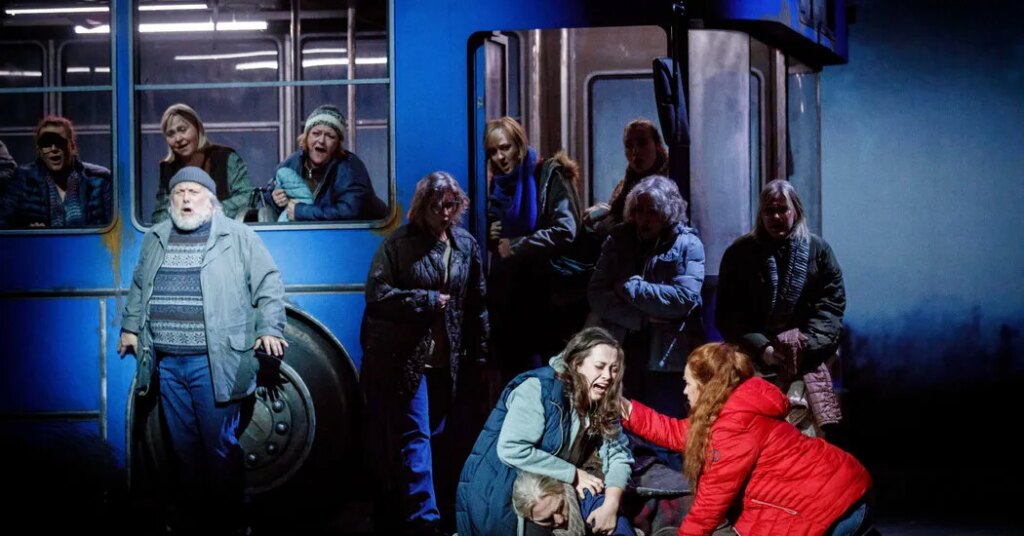
Ukrainian folk music is woven throughout the score, but subtly and not too often. Kolomiiets uses a bandura, a Ukrainian plucked-string instrument, in a scene of mourning for Olha, the sunflower seed-scattering grandmother. Elsewhere, he illustrates characters as quickly and persuasively as Brant’s libretto. The women’s bus driver (a warm Olafur Sigurdarson) is introduced with comically bumbling rhythms. Lvova-Belova (Katarzyna Wietrzny) is accompanied by the kind of wickedly ironic waltz that Shostakovich would write, and the children her associates indoctrinate at Camp Friendship sing music reminiscent of Prokofiev’s Soviet propaganda.
Wilson conducted with her signature muscularity, but her vigor went only so far as the music became bogged down by a series of interludes. Absent from an earlier version of the score, they seem to have been written to accommodate Barbara Wysocka’s production, which blends documentary realism (reflected in Julia Kornacka’s streetwear costumes) with touches of fantasy, like the first act’s set of a capacious bunker that lends each scene a resting state of panic. (Barbara Hanicka is the designer.) Act II, though, shifts between Camp Friendship and the mothers’ journey on the bus, and those changes take time. Perhaps the staging’s mechanics, along with the minor imperfections of the libretto and the score, can be sharpened before “The Mothers of Kherson” arrives at the Met.
Who’s to say what the world will look like then? The war, entering yet another punishing winter, is less resolved than ever. And its effects are bound to linger. “The Mothers of Kherson” ends with projected text that says, “Dedicated to the over 20,000 Ukrainian children who have not yet returned.” This opera may be built like a myth, but it is very much our reality.
The post An Opera Ripped From the Headlines of the War in Ukraine appeared first on New York Times.