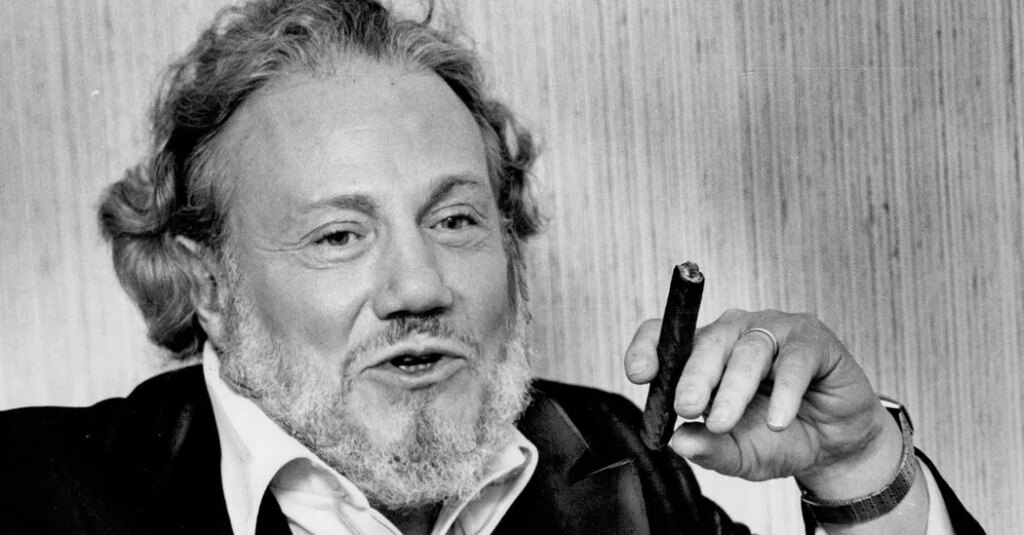
Leslie A. Fiedler’s LOVE AND DEATH IN THE AMERICAN NOVEL (New York Review Books, 505 pp., paperback, $24.95), first published in 1960 and reissued earlier this year, is an exposé of the secrets American literature didn’t know it was keeping. It is a tour de force of literary criticism — strange, ecstatic, a kind of séance — that puts classics like “The Scarlet Letter,” “Adventures of Huckleberry Finn” and “Moby-Dick” under a portable Freudian lens, as if Fiedler were chasing the American psyche with a Steadicam.
It arrived to acclaim and outrage. Fiedler (1917-2003) hauled up, from the bottom of the tank, a squirming freight of symbolic incest in our best fiction, as well as eroticized male bonding and a bedrock inability to deal with adult women and adult sexuality.
That inability is why American male writers had their characters flee to the frontier, the ocean, the saloon, the road, the company of other men or the battlefield, and why they wrote plots that flopped over into violence and gothic horror. Fiedler’s book is finally about American literature’s long refusal, especially when contrasted with its European counterpart, to grow up.
I first read “Love and Death in the American Novel” when I was too young for it, still in my midteens. I was a fool for American literature, but in a manner that chimed more with the sensibility of the critic Seymour Krim, who had this to say about being a Jewish kid in love with big 1930s realist novels:
I dreamed Southern accents, Okies, bourbon-and-branchwater, Gloria Wandrous, jukejoints, Studs Lonigan, big trucks and speeding highways, Bigger Thomas, U.S.A., U.S.A!
Fiedler pulled young me, inwardly shrieking, back into a swamp — exactly as he intended. His book scared me, the way certain malevolent fairy tales and creepy Saturday morning cartoons did. It was sometimes tough going, too. It’s easy to get bogged down (talk about swamps) in his early material about archetypes in Charles Brockden Brown and James Fenimore Cooper. What stayed with me, though, was the bracing notion that life, and reading, were going to be vastly weirder than I thought they were going to be.
“Love and Death in the American Novel” was reissued by New York Review Books, that peerless reanimator of literary corpses. Rereading it all these decades later, I felt Fiedler’s book light up nearly all the lights in my internal pinball machine. It made me feel 14, 35 and 61 at the same time. It reinstalled nodes in my understanding of our fictional origins. But this time around I loved it mostly as an outrageous and iconoclastic piece of rhetoric, nearly novelistic in its scope.
The critic Greil Marcus has suggested that “when criticism really hits its stride, when it’s at its highest pitch, it’s fiction.” He added: “It does what fiction does.” I’m with him only about half of the way on that. But if any works of criticism can be read in this manner, Fiedler’s is near the top of the pile.
He starts at the beginning, in the 18th century, and runs through about 1960. His book contains spirited readings of Carson McCullers’s “The Heart Is a Lonely Hunter,” William Faulkner’s “Absalom, Absalom!,” Ralph Ellison’s “Invisible Man” and a good deal of Ernest Hemingway’s fiction. It contains a lot of offbeat observations. (He describes Saul Bellow’s 1959 novel “Henderson the Rain King,” for example, as “a homoerotic ‘Tarzan of the Apes.’”) But the book’s telltale heart resides in the 19th century, not the 20th.
The book’s crucial line — it’s one I’d forgotten but must have internalized — is a reiteration of the French philosopher Denis Diderot’s notion that the greatest fiction (forgive my italics, but this matters) carries the torch to the back of the cave. Fiedler returns to this image repeatedly. It’s a way of saying that fiction must come to terms with our worst impulses, sexual and otherwise, as well as those of our better angels.
He was talking only partly about explicit sexual descriptions, which heterosexual male writers avoided then and suddenly do again now, for different reasons, one of them being an anxiety Elaine Blair summed up in a 2012 essay: In fiction, “if a man has good sex, he must be exploiting someone.” Another is the fear of being lit up by the Literary Review’s annual Bad Sex in Fiction award.
Fiedler did think that our fiction “is in flight from the physical data of the actual world,” which is something I still write about all the time. But he was speaking more about the human heart, and confronting both buried cultural anxieties and the dark expanse of our subconsciousness.
I wish Fiedler were alive to read Marlon James’s dangerous new novel, “The Disappearers,” which carries the torch further into the cave than any fiction I’ve read in a long time. James — he’s a Jamaican writer, but America has claims on him too — has delivered a novel flooded with sexual description, yet it’s never pornographic. The sex is bent to profound psychological use.
It’s a very funny book yet one that disturbs and appalls. It’s not interested in making you feel virtuous. It will never be a consensus novel, for award committees or reading groups, because consensus novels mean to please generally, which usually means they don’t please intensely. Fiedler, with his deep interest in brothers-in-arms, would have appreciated the fact that it took a gay man to write it.
I wish Fiedler had been alive, too, to see the director Daniel Fish’s myth-exploding 2018 reimagining of the musical “Oklahoma,” which ends with the cast covered in blood. It would have taken him 500 pages to unpack it.
Fiedler had a gregarious sense of humor, and I think he would have been delighted by the ability of some of our best writers to dance knowingly around the volcano — the “chuckles and whispers and much munching about the neck and shoulders” in Lorrie Moore’s “Anagrams,” for example, or the “tumblings and flexings and shudders” in John Barth’s “The End of the Road,” or the “stiffened giblets” in Tom Wolfe’s “Hooking Up,” or the “freaky rubs and naughty pinches” in Chuck Berry’s extraordinary autobiography.
He would have definitely admired the bracing psychosexual intensities in fiction by Annie Ernaux, Mary Gaitskill, Sheila Heti and Chris Kraus, to name just a few living writers.
Fiedler was a word-eater of the old school. He fileted books as if they were fish. He drives his audience back to the nation’s early novels, but does not allow them, as he put it, to be read “in the state of torpor they have taken for cultural security.”
He walked into American fiction’s basement and carried the torch all the way to the back.
The post A Field Guide to the Dark, Sexy Swamp of American Literature appeared first on New York Times.