In downtown Minneapolis, on a corner occupied by routine towers, there is an odd looking structure with a green serpentine stone facade, topped with a hypnotic series of gothic arches. At first glance, it looks more like an urban temple than the former headquarters of a staid Midwestern insurance company.
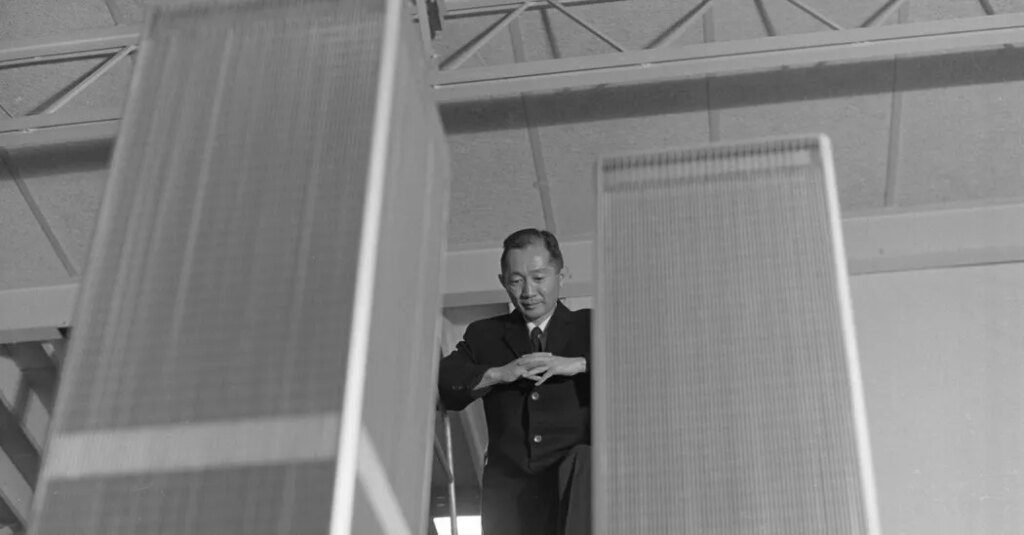
This building, which opened in 1965, is the work of Minoru Yamasaki, the Japanese American architect most famously known for the World Trade Center, a complex — until it was destroyed in 2001 — that generally drew disdain from both architecture critics and New Yorkers as too sterile and overpowering.
With the 25th anniversary of the attack on the trade center towers this fall, it’s a fitting moment to reflect on Yamasaki’s body of work, including several dozen other office buildings, college campus structures, synagogues, hotels and airport terminals around the world. This collection is undergoing a reassessment now, as is his place among 20th-century architects. And for good reason.
“Surprise, serenity, delight” was Yamasaki’s mantra, as he tried to combine the steel and glass boxes popularized by 20th-century modernist giants like Mies van der Rohe with decorative flourishes on grand cathedrals and palaces of Europe and Asia that Yamasaki first fell in love with during a 1950s trip around the world.
It was an all-but impossible aesthetic matchmaking of opposites that generated decades of angst for Yamasaki. But he could and did, at times, pull it off.
That is on display at the former headquarters of Northwestern National Life Insurance Company in Minneapolis or at Temple Beth El in Bloomfield Hills, Mich., where he designed a main sanctuary with a sloped concrete roof that seems to defy gravity. It creates a light-filled spiritual space that is home to Michigan’s oldest Jewish congregation, and is an inspiring place to enter.
I saw this all firsthand — the successes and the failures — as I visited nearly 20 of Yamasaki’s buildings across Michigan, Minnesota and Japan, as well as others on earlier trips to Seattle and St. Louis, of the approximately 300 projects he and his firm designed.
This journey was a very personal one for me.
I did not lose a family member on Sept. 11. But I stood there on Seventh Avenue in Lower Manhattan, a recently hired reporter for The New York Times, emerging from my apartment just after the second plane hit. I then watched in disbelief as the giant towers burned that morning, and inexplicably fell, sending waves of dust toward where I was standing.
I spent much of the next eight months with my Times colleague James Glanz detailing the efforts at ground zero by ironworkers to deconstruct what was left of Yamasaki’s towers and the much more gruesome task, by firefighters, who picked through the debris one bucket at a time to recover human remains.
How did it come to this? And who were the people who created this place that the terrorists had now destroyed? This inspired a book we published in 2003, called “City in the Sky: The Rise and Fall of the World Trade Center.”
But my journey was not done. This past summer, I pulled up a list of Yamasaki’s buildings and marked the spots on a Google Map, working out a road trip to visit as many as practically possible in the Midwestern United States. Planning a family trip to Japan, I also marked the spot in Tokyo where he had designed a still-standing Sheraton hotel. (A second building he designed in Kobe has been demolished.)
One thought that became increasingly obvious as this grand road trip played out: Fame is a very fleeting thing.
Yamasaki, for about a decade, and despite his diminutive size — he was 5 foot 5 and weighed about 130 pounds — became a towering figure in his field.
He was featured on the cover of Time magazine. His airport design for Saudi Arabia was such a hit that it was twice reproduced on the Saudi Riyal currency.
His personal papers on file at a university library in Detroit show letters between Yamasaki and Mies van der Rohe, Eero Saarinen and Philip Johnson as they compared notes on various innovations that were redefining modern architecture.
“I am fascinated by your structural system and wish you would send me more on it,” Johnson wrote to Yamasaki in 1956, after completing his own series of glass houses and an annex to the Museum of Modern Art in New York that had made him even more famous.
By 1962, Yamasaki, known affectionately as Yama, had won the job to design the World Trade Center, beating out Johnson, as well as I.M. Pei and Walter Gropius. “Mr. Yamasaki would bring a new and desirable architecture to New York,” the Port Authority of New York and New Jersey evaluation team wrote in its scorecard ranking the applicants. “Warmth and human scale so rarely found in modern architecture are experienced by those who view or enter his buildings.”
Yamasaki himself was surprised he got the job: He ran a relatively small Detroit-based firm and still was working to oversee his first skyscraper when the Port Authority reached out about its building project, with a planned budget of $280 million.
“My first reaction was that there had been a typo, an extra zero had been added,” he later wrote in an essay about the project.
But 11 years later, when the trade center was completed, the reviews were so harsh that his reputation never recovered. Today he is not taught at architecture schools or remembered even by many of the people I met who work in his surviving buildings.
And worse, many buildings are in terrible shape, like the former Reynolds Aluminum Showroom in suburban Detroit. I pulled into the empty asphalt parking lot in Southfield, Mich., and walked up to the once-celebrated building The New York Times had described in 1957 as “delicacy” combined with “efficiency.”
Vandals in recent years had broken in and tagged the interior with graffiti after the building became an oxycodone pill mill — and its recent owner was sent to jail. It then flooded during a winter freeze when the heat was left off and the pipes burst.
It was a sad and perhaps final chapter for this work by Yamasaki. “We need a savior,” said Kenson J. Siver, the mayor of Southfield, who has struggled to try to find a way to restore the building.
Even in this squalor, I was overcome with an odd déjà vu.
Yes, the World Trade Center towers were gone. But in so many of Yamasaki’s other works, as I stood before them, I saw hints of the towers’ aesthetic achievements.
Consider the Tridents, the nickname for the massive three-pronged columns at the base of each World Trade Center tower. These 70-foot-tall steel structures were forged in the shape of a Gothic arch and carried the unfathomable weight of the buildings deep into the ground. The bones of the towers broke apart as the fires burned inside, but large pieces of these tridents remained standing on that terrible day after the buildings fell.
A variation of these same arches was immediately recognizable as I approached the pavilion that Yamasaki designed for the 1962 Seattle World’s Fair. I was so struck by this familiar sight that I paused and teared up.
They were there, again, at Goodhue Hall at Carleton College in Northfield, Minn. And at Wayne State University in Detroit, and the airline terminal he designed for the government of Saudi Arabia in Dhahran.
The repetition recalled to me Cézanne, who painted more than 150 versions of bathers in a series of watercolors and oils over the final three decades of his life. It was clear to me now that Yamasaki throughout his career was trying to perfect a form that had become central to his art.
Yamasaki had grown up poor in Seattle, working through his summers during the Great Depression at Alaska salmon canneries to earn the money to put himself through architecture school at the University of Washington. He married on Dec. 5, 1941, two days before the Pearl Harbor attack, and members of his family were soon sent to an internment camp in California.
As an American-born architect, he and his new wife, a concert pianist admitted to Juilliard, had already moved to New York City. But he still was investigated before he was granted permission to work on federal government projects, his letters show.
As World War II was ending, Yamasaki got a new job at a firm in Detroit, where he gained his first recognition for a Federal Reserve building annex he designed in what emerged as the first modernist tower downtown.
The annex (listed along with the main Federal Reserve building on the National Register of Historic Places in 2008) had a minimalist, geometric core, echoing the lead of Yamasaki’s mentor, Mies van der Rohe. But Yamasaki had also featured decorative elements, including white marble panels and tinted green glass on its facade.
Just a few blocks away, a building now known as One Woodward emerged on the city’s skyline in 1963, Yamasaki’s first real skyscraper. Its hexagon-shaped, floor-to-ceiling windows still carry the eyes straight up into the sky, to the setback rooftop structure that recalls the battlements atop Medieval castles.
“A sense of soaring upwards, a verticality which I think is the thrilling thing about a high building for the average person, the man on the street,” is how Yamasaki described this Detroit design in a 1959 interview.
For a short while, Yamasaki became a darling of architecture journals and other publications, including The New York Times, whose magazine published a profile by its architecture critic, Ada Louise Huxtable. “His experimental architecture goes beyond conventional standards to explore a more adventurous and evocative world (Xanadu and Shalimar) for a broader, richer and more ornamental contemporary style,” she wrote in 1962.
Yamasaki was experimenting with an aesthetic that emerged after his mid- 1950s journey through Asia and Europe, when he was hired to build an American consulate in Kobe, Japan. Stopping at St. Mark’s Square in Venice, he saw the Gothic arches that adorn the Doge’s Palace.
“I discovered scale, texture, contrast, sun and shade, silhouettes against the sky,” Yamasaki said, in an interview from the 1960s. “It changed my whole attitude toward life and architecture.”
It also allowed him to define his own style.
“Mies van der Rohe was the first one to show what beautiful things machinery could achieve,” Yamasaki explained in 1973, adding in a second interview that “if he had had to build a whole town, it would have been dull.” On his trip around the world, Yamasaki said, “I learned that good architecture makes you want to touch it.”
Henry Guthard, an engineer who spent decades working alongside Yamasaki and accompanied him to Venice, told me that what Yamasaki saw there at the Doge’s Palace offered an answer to this riddle he had been trying to solve: How to merge form and function.
The Venetian Gothic arch exists for a very practical reason: it can transfer heavy vertical loads outward. For a modernist like Yamasaki, it also could be used to play out a design in a visually compelling way.
Yamasaki ran with this in his World Trade Center design, a choice that determined in part who lived and who died that day in 2001.
Yamasaki teamed up with a fast-growing Seattle-based structural engineering firm led by John Skilling and a younger structural engineer named Les Robertson, who at Yamasaki’s urging made the arch a key element in towers they started to build together.
A precursor to the World Trade Center in New York was a 20-story building in Seattle that housed IBM offices, now known as 1200 Fifth and considered a breakthrough in skyscraper design.
Suddenly, the exterior walls of tall buildings became key elements in the structural design that supported the buildings’ weight, instead of just a sleek skin, as older skyscrapers had relied more on a maze of interior columns.
Architectural Record in December 1963 reported on the design that Yamasaki and Skilling had come up with, noting how it “makes a notable mark in the evolution of the American skyscraper.”
This same structural innovation would later become a vital element of the World Trade Center design: as the 236 exterior steel columns of the towers helped hold the buildings up, along with 47 core columns, the arches at the base of the towers took part of that load and redistributed it. They were decorative elements with a real structural job, and this helps explain why the twin towers at first survived the strikes by the Boeing jets.
(The final report by the National Institute of Standards and Technology found the towers “withstood the impacts and would have remained standing were it not for the dislodged insulation (fireproofing) and the subsequent multifloor fires.”)
But enthusiasts of International Style and other Modernist buildings began to mock Yamasaki’s works, at times with good reason.
The showroom he designed for Reynolds Aluminum in Detroit — now abandoned and vandalized — looks almost like a box with too much wrapping paper.
The building is surrounded with a Japanese-inspired grille made up of hundreds of circular, gold-anodized aluminum sculptures. “Confections of the decorated box school of design,” is what Robert A.M. Stern, a competing postmodernist architect, said of some of Yamasaki’s pimped-up works.
At other moments, Yamasaki swung in the opposite direction.
He was embarrassed when the Pruitt-Igoe public housing complex he had helped design in St. Louis was later denounced as a failure and demolished. And many of his late-career works, like the hotel in Tokyo I stopped by to see, are bland, at best.
In the World Trade Center, the monotony of the design and its overwhelming size — and the vast, mostly empty plaza — seemed an impersonal monument to grandeur.
Yamasaki was crushed, his letters at Walter P. Reuther Library in Detroit show, when Huxtable, then the Times’s critic, wrote in 1973 that the finished World Trade Center “are big buildings but they are not great architecture,” dismissing the arches at the bottom of the towers as “dainty” and “General Motors Gothic.”
“I certainly have no shame in this,” Yamasaki wrote in a seven-page letter to Huxtable. “This delicate wall that you call dainty, is not only a very beautiful truss, but it carries floors with spans of 60 and 37 feet,” he continued.
“To me, this is one of the gifts of our technology, when we can build 110-story buildings with both human-scale elements and the advantage of long spans,” he added.
Yamasaki never really recovered from Huxtable’s rebuke. “I am curious to know how you can attack my work so violently?” he asked her in a follow-up letter.
“I was not aware that I was attacking your work,” she wrote in July 1975. “The fault is not yours, it is the Port Authority’s.”
The road trip I took in search of buildings conceived and constructed in the two decades before this exchange illustrates why there was so much disappointment: Yamasaki had clearly achieved greatness leading up to this stumble, producing works that are worth celebrating.
With the many reflecting pools, courtyards and elaborately outfitted interior spaces of his buildings fitted with materials like travertine limestone and teakwood, it is also often easy to identify a Yamasaki building, even as you approach it.
The 32-story One Woodward Avenue skyscraper in Detroit remains a gem on the city’s skyline.
Yamasaki’s 1956 design for the main terminal at St. Louis Lambert International Airport, featuring domed concrete ceilings and a vast, column-free interior, kicked off a revolution in the way airports look, as it celebrated flight and aerodynamics.
I watched one recent evening, as the sun was going down, and the light was reflecting off the exterior of the former Northwestern National Life building in Minneapolis, shifting its color along a skin clad with Vermont Verde Serpentine, a green stone that turns each block on the exterior into sculptures. The building has been there for six decades, but people passing by looked up and in certain cases even paused to take photographs.
“These qualities — surprise, delight, serenity — and the play of sunlight and silhouette are what I learned from my study of the past,” Yamasaki said in a 1959 speech at the Detroit Institute of Arts. “To somehow infuse these qualities into today’s buildings and still be true to the technological means and materials of today,” he added, “is the path to creating a contemporary aesthetic in architecture.”
Yamasaki died in 1986, at the age of 73, without ever being able to re-establish his standing among leading national architects — and 15 years before his most ambitious project would be targeted in the 2001 attacks.
Dale Allen Gyure, an architecture professor at Lawrence Technological University and author of the 2017 book “Minoru Yamasaki: Humanist Architecture for a Modernist World,” argues that Yamasaki — like his contemporary Philip Johnson — played a vital role in pushing colleagues worldwide to accept that architecture had to embrace more than rectangular boxes of modernism.
Even Robert A.M. Stern, who mocked Yamasaki’s “confections,” ultimately owed him credit, Gyure argues.
“Without trailblazers like Yamasaki leading the way in the 50s, their investigations of modernism’s proper relation to its historical past would have been more difficult, if not impossible,” Gyure said.
A Minnesota real-estate developer named Chad Tepley has taken a big bet on the former Northwestern National building in downtown Minneapolis.
Mr. Tepley recently pieced together $7.1 million to buy the office tower. Now he is working to get it designated as a National Historic Landmark. He plans to convert it into a 165-room hotel.
“It is coming back to life,” Tepley said, as he took me on a tour, including a penthouse conference room that is filled with the original blueprints from Yamasaki’s design. “This is a history worth saving.”
The post 25 Years After the World Trade Center Fell, an Architect’s Legacy Is Still Being Written appeared first on New York Times.