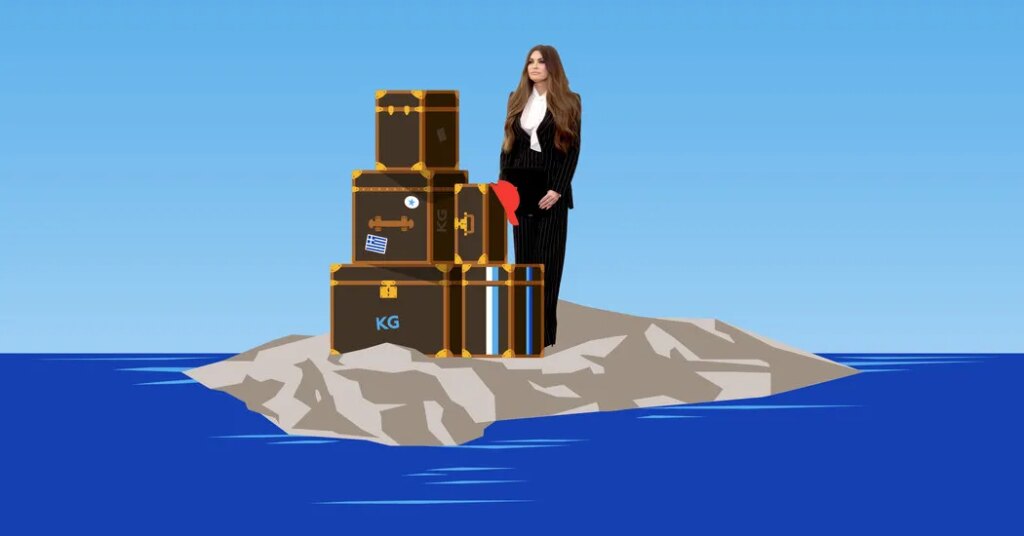
Kimberly Guilfoyle must be frenzied. She was abruptly ousted from her role as the U.S. ambassador to Greece and needs to scram, but I doubt she’s capable of packing in a jiff. She probably fills a half dozen steamer trunks with the wardrobe needed to maintain her busy social calendar.
Guilfoyle must be panicked. Normally, a disgraced or displaced Trump-administration showboat can hope for lucrative harbor at Fox News, but she already worked for the network years ago, and that arrangement also had a tawdry finale. According to an article by Jane Mayer in The New Yorker, she was forced out after a female assistant accused her of such inappropriate behavior as sharing photographs of the phalluses in her life.
But above all, Guilfoyle must be baffled. What exactly did she do to warrant President Trump’s contempt?
The rap against her is that she crassly exploited her ambassadorship for pleasure and profit, as a recent series of reports in The Wall Street Journal detailed.
But with her fame-hungry dreams and money-ravenous schemes, she didn’t violate the Trump ethos. She paid tribute to it. She didn’t contradict the Trump brand. She was its gaudy, greedy hood ornament.
In conventional political circles in ordinary times, an aide gets the ax because he or she has fallen out of step with the other members of the team and misunderstood the operation’s ideals. Guilfoyle understood and embodied them perfectly.
That’s what makes her banishment so interesting. It speaks to one of Trump’s favorite parlor tricks: pretending to be the opposite of who he is by feigning offense at behavior that’s a mirror of his own. He accuses Democrats of the very political thievery that he has attempted. He calls his predecessors economic ignoramuses as he redefines incompetence in that arena. And he signals disapproval of how Guilfoyle took advantage of her station as if such unscrupulous opportunism isn’t the very essence of him, his family and his friends.
The way I figure it, Trump made an example of Guilfoyle so that he doesn’t have to crack down on others in his rancidly corrupt administration. She’s the sacrificial ham. And he allowed himself an extra measure of cruel fun by acting as if he barely knew her.
“She wasn’t a member of my family,” he told reporters who asked about her resignation when it was announced last week. “She, I guess, dated my son a long time ago.”
A long time ago? Guilfoyle, 57, and Donald Trump Jr., 48, broke up in 2024. The president guesses? She and Junior were engaged and owned a house together in Florida. And she shrieked her allegiance to his wretched clan in speeches at both the 2020 and the 2024 Republican conventions. People in the front rows still haven’t gotten their hearing back.
Then Junior pivoted to Bettina Anderson, a sometime model 18 years younger than Guilfoyle, and married her. Greece was Guilfoyle’s runner-up prize. And from the moment she arrived there, touching down in the private jet of a rich Greek American businessman, she began clubbing and hobnobbing and styling her ambassadorship as an ego odyssey of ever-changing outfits.
Those articles in The Journal — whose claims she has disputed — recount how she cozied up to Greek business leaders in inappropriate ways, accepted lavish gifts and played financial footsie with a Trump donor who promised to pay her as much as $1 million if she helped him win access to and the favor of key administration officials. That donor gave The Journal what appeared to be text messages in which Guilfoyle pleaded with him to take care of a $100,000 American Express bill of hers in advance of her Senate confirmation hearing. Instead, he exposed her, and the nakedness of their transactions apparently rankled the president to a degree that the sprees and spending of other Trump aides — Kash Patel, the F.B.I. director, and Sean Duffy, the transportation secretary, come instantly to mind — hasn’t.
Trump is quicker with pink slips for the women in his employ than for the men, as Erica L. Green recently recognized in The Times and as Katie Zacharia discovered last week, when she was terminated as White House press secretary just five days after assuming the post. That surely isn’t lost on Guilfoyle, and I’m betting she also noticed that Junior let a Russian businessman with ties to the Kremlin spend hundreds of thousands of dollars on a post-nuptials bacchanal in the Bahamas for him and the lovely Bettina. Guilfoyle’s platinum panhandling was no more shameless than his.
And he’s the one who’s really getting richer — he and his brother Eric, his stepmother Melania, his brother-in-law Jared Kushner and a grifter’s gallery of money-mad, morally bereft hangers-on. In Trump’s second stint in the presidency even more than in his first, he leverages misbegotten policy and misguided diplomacy for personal profit — for his kin, his associates, his donors and most of all himself. He eschews do-gooders restrained by ethics; go-getters don’t encumber themselves with such self-effacing silliness. And smart people maximize perks that dullards and weaklings don’t even spot.
Guilfoyle was an Einstein of avarice and avatar of Trump. In thrall to the television camera, she long ago traded real lawyering for on-air legal analysis for CNN and ABC and then Fox News, where she ascended to the role of co-host of “Fox & Friends.” She was inconstant in her ideology but consistent in her attraction to celebrity, segueing from a brief marriage to Gavin Newsom to her aborted engagement to Junior. And she was — and is — unabashed in her self-adoration. She decorated Jefferson House, the Athens residence of the American ambassador, with enormous portraits of herself.
From her vanity-driven messes to her cartoonishly voluminous tresses, she’s MAGA incarnate, and if imitation is the sincerest form of flattery, then she flattered Trump as sincerely as anyone ever did. For that, she’s exiled? I’m not sure if that’s irony, tragedy or comedy. In Trump’s world, the three have a habit of blurring.
Forward this newsletter to friends …
… and they can sign up for themselves here. It’s published every Monday.
For the Love of Sentences
As is often the case after the newsletter has gone dark for a few weeks, I’m allotting this section extra space, so I can fit in a few more of the accumulated nominations.
In his newsletter, Ron Charles recognized the impossibly high bar that an author’s previous novel set for her follow-up: “To say it’s no ‘Demon Copperhead’ hardly seems fair. But that’s the unenviable starting point for Barbara Kingsolver’s new novel, ‘Partita.’ One squints to read it in the glaring light of its predecessor.” (Thanks to David P. Barash of Goleta, Calif., for nominating this.)
In The Times, Jeff Giles described what he saw when he read the book: “Kingsolver is interested in what we accrue over our lifetimes, like iron filings to a magnet. Or shrapnel.” (Donna Stephens, Cape Cod, Mass.)
Also in The Times, Rukmini Callimachi explained why many of the omelet-mad Americans who joined the craze for miniature coops in their backyards got a loud and eggless surprise: “A chick is a fluffy question mark, and even the professionals tasked with determining the sex of chicks sometimes get it wrong. As a result, a meaningful share of ‘hens’ carried home during the great chick rush grew up, found their voice and started using it at 4:30 in the morning.” (Julie Jennrich, New Glarus, Wis.)
In The Wall Street Journal, Dan Neil reported that while nobody in Monterey, Calif., batted an eye at the Ferrari Amalfi that he was driving, it drew a different reaction in Raleigh, N.C.: “The rakish Amalfi would have high schoolers jumping around like the early hominids in ’2001: A Space Odyssey.’” (Andy Laster, Charlotte, N.C.)
In The London Review of Books, Adam Mars-Jones contemplated the limits of the “absolute outrage” that “The Disappearers,” a celebrated new novel by Marlon James, asks readers to feel: “Outrage is no more than anger in the key of helplessness.” (Val Traversy, Clam Bay, Nova Scotia)
In The Washington Post, David Von Drehle rued the tawdry and transactional religion of the televangelist Jim Bakker, who died this month, and his spiritual kin. “God is a celestial A.T.M., coughing up the cash we’ve banked through our displays of virtue plus the interest earned by his grace, provided we enter the right scriptural PIN,” he wrote, then asked: “How all-knowing is a deity that needs constant reminders in the form of tithes and offerings? That needs TV preachers to manage his miracles? The God of the prosperity gospel was really no greater than the squabbling mercenary gods of the Greeks and Romans, jealous clerks in the great department store of nature, this one dispensing rain, that one arranging harvests.” (Matt Bai, Bethesda, Md. and Stan Martin, Andover, Mass., among others)
Also in The Post, Megan McArdle deconstructed many Americans’ shock at the botched attempt to execute Christa Pike. “As long as we do not confront certain brutal realities, we can keep imagining that death looks like the peaceful portrayals in television and movies, where patients apparently suffering from Extreme Paleness murmur loving final words and quietly close their eyes.” (Carey Winfrey, Amenia, N.Y.)
In Slate, Chason Gordon mulled melons: ”There’s always been a cutthroat rivalry between honeydew and cantaloupe. Honeydew’s a little sweeter and firmer, and cantaloupe — with its bright orange flesh and netted rind — looks like a sofa from the 1970s, and when bad, can kind of smell like one, too.” (Harold Gotthelf, Fords, N.J.)
In The Atlantic, Rogé Karma asserted that there are problems well shy of humanity’s erasure — bank heists, disinformation campaigns, attacks on power grids — that argue for firm guardrails for A.I.: “If those have the side benefit of averting the apocalypse, it wouldn’t be the end of the world.” (Mike Shelton, Sand Springs, Okla.)
Also in The Atlantic, Alexandra Petri ventriloquized Katie Zacharia, then the new White House press secretary, giving her a script truer than the one she used for her dubious debut: “You may know me from my appearances on Fox News; I am pretty sure that is how the president knows me. That is how he identifies all possible candidates for jobs: turning on the TV and pointing. My successor will be a Kalshi commercial.” There was more. “I’m bringing a kind of ‘unlicensed bus driver’ energy to this speech: unsteady at best, with many seemingly random stops in unexpected places. Just call me Vote by Mail, because my delivery is raising a lot of questions in the White House.” (Stan Shatenstein, Montreal)
In The Dispatch, Jonah Goldberg responded to Trump’s apparent belief that Republicans can triumph in the midterms by insisting that the economy is great and pretending that he’s on the ballot: “Also, the best way to repel grizzly bears is to slather yourself in a thick paste of salmon, honey and vanilla ice cream and then grab a bear cub for a selfie.” (Dan Markovitz, Corte Madera, Calif.)
And in her newsletter, Joanne Carducci, a.k.a. JoJoFromJerz, saw pure shtick in the performance of Senator John Kennedy, Republican of Louisiana, during that tragicomical Senate hearing into the former special counsel Jack Smith’s investigations of Trump: “Kennedy has a law degree from the University of Virginia and studied at Oxford, but point a television camera at him and suddenly he’s three syllables away from telling us his meemaw always said you can’t prosecute a possum during crawfish season. It’s not folksiness. It’s intellectual drag.” (Julie Lalo, Glenshaw, Pa.)
To nominate favorite bits of recent writing from The Times or other publications to be mentioned in “For the Love of Sentences,” please email me here and include your name and place of residence.
What I’m Reading, Watching, Writing and Doing
-
Not everyone has the emotional honesty and intellectual nimbleness to love a country madly while seeing its faults clearly, but that’s what my Times colleague Jason Horowitz brought to his coverage of Italy during the years — 2017 to 2025 — when he served as our Rome bureau chief. He reflects on that experience in a memoir, “The Italian Job,” that was published early this month.
-
The new HBO Max series “War” imagines “the biggest divorce trial in British legal history,” as one of the many shady lawyers involved in it says. And so far (just three of eight episodes have been released), it delivers the snippy, snappy pleasures you’d expect.
-
My Duke colleague Phil Napoli, working with a team of students at the school, confirmed and quantified an impression that I — and, I bet, many of you — have had: Fox News lavishes an inordinate amount of airtime on trashing journalists and journalism. Read more in their article in Nieman Lab.
-
In our most recent exchange, Bret Stephens and I debated the meaning of the midterms. We previously examined the resistance to artificial intelligence. Before that we parsed the president’s attempts to quash journalism he doesn’t like.
-
I have long enjoyed and admired the perspectives of Katherine Mangu-Ward, the editor in chief of Reason magazine, including recent essays in The Times about the wisdom of libertarians and the loneliness of the Republican congressman Thomas Massie. She’s an unconventional thinker and a spirited communicator, and that combination should make for a great evening at Duke University on Monday, Oct. 26, when I’ll chat with her onstage about American politics, the midterms and the country’s uncertain future. You can register for the free, in-person-only event here.
On a Personal (and Partly Regan) Note
The newsletter went dark for the last two weeks because I was dealing with a serious medical issue, and both the time consumed by daily treatments and their painful side effects slowed me down significantly.
I’ll perhaps at some point say more about that; I just haven’t figured out what or if there’s any purpose. For one thing, those treatments, which lasted six weeks, are over; the side effects shall slowly fade; and my long-term prognosis is excellent, probably allowing me to put this challenging chapter firmly in the past. For another, I reflected on illness, vulnerability and aging in my 2022 book “The Beauty of Dusk,” which recounted a rare stroke that compromised my vision, and in several essays in The Times related to that. (Here’s the first of those articles; here’s another.) I’m not sure I have additional insights.
Except about my beloved Regan. I went through that medical odyssey before she shared my home with me. I went through this one in her furry company.
My friends, who know how strong the bond between Regan and me is, kept asking: Did she sense that I was hurting? Did she hover, cling, console? At first I said no, not really. She seemed to me no more or less affectionate than usual, which was plenty affectionate.
Then, well, she did start to cling. Maybe. I couldn’t definitively tell, and I couldn’t be trusted to decide: I was too primed to detect some extrasensory perception in her, too eager for a storybook uptick in doggy empathy. Isn’t that the great flaw in all our observations? They’re tainted by what we want — and have been coached — to see.
Here’s what I indisputably noticed: As I struggled, she adapted. As I focused more and more on my needs, she relaxed hers. She made no visible protest over fewer walks, earlier bedtimes, long spells in the middle of each day when I was away at the medical center. I teetered; she didn’t.
Dogs have a way of surrendering to changes beyond their control. It’s a part of their wisdom, an aspect of their grace. I can’t say that Regan doted on me, nor am I sure what, exactly, that would look like. But she did something simpler and better: She stood steadily by me. Slept snugly beside me. As if nothing were wrong. Which made everything a crucial bit more right.
The post Kimberly Guilfoyle, Sacrificial Ham appeared first on New York Times.