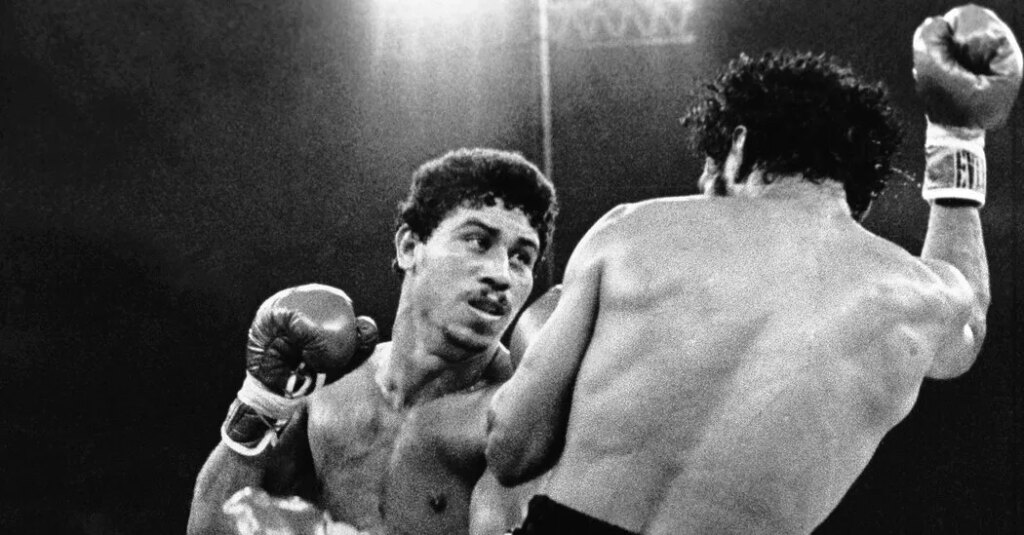
Wilfredo Gomez, a boxer as slender and explosive as a stick of dynamite who from 1977 to 1985 incinerated an entire weight class of his sport, died on Oct. 10. He was 69.
His death was announced on social media by Paco Valcárcel, the former president of the World Boxing Organization. Telemundo reported that the cause was a respiratory condition.
Gomez was a 5-foot-5 boyhood street fighter from the slums of San Juan, P.R. In his heyday, he taunted challengers in the press, then mutilated them in the ring.
He opened up such a wound against one opponent’s right eye that Gomez’s own white shorts were covered in blood. He toyed with fighters who were practically undefeated, absorbing jabs for a few rounds, encouraging the man to come in close — then calmly knocking him off his feet again and again. He sometimes pursued his foes right to the canvas, with referees struggling to hold him back.
Many Puerto Ricans felt the entire nation would come to a halt when Gomez fought.
He had brief stints as a world champion in two featherweight divisions. His six-year reign as champ, 1977 to 1983, came in an even lighter class, super bantamweight: 118 to 122 pounds.
That made Gomez about 100 pounds lighter than Muhammad Ali in his prime and 150 pounds lighter than George Foreman during his comeback.
Yet in 2003, Ring magazine listed Gomez as the 13th greatest puncher in the history of the sport, ahead of Rocky Marciano and Sonny Liston.
In 1981, Jack Fiske, a sportswriter for The San Francisco Chronicle, called Gomez “the most devastating puncher in the ring today” — more so than contemporaries like Sugar Ray Leonard and Marvelous Marvin Hagler.
Forty-two of his 44 career wins came by knockout — meaning he flattened his opponent in an astonishing 88 percent of his bouts.
Most notably, he defended his titles by knocking out his challengers 17 times in a row — a record that stands today.
His 32 consecutive knockouts is second only to LaMar Clark, who is generally credited with 42 straight KOs, though Clark did not face championship contenders and never held a title.
In 1979, in the middle of Gomez’s streak, Sports Illustrated reported that half of his last 26 opponents had subsequently quit the sport completely.
Gomez’s nickname was Bazooka. With his chiseled looks and a rakish mustache, Gomez was called “the Puerto Rican Clark Gable” by the boxing promoter Don King.
He first attracted notice in Puerto Rico by qualifying for the 1972 Munich Olympics as a 112-pound flyweight. He was just 15 and had faked his age.
Five years later, he claimed the super bantamweight title by knocking out the South Korean boxer Yum Dong-Kyun.
In 1981, after four years of uninterrupted knockouts, Gomez made the leap to featherweight for a title bout with Salvador Sanchez. He was cruising, literally — Don King had to reach Gomez by phone on a boat just 25 days before the fight. Gomez pleaded for a postponement, to no avail.
He was so overweight that, at 4:30 on the morning of the fight, Gomez was out on a run in a plastic suit, desperate to get under the 126-pound limit.
Within a minute of the starting bell, Sanchez had dropped Gomez to the mat. Gomez persisted until the eighth round — but the bout became his first defeat. It precipitated a “national day of mourning” in Puerto Rico, Carlos Acevedo wrote in his book “Sporting Blood: Tales From the Dark Side of Boxing” (2020).
“I was doing everything that you are not supposed do a few weeks before the fight, to no one’s fault but my own,” Gomez said in a 2007 interview with the website Fight News.
Sanchez died in a car crash a year after defeating Gomez, preventing a rematch.
But Gomez got vindication in 1982 by defending his super bantamweight title against Lupe Pintor — “the toughest guy I ever fought,” he told Fight News.
He claimed his long-sought featherweight title by defeating Juan LaPorte in 1984. He moved on to a super featherweight title challenge against Rocky Lockridge, in what would become the pivotal fight of his career.
After the 10th round, Gomez was oozing blood from his mouth. His handlers tried to stop the fight. Gomez then threatened to kill his own corner man. “Don’t do this to me,” he was quoted saying by The Miami News. “I want to die like a soldier.”
The crowd chanted: “Gomez! Gomez!”
He returned and changed the momentum for the rest of the fight, leading to a split-decision victory. Afterward, he was unable to respond to the crowd’s frenzied applause. His larynx was so damaged he could hardly talk.
Years later, he told the website Boxing Insider, “I’ve never really recovered.”
Friends, including his doctor, said he should retire. The man who wanted to die like a soldier refused.
Wilfredo Gomez Rivera was born on Oct. 29, 1956, in San Juan. His father, Jacobo Gomez, drove a taxi and ran a makeshift general store out of the family home. His mother, Paula, raised the children.
Wilfredo’s sister, Laura, was deaf and mute. He spent his boyhood looking out for her in the rough neighborhood where he grew up.
With his father’s encouragement, he devoted himself to boxing. In 1974, he won the World Amateur Boxing Championships in Havana. Soon, a boxing promoter was tapping on the window of his family home. Wilfredo, still just 17, was sleeping on the floor.
He got $15,000 for his first fight and bought his father a taxicab of his own. In later years, he often earned between $250,000 and $600,000 for fights. He bought his mother a house and acquired a collection of cars.
“Women consider him perhaps the most eligible bachelor in Puerto Rico,” The Detroit Free Press reported in 1982.
After the Lockridge brawl, he never looked like the same fighter. He suffered a brutal knockout at the hands of Alfredo Layne defending the super featherweight title. His doctor feared a brain injury.
In 1988, The Miami News found him preparing for a bout in a low-rent club, with a puffy face and heavy, husky voice.
“You don’t know what it’s like to once have everyone in your country consider you a boxing legend — almost a God — and then have it all change,” Gomez said.
The next year, he sold the mansion he had built himself, with a pool in the shape of a boxing glove. In 1990s, he was arrested on charges of domestic violence and cocaine possession. In the 2007 interview with Fight News, he described himself living a modest life, saved by sobriety and new Christian faith.
Gomez was married three times and had four children. A complete list of survivors was not immediately available.
In 1981, still undefeated, Gomez told The Los Angeles Herald Examiner that his power came from a kind of heedless freedom.
“My blood runs hot and I can’t always be on guard to everything in the wrong,” Gomez said. “That is why there is a referee to notice and correct any errors I make. It’s his responsibility. I’m not busy reading the rulebook.”
The post Wilfredo Gomez, Knockout King at 122 Pounds, Dies at 69 appeared first on New York Times.