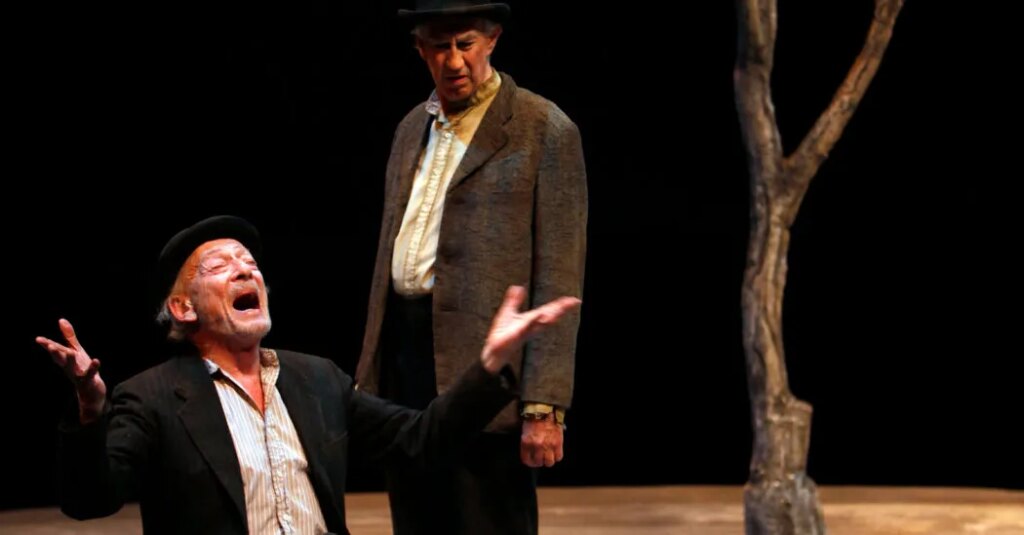
Alan Mandell, a theatrical polymath devoted for decades to the absurdist, experimental works of the Irish playwright Samuel Beckett — including helping stage a performance of “Waiting for Godot” before 1,000 inmates at San Quentin State Prison and being directed by Mr. Beckett in a production of “Endgame” — died on Tuesday at his home in Los Angeles. He was 98.
His son, Peter, confirmed the death.
Mr. Mandell was an actor, producer and director who also managed theater companies in Toronto, San Francisco and New York. But he was most often thought of as a leading interpreter of Mr. Beckett’s plays.
“It was in his DNA,” said Michael Arabian, who directed him in “Godot” at the Mark Taper Forum in Los Angeles in 2012. Mr. Mandell played Estragon, one of the play’s two tramps (Vladimir, played by Barry McGovern, is the other) who await salvation from Godot, who never appears.
“Mandell at 84 is as spry as a man half his age,” the critic Charles McNulty wrote in The Los Angeles Times. “But his pratfalls are those of someone with too much experience to pretend that bruises don’t hurt and beatings are a laugh riot. His comedy echoes down a corridor of years.”
Mr. Mandell’s introduction to Beckett came around 1956 when he was the business manager of the Actor’s Workshop of San Francisco. One of its founders, Herbert Blau, sent a copy of the “Godot” script from Europe.
“I hadn’t the faintest idea what I was reading,” Mr. Mandell told the Working Actor’s Journey podcast in 2019. He awaited Mr. Blau’s return to explain it.
In early 1957, the workshop performed “Godot” to acclaim at a theater in San Francisco; later that year, Mr. Mandell got a call from a San Quentin official asking if the avant-garde regional theater company would mount a play at the prison.
The official had two conditions: no women and minimal scenery changes. That was no problem, Mr. Mandell said on the podcast: “Godot” had a cast of “four men and a boy and not much scenery — a couple of rocks.”
The one-night performance of “Godot” was a hit; the rave in the prison newspaper — “The San Francisco company had its audience of captives in its collective hand” — was one of Mr. Beckett’s favorite reviews, said Mr. Mandell, who would later befriend and collaborate with him.
The play succeeded because “the prisoners understood what waiting was all about,” Mr. Mandell, who was the assistant director, said on the podcast.
Mr. Mandell soon advised prisoners on starting their own drama workshop. One of the inmates, Rick Cluchey, who had been serving a life sentence for armed robbery, immersed himself in Mr. Beckett’s plays. After he was paroled in 1966, he became an actor and protégé of Mr. Beckett’s; they asked Mr. Mandell to join the “Endgame” cast at the Peacock Theater in Dublin.
In the postapocalyptic tragicomedy, which Mr. Beckett directed, Mr. Mandell played Nagg, the legless father of the lead character, Hamm (Mr. Cluchey), a blind, paralyzed man who verbally abuses his parents (who live in empty ashcans) and Clov, his servant.
During a rehearsal, Mr. Mandell asked Mr. Beckett if he could describe Nagg’s character and how he had ended up in the ashcan.
“Beckett stared at me intensely and with a long sweep of his hand said, ‘He’s greeey!’” Mr. Mandell said in “Beckett Remembering, Remembering Beckett” (2006), a book of interviews, edited by James and Elizabeth Knowlson. “It wasn’t the response I was expecting, but I jumped back into my ashcan thinking, ‘Grey.’” Later, when he asked about Hamm’s mother, Nell, Mr. Beckett said, “She’s not there.”
Albert Mandell was born on Dec. 27, 1927, in Toronto. His father, Louis, owned a restaurant, and his mother, Bella (Grosshaus) Mandell, a Polish immigrant, ran the home, with eight children, and helped in the restaurant.
Albert — who changed his name to Alan in 1968 — became entranced with acting when he was 4 or 5, watching an elementary school play where a young actor burst into tears. He began acting and played the lead in a school production of “Oliver Twist.”
Mr. Mandell, who did not finish high school, acted in radio dramas before joining Theater ’49, an acting company in Toronto. After rising to artistic director, he relocated to San Francisco in 1954.
At first, he was there to visit his sister, but while looking for a place to work on scenes, he went to the Actor’s Workshop, then a recently formed group in a converted garage. He found himself alone in its office and decided to neaten a desk, jot down phone messages and take reservations for “The Crucible.” He was soon hired as the business manager for the pioneering regional theater and continued to act.
He left in 1965 to take a similar job at the Repertory Theater of Lincoln Center, where he joined Mr. Blau and Jules Irving, the workshop’s other founder, who were the theater’s directors. While at Lincoln Center, Mr. Mandell appeared in productions of “The Merchant of Venice” and “The Country Wife.”
He moved to Los Angeles in the mid-1970s and worked with the Los Angeles Actors’ Theater (later the Los Angeles Theater Center) as a consulting director. In 1982, he directed a production of three short plays by Mr. Beckett — “Rockaby,” “Footfalls” and “Ohio Impromptu” — and three years later, starred in the one-man drama “Company,” speaking to himself, about himself.
“Mandell looks the Beckett actor — his wispy gray hair flies askew and he converts his body into a reptilian torso bobbing under the shifting light that confronts him: now autumnal, now spectral, now as blinding as a police detective’s inquiry lamp,” the critic Jack Viertel wrote in his review in The Los Angeles Herald Examiner.
Nearly 30 years later, when Mr. Mandell played Estragon in Los Angeles, he and Mr. Arabian, the director, bounced ideas off each other about how to interpret Mr. Beckett’s text.
“I saw things in the writing that I had not seen in previous productions,” Mr. Arabian said. “It was nice to have Alan, with his knowledge, understanding and support.”
Mr. Arabian later watched Mr. Mandell capture the humor in Estragon at the start of the play. “He’s unable to take off his boot, probably because his foot was swollen from walking,” he said. “And the audience was hysterical.”
His performance in “Godot” earned him one of three Ovation Awards for lead actor in a play from the LA Stage Alliance. His others were for “Trying,” by Joanna McClelland Glass, in which he played Francis Biddle, a former chief American judge at the Nuremberg trials, and for Harold Pinter’s “No Man’s Land,” in which he was a poet. He received a fourth Ovation, for featured actor, as an estate appraiser in Arthur Miller’s “The Price.”
In addition to his son, Mr. Mandell is survived by his daughter, Olivia Shulman; three grandchildren, and his brother, Jerry. His marriage to Elizabeth (Heller) Mandell — a gallery owner, arts patron and consultant to nonprofit agencies — ended in her death in 1997.
When the actors Alex Winter and Keanu Reeves researched Mr. Beckett’s work in advance of performing “Godot” on Broadway in 2025, they consulted with Mr. Mandell.
“He gave us great advice about how to stay grounded and get all the juice out of the prose,” Mr. Winter said in an interview. And he advised them to “just talk to each other. Have a conversation. He didn’t like hypertheatrical clowning; it’s just two people talking. It was different from an acting coach telling you to get over yourself.”
The post Alan Mandell, Star of ‘Godot’ and Other Beckett Plays, Dies at 98 appeared first on New York Times.