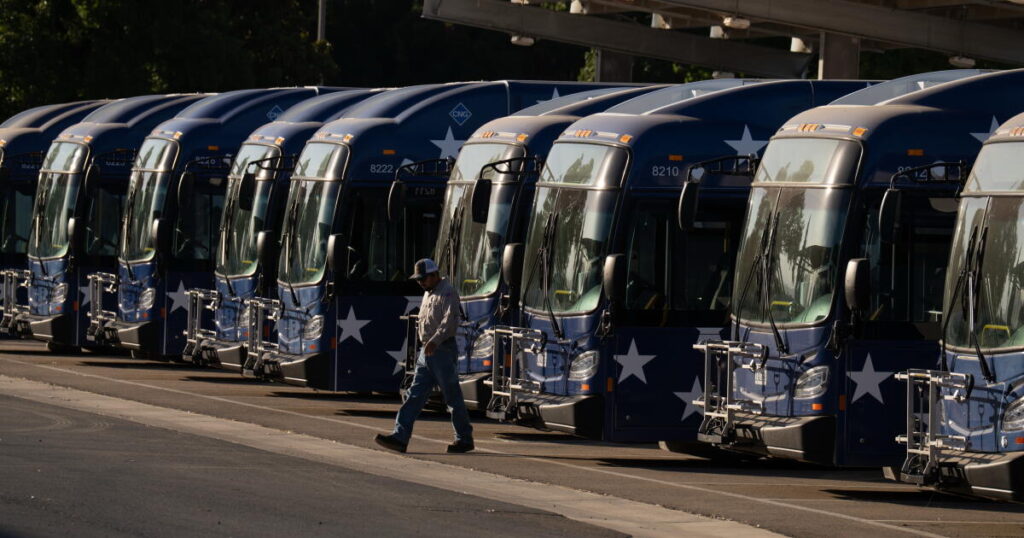
With over $1 billion spent, California’s Clean Truck and Bus Voucher Incentive Project is one of the state’s most well-financed environmental initiatives.
By subsidizing up to 90% of the cost of hybrid and zero-emission vehicles, state officials say the project has helped businesses and transit agencies deploy nearly 12,000 trucks, buses and vans throughout California — particularly in neighborhoods that have been plagued by cancer-causing diesel pollution.
But what was designed 17 years ago to be the nation’s premier green transportation initiative is now facing accusations of fraud, waste and poor oversight.
Although officials have described the program as a “resounding success,” state authorities have launched an investigation into an EV manufacturer that allegedly received nearly $1 million in public funds for “vehicles that did not exist,” according to a ruling in a civil case involving the manufacturer. Authorities are also probing whether vehicle identification records were altered in order to “impermissibly double-dip,” and obtain multiple vouchers for a single EV, according to a court petition to enforce investigative subpoenas filed by the state attorney general’s office.
Officials say the voucher program has helped to accelerate the adoption of zero-emission trucks and buses, but some businesses and transit agencies claim that officials have failed to properly vet vehicle manufacturers. One in four automakers that have participated in the program have ceased production or exited the zero-emission vehicle market, leaving trucking businesses and transit fleets without critical support to keep their EVs on the road.
And although officials say the program has prevented the release of nearly 1.5 million metric tons of planet-warming carbon dioxide and 2,200 tons of smog-forming emissions, the state has failed to keep accurate records of program vehicles, making it difficult to verify the project’s pollution reduction claim.
The Times obtained mileage records for roughly 2,300 program vehicles, and nearly half were driven less than the state’s conservative benchmarks. Also, at least 5,340 project vehicles, or 45%, burn fossil fuels — either because they are hybrids, or run entirely on natural gas — according to a Times analysis.
The findings have angered some lawmakers and industry officials.
“Californians are working harder than ever just to make ends meet, so learning that millions of dollars have been mismanaged is both frustrating and insulting,” said state Sen. Tony Strickland (R-Huntington Beach). As vice chair of the Senate transportation committee, Strickland has urged that state lawmakers — not state agencies led by governor appointees — oversee the voucher program.
Peter Tawil, executive director of commercial operations at RIZON, an electric truck manufacturer, has repeatedly petitioned state officials to audit the program.
“They always say, ‘Buyer, beware.’ But I think the problem is, when you’re using state money or taxpayer dollars, shouldn’t there be a requirement that there should be vetting?” Tawil said. “We, as an industry, have to do better, because if we don’t do it right, when people buy their first EV, then they may not buy their second.”
The agencies that oversee the program — the California Air Resources Board and its nonprofit partner CALSTART — insist the program is managed effectively and has an “intentional and robust” process for vetting participants and ensuring the legitimacy of vehicles that received state funding.
They say challenges are to be expected when dealing with emerging markets and budding technology.
The voucher program, in most cases, “is supporting the very first zero-emission trucks that a fleet has ever put into service,” said Peter Christensen, head of the innovative strategies branch at CARB. “Most people are having good experiences, but it doesn’t always work out that way.”
ACCUSATIONS OF FRAUD
Los Angeles-based startup Green Commuter seemed a good fit for the California voucher program. The all-electric van pool provider said it was “democratizing” the EV market by allowing people in disadvantaged and heavily polluted communities to rent vehicles for shared commutes.
From 2019 to 2021, California awarded nearly $10 million in vouchers for nearly 100 Green Commuter electric shuttle vans that were intended to serve riders in downtown Los Angeles, the Inland Empire and the San Joaquin Valley.
But in late 2022, CARB discovered that at least 10 vans Green Commuter had leased with nearly $1 million in state funding were actually sitting in a factory, unassembled and unusable, according to the judge’s ruling in the civil case involving Green Commuter. Although Green Commuter executives told the state that they had started driving the vans several years prior, the vehicles had plywood floors and lacked passenger seats, according to the ruling and evidence filed in the civil case.
Green Commuter and the vehicle manufacturer — Vancouver-based GreenPower Motor Co. — were admonished by the Los Angeles County Superior Court judge during the breach-of-contract trial. The companies had “collaborated and misrepresented that vehicles had been manufactured and delivered, when they had not — constituting fraud upon CARB,” the judge wrote.
Green Commuter Chief Executive Gustavo Occhiuzzo declined to comment. Fraser Atkinson, chief executive of GreenPower, said in an email to The Times that it “follows the rules and regulations to the best of its ability.” He said his company “shares the same mission as the California Air Resources Board: helping fleets transition to a cleaner, zero-emission transportation solution.”
The matter appears to be the subject of a larger probe by authorities. State officials have scrutinized dozens of other vehicle orders from other operators, according to investigative subpoenas filed in court by the state attorney general and interviews with a voucher applicant.
The corporate fraud section of the California attorney general’s office said in these court filings that it had received credible information that some state-funded vehicles were “never delivered or operated.” The information also suggested that certain program participants may have changed vehicle identification numbers (VINs) to obtain multiple vouchers for a single EV, the attorney general’s office said in the court documents.
The attorney general’s office said it was seeking to identify an “interconnected network of [program] participants who may have information about the fraudulent scheme,” the court filing said.
Neither the AG’s office nor officials with the California Clean Truck and Bus Voucher Incentive Project would comment on the status of the GreenPower investigation, or whether it was ongoing.
CARB removed GreenPower from the program in March 2023, saying the company “failed to demonstrate all vehicles were delivered to purchasers,” according to a suspension notice reviewed by The Times.
Months later, GreenPower filed a legal challenge in Sacramento County Superior Court, arguing CARB acted “arbitrarily” in suspending the company from the program. CARB reinstated the company. An appeals ruling noted that the attorney general’s investigation was a separate matter from the administration of the program.
Separately, a Times analysis found that CALSTART’s database contained 2,681 VINs that did not appear to match the model year of their voucher applications. At least 83 VINs had an erroneous ninth digit — the security digit — a potential indicator of error or tampering.
CARB staff said the invalid VINs could have been mistyped into the system. They acknowledged that they conduct random “spot checks” of VINs, but not systematic reviews.
BIG MONEY, LOW MILES
At the base of the Sierra Nevada, the city of Porterville’s transit depot has devolved into a graveyard of inoperable electric shuttle buses and vans whose interiors are covered in cobwebs.
Since 2018, the city purchased nearly 30 electric buses and vans, mostly through the voucher program, for public transit and a rideshare service. Today, only three of the buses are operational after a series of battery malfunctions and service issues.
“We’re located in the Central Valley and, unfortunately, we’re home to some of the worst air quality in the nation,” said Rich Tree, Porterville city manager. “So we wanted to be an early adopter of zero-emission technology when it comes to our fleet.”
But problems started after the battery of one GreenPower bus caught fire while charging overnight. The city pulled the rest of those buses from service and waited for repairs. Not long after, another EV manufacturer the city purchased from, Lightning eMotors, went out of business, leaving the city without an automaker to service those shuttle vans.
The city eventually decided to pause buying any new electric vehicles.
Porterville’s experience is not unique. The Times reached out to dozens of businesses and transit fleets that purchased vehicles through the program. They say they have been plagued by breakdowns, unreliable maintenance and dissolved manufacturers.
On the outskirts of San Francisco, a senior living facility that bought an EV shuttle bus resold it after a close call — the seven-ton vehicle was transporting residents when it stalled on a hill, rolled backward and then sideswiped several parked cars.
In Berkeley, independent trucker Bill Hall purchased a $484,000 hydrogen-powered big rig with state funding. But the truck has been parked indefinitely after the manufacturer, Nikola Corp., went bankrupt following fraud allegations, serious safety recalls and other issues.
Although the state subsidized much of the vehicle’s cost, Hall still paid a healthy sum for a truck he can’t use. He has been pleading with California state officials for compensation.
“I’m all for zero emissions … but as a small-business owner, I can’t afford to have $123,000 go down the drain,” said Hall, who started his trucking business five years ago.
And in Los Angeles, EV buses purchased by two major public transportation agencies are driven only a fraction of the distance of their hybrid and fossil fuel-powered counterparts.
At L.A. Metro, $15.7 million in state funding was used to purchase 93 all-electric buses. On average though, the agency’s EVs are driven 36% less than its fossil fuel-burning buses.
Meanwhile, at the Los Angeles Department of Transportation, 155 electric vehicles were purchased with $20.2 million in state-funded vouchers. But the city’s EVs drove just half the mileage of the fossil-fuel fleet. Some have barely been driven at all, including a $630,000 BYD bus that has logged only 555 miles since it was added to the fleet in June 2024. An LADOT official said the vehicle had been idle due to lack of charging infrastructure.
Recently, CARB has proposed that every vehicle model that is eligible for a state voucher be inspected at the agency’s Riverside facility. While there, the vehicle would be tested for battery range and other specifications. This proposal has yet to be implemented.
KICK-STARTING EV ADOPTION
When California’s voucher program launched in 2009 as the Hybrid and Zero-Emission Truck and Bus Voucher Incentive Project, its goal was to accelerate the adoption of zero-emission vehicles by reducing the upfront purchase price for electric buses and trucks. Since that time, it has led to the adoption of similar programs in New York, New Jersey, Illinois and Washington.
The program works on a first-come, first-served basis. Businesses and transit agencies browse a catalog of eligible dealers and vehicles, and once they decide on a particular bus or truck, the dealership fills out paperwork and applies for a state voucher on the customer’s behalf.
The voucher system uses state and local funding to cover up to 90% of the vehicle’s price, and the customer pays the balance. Customers must agree to operate the vehicle in California for at least three years.
When the voucher program began, battery technology was still in its infancy and manufacturing limited. These zero-emission vehicles often cost several times more than their diesel counterparts but promised cleaner air. (Although they make up just 10% of all vehicles on U.S. roads, heavy- and medium-duty trucks produce nearly half of all smog-forming emissions and a quarter of all carbon emissions.)
The program initially subsidized a broad mix of vehicles considered to be cleaner than diesel, including hybrids and natural gas vehicles.
As a result, 45% of all vehicles funded through the program burn fossil fuels — either as gas- or diesel-electric hybrids, or natural gas-burning transports — according to a Times analysis. The program’s best-selling vehicle is a hybrid diesel box truck that was the subject of an emission-cheating scandal.
As California adopted more aggressive auto emission rules and the technology matured, the state became more selective.
By the end of 2021, the program funded zero-emission vehicles only, and the program’s funding surged with help from cap-and-trade revenue and fees paid by diesel trucks visiting California ports.
As money poured into the program, dozens of auto manufacturers rushed to be considered for vouchers. They included major brands such as Tesla, Volvo and BYD, but many were small companies, known as upfitters, that convert fossil fuel-powered vehicles into EVs.
Most had never produced zero-emission vehicles at scale, and the result was a program with a high rate of corporate failure. Among the 57 automakers that have participated in the voucher program, 15 have ceased operations or pivoted away from making zero-emission vehicles.
Tom Brotherton, director of market acceleration at CALSTART, acknowledged there was a high rate of manufacturer failure but argued these were mostly smaller companies that produced a fraction of state-funded vehicles.
“Some of the earlier entrants and suppliers were small startups. And some of them made it, and a lot of them didn’t,” he said. “Whether or not they survived in that marketplace or not, they made a difference by at least showing that that market was there and drawing in some of the larger players who are still in the market today,” he said.
PROBLEMATIC MANUFACTURERS
At least five automakers that have participated in the state voucher program have been accused of fraud related to their production of zero-emission or hybrid vehicles. One of the companies has admitted to fraud, and three have agreed to pay settlements without admitting or denying wrongdoing. Collectively, the companies have received at least $122 million in public incentives, a Times analysis found.
The most publicized case involved Nikola Corp., which collapsed less than three years after seeking California vouchers, leaving customers with a limited supply of spare parts and additional costs for maintenance.
CARB has also suspended several manufacturers and dealers from the program for inflating vehicle prices, providing false information, selling vehicles to themselves and failing to deliver vehicles, according to public records.
But critics — and even one former program official — claim the agency has been slow to act or has failed to act in situations where a company’s history or recent actions pose red flags.
Cenntro Automotive was suspended in late 2024. The company had applied for more than 1,200 vouchers seeking $145 million in state funding to discount its electric trucks. More than 85% of those were canceled after CARB discovered the company had submitted “false information” related to its voucher requests, according to a suspension notice obtained by The Times.
A former voucher program administrator, who requested anonymity for fear of retaliation, claimed that Cenntro’s actions should have raised suspicions much earlier. Cenntro requested vouchers on behalf of companies that had been created just days before, according to public business records filed with the California secretary of state’s office and voucher application documents. Cenntro has acknowledged in financial statements to shareholders that one of its EV delivery truck models was no longer eligible in the voucher program but has not provided further explanation.
“It was massive oversight,” the administrator said. “Every loophole that was in place, Cenntro took advantage of it. And it’s just unfortunate,” because they had accusations of fraud against another company “way earlier.”
CARB declined to comment on Cenntro, saying an investigation into the program was ongoing. Cenntro failed to respond to repeated requests for comment.
LACK OF REPORTING
State officials insist the voucher program has helped reduce CO2 emissions by 1.5 million metric tons — equivalent to the annual emissions of four natural gas power plants — and an April 2026 reporttook credit for 181 million “cleaner-air” miles driven by program vehicles.
But those claims rely heavily on assumptions and estimates, instead of actual data.
A Times analysis found that program administrators have consistently failed to track the most critical metric of emission reductions — mileage.
Although CARB requires automakers to submit three years’ worth of quarterly mileage for every vehicle, manufacturers failed to submit a single mileage report for 64% of vehicles since 2020, according to an analysis of state data. Without this data, program administrators cannot verify how much vehicles are actually driven — or accurately calculate emission reductions.
The Times obtained thousands of title records to track mileage over time and found that average usage varied greatly.
A Times analysis found that out of 948 trucks, shuttles and vans, 55% were driven less than 12,000 miles a year — the state’s conservative benchmark.
The Times also obtained mileage records for 1,383 program-funded transit buses, and found that about 42% reported mileage below the program’s 30,000-miles-per-year target.
When considering only electric and hydrogen vehicles that The Times obtained mileage for, 80% of the program vehicles drove less than what was benchmarked by the state.
Despite the limited mileage data, CALSTART officials insist the program has achieved emissions reductions.
“I don’t think there’s a question that it’s reduced pollution,” said Brotherton, of CALSTART. “You can argue by how much.”
PRICE INFLATION
The overarching goal of the incentive program was to make zero-emission vehicles more affordable. But even some CARB officials worry that California’s generous incentives may be inadvertently inflating the retail price of zero-emission heavy-duty trucks. CARB has even floated the idea of establishing a retail price cap for eligible vehicles in the program.
The cost of lithium-ion batteries, typically the most expensive component of an EV truck, have dropped 90% from 2008 to 2023, according to the U.S. Department of Energy. Yet the average price of zero-emission semitrucks in the U.S. has risen.
The trend angered Hector De La Torre, former CARB board member, who called for an analysis of the price trend.
“There is something rotten here,” he said at a CARB meeting in 2024. “There is no explanation for this other than they [truck manufacturers] are making an active choice to screw California fleets and buyers and the state of California for subsidizing them.”
Sen. Eloise Gómez Reyes (D-Colton), who represents the Inland Empire — a region that endures the nation’s worst smog — is the author of a newly signed law that requires automakers to provide a recommended base price for state subsidized EVs.
“For communities like the Inland Empire, this is about more than the price of a vehicle,” Reyes said in a statement. “It is about cleaner air, healthier neighborhoods and making sure small businesses and fleet operators can afford to be part of California’s clean transportation future.”
The post California spent over $1 billion subsidizing clean transit. Accusations of fraud and waste followed appeared first on Los Angeles Times.