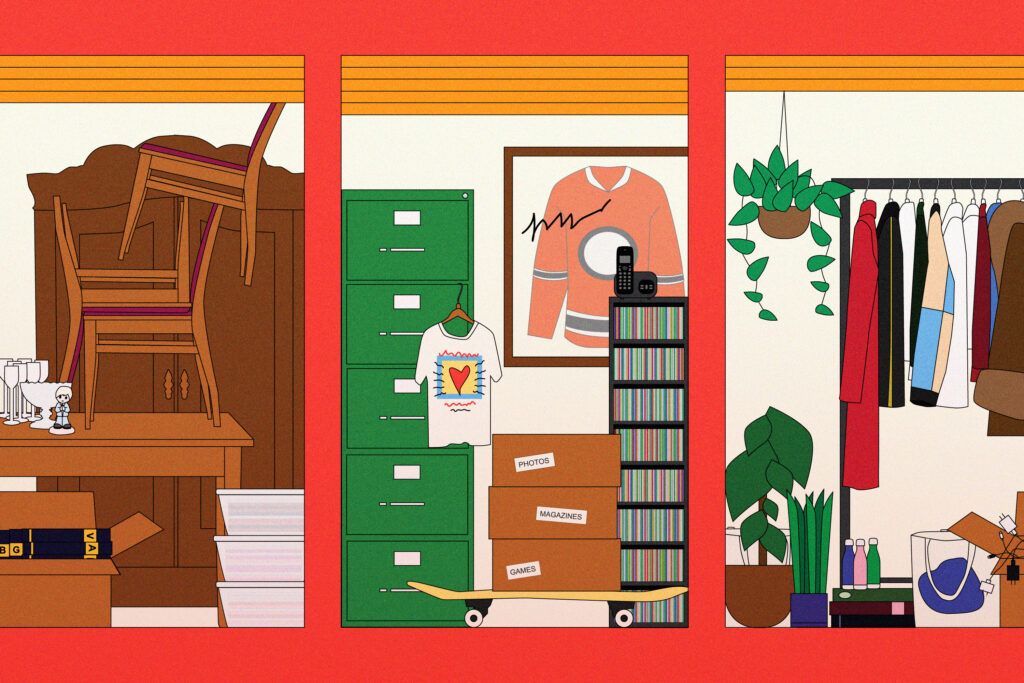
Each generation has its hallmarks — slang, clothing, hair styles and historical touchstones — that can give someone away as a boomer, a Gen Xer or a millennial. To those, add an unexpected generational signifier: your clutter.
“Every generation has its own clutter. It’s a way of documenting life,” says Hana Ben-Shabat, a generational researcher and the founder of the research and advisory firm Gen Z Planet. “The differences are the medium, the meaning that each generation assigns to ownership of an item and the amount of physical space available to keep it.”
That stands to reason, says Jeff Galak, associate professor of marketing at Carnegie Mellon University’s Tepper School of Business. “Clutter is really just an artifact of the economic conditions of our formative years,” he says. “Boomers view possessions through the lens of legacy, equity and permanence. Gen X reflects a pragmatic self-reliance. Millennials reveal the tension of deferred adulthood and the pursuit of intentional living.”
Those artifacts take a predictable form, experts say, making it easy to tell which generation you hail from just by looking at the clutter in your home.
Boomers (born 1946-1964): Your clutter is formal and durable
Boomers’ homes, Galak says, are filled with “goods purchased under the assumption of permanence — formal china cabinets, crystal glassware, solid wood furniture and physical photo albums. To them, durable goods were serious financial investments meant to last a lifetime and pass down.” Kayleigh Davies, an antiques and collectibles specialist at Auctionet, describes boomers as “the generation that has a good front room full of things nobody is allowed to use.”
Formal china and silverware
Marielle Goldberg, a Brooklyn-based professional organizer and owner of Sorted Home NYC, calls high-end dinnerware and entertaining pieces, some of which boomers inherited from parents or grandparents, “formal clutter” — and there’s a lot of it. “You’ll find a vast amount of dinnerware in a boomer’s house,” she says. “Dozens of plates, multiple sets of formal china, as well as platters, gravy boats, soup tureens and butter dishes.”
Precious Moments figurines and other collectibles
In addition to all those fancy serving pieces, boomers collect pieces to display, including figurines, coins or commemorative plates. Goldberg sees collections of such figurines as Royal Doulton, Lladró, Hummel, etc., that have typically been inherited from parents or grandparents. Even if these pieces aren’t on display, “they’re very sentimental and can be hard to let go of,” she says.
Encyclopedias and other book collections also abound. “Boomers grew up in the age when physical ownership of knowledge felt important, so you’ll usually see a collection of things like old encyclopedias and an atlas,” Davies says.
Heavy wood furniture sets
Boomers’ homes are filled with matching furniture sets, heavy wood furniture and furniture designed to display collections. “Those who invested in good quality furniture in their early married life have dining tables and sideboards,” Davies says.
“These homes also tend to be more focused on these items being a centerpiece or display piece,” says Nick Friedman, who has seen his share of clutter as co-founder of College Hunks Hauling Junk & Moving. “Lots of china cabinets, furniture built to display curios or matching bedroom suite sets.”
Expired food
Excavating expired food out of a boomers’ pantry is a favorite game of Gen Xers and millennials, and the good news is that there’s apparently no shortage of ancient jars of allspice to marvel at. “Boomers hold on to expired foods more than any other generation,” says Amanda Rivera, a professional organizer and the owner of Tidy Red Professional Organizing. “When I ask them about it, they say things like, ‘I haven’t died yet. It doesn’t matter if these anchovies are 10 years old. I’ve been doing this forever.’”
Duplicates, triplicates and extras of everything
“In a boomer’s home, there is a lot of functional redundancy,” Galak says, “like cupboards full of saved plastic containers and extra linens.” Many of these extras are things boomers are holding on to for someone else. “They are saving clothes for their children, toys for grandkids, decorations for a neighbor,” Rivera says. “They just have difficulty usually getting the items to the person.”
Gen Xers (1965-1980): Your clutter is cultural and nostalgia-centric
A Gen Xer’s home, Galak says, “looks like a time capsule of the shift from physical to digital. For Gen X, physical media was the primary mechanism of youth culture and subcultural identity. Tossing a crate of records or old concert shirts feels like discarding pieces of who they were, and they still prefer the security of physical ownership over the cloud.”
Goldberg says Gen X has the most physical memorabilia, including boxes of printed photographs, letters, CDs and DVDs. “I think Gen X’s experience of seeing technology change so quickly in their lifetime has made things like physical media and photographs inherently nostalgic, making them harder to let go of,” she says. Davies describes a stark contrast between the items that Gen X keeps compared with other generations: “Gen X usually holds on to things from their formative years, and collects nostalgia instead of displaying lots of trinkets.”
CD towers
“The most telling [Gen X] collectible is the CD tower rack,” Ben-Shabat says, along with the CD collections they hold. Friedman also sees a lot of cassettes and vinyl records in Gen X homes. “Music is tied to identity for many of Gen X,” Davies says, “and over the years they’ve collected ticket stubs, programs from festivals and concert T-shirts, which were worn until they were rags.”
Outmoded electronics
Gen X keeps old electronics for their nostalgic value, Ben-Shabat says, and for their cool factor. “Think Panasonic answering machines, a Walkman or a portable video camera.” She ascribes this to Gen X coming of age during what she calls “an electronics explosion. Companies like Radio Shack used to take full-page advertisements in newspapers to advertise a variety of products that today we all have on our phone. Gen Xers viewed ownership of these products as a sign of being both advanced and cool. Keeping them is an attempt to hold on to that coolness, and what it symbolized at that time.”
Vintage toys and retro games
As they aged into their disposable income era, Gen X regressed, buying toys and games that were popular in the 1970s and ’80s. “‘Star Wars’ was the smash hit of their childhood, and grown-up boys are trying to buy back their childhood,” Davies says. “It’s not restricted to ‘Star Wars.’ Other toys of the era, like Masters of the Universe and G.I. Joe, are also popular.” (Girls’ toys of this era, she says, aren’t as heavily collected.)
“Retro gaming has seen similar growth,” she adds, such as old consoles and video games. “Those who play their consoles rather than just display them sometimes have CRT TVs set up so they can be played properly.”
Sports and pop culture memorabilia
Friedman says old magazines, skateboards, VHS tapes, sports gear, jerseys and signed photos make up what he calls “miscellaneous ’90s nostalgia.”
“They hold on to it to keep them attached to a much simpler time,” Friedman says. “There was no streaming music, so they had physical copies of all their favorites, making it hard to just trash. It is more than a disc — it’s a memory.”
Millennials (1981-1996): Your clutter is disposable and identity-driven
Millennials, says Ben-Shabat, don’t hang on to as much as previous generations. “Millennials are known for delaying both homeownership and family formation, and that is reflected in their more streamlined, minimalist, modern homes,” she says. “Because housing costs and economic instability delayed traditional milestones, they invested heavily in self-improvement and hobbies.”
“Millennial clutter is cheap and cheerful,” Goldberg says. “Raised alongside the growth of e-commerce, millennials can be quick to click ‘Buy,’ and their clutter reflects it in the form of fun, trendy, lower-cost items.”
Stackable dinnerware, water bottle collections and novelty kitchen appliances
Stackable dinnerware, Ben-Shabat says, is a staple of millennial lifestyle clutter. “They hold on to this stuff because they are still at an age that they can make use of whatever they own, as well as for the nostalgic value and the memories attached to the items.” Elsewhere in the kitchen, a large collection of water bottles is “the most typical millennial clutter,” Goldberg says, along with what she dubs “fun small appliances” such as milk frothers, novelty waffle makers and hard-boiled egg cookers.
Reusable shopping bags, houseplants, hobby supplies and other identity markers
“Millennials have a totally different footprint because they move more often,” Galak says of what he calls “modular, lifestyle-driven goods,” such as specialty coffee gear, sourdough kits, piles of branded tote bags and lots of houseplants. “It is less about heirlooms and more about everyday identity markers.”
Items that Goldberg dubs “hobby clutter,” and what Friedman calls “fad stuff,” abound as well. “Typically they’ve learned about a hobby online, quickly purchased the supplies, had a brief period of engaging with the hobby and have since moved on,” Goldberg says. Ben-Shabat says millennials are also the generation most likely to have clutter that doubles as a statement of values. “You’re most likely to find items that indicate their concern for the environment, such as reusable shopping bags.”
Shelfie styling
“Millennials are a generation who have seen home become content, and this has had an influence on aesthetics,” Davies says. “Items accumulated over a lifetime are less important to display than for previous generations, but a carefully curated shelf takes pride of place. Carefully stacked coffee table books, a single expensive vase and a monstera [plant] in a stylish pot are the hallmarks of a millennial home.”
Like the boomers before them, Davies adds, millennials love figurines and other collectibles. “However, for this generation it’s nostalgia-driven and meant to show identity. Think Funko Pops, action figures and high-end figurines. Brands like My Little Pony and Polly Pocket have reissued items or made new variations to catch this crowd, so girls’ toys are emerging more strongly for millennials than for Gen X.”
Digital photos — and digital detritus
Digital clutter is a real thing, and it is most likely to plague millennials. “Many of their memories are in their camera roll on their phone, so it is a very different approach on how they look at things,” Rivera says. In addition to all those digital files, millennials are the generation most likely to have “tons of memory sticks, chargers and cables,” Ben-Shabat says.
The post Show us your clutter, and we’ll tell you which generation you come from appeared first on Washington Post.